

Archive position — measured, not model output
1 like on Devpost
505 of the 7,850 archived projects have more likes, and 1,758 share exactly 1 — so this project's #1,211 place in the like-ranked listing is a tie-break inside that group, not a ranking.
Projects (log scale)
Likes on Devpost. ▲ marks this project's group.
Show the figures
| Likes | Projects | Share of archive |
|---|---|---|
| 0 | 5,587 | 71.2% |
| 1 | 1,758 | 22.4% |
| 2 | 284 | 3.6% |
| 3–4 | 132 | 1.7% |
| 5–9 | 75 | 1.0% |
| 10+ | 14 | 0.2% |
 User Stories BotA demo video on every pull request
Get a demo video on every new feature
GitHub App that watches your pull requests and records a narrated, captioned demo.
Save time on demo prep and make informed decisions faster with a video walkthrough of every new feature.
Executive Summary
What the company appears to be
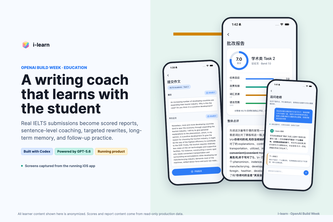
i-learn is a self-reported AI-powered educational platform focused on essay grading and tutoring for IELTS and Gaokao test-takers. It operates in production with real users, using an agentic architecture that includes dual-examiner scoring, long-term student memory, and Socratic math tutoring.
What changed
The project has evolved from a hackathon submission into a live product serving real users, with multiple lines of functionality (IELTS writing coaching, Gaokao essay grading, Gaokao math tutoring) built using an agentic development workflow. It includes structured calibration processes and cross-model review workflows.
Single most important open question
Is there evidence of actual user traction or revenue beyond the author’s self-reported claims?
What The Product Actually Is
The description states that i-learn is a platform for AI-powered essay grading and tutoring, with three main lines:
- IELTS writing coaching (live in production),
- Gaokao English essay grading (newly built during Coding Week),
- Gaokao math Socratic tutoring (also live in production).
It uses an agentic architecture where:
- A "coach agent" reads long-term student memory, grades essays sentence-by-sentence, writes model rewrites one band higher, and extracts reusable expressions.
- A second "examiner agent" independently scores the same essay without memory or teacher persona.
- The final score is taken as the maximum of both agents' scores per dimension.
- The system supports follow-up questions via async jobs with live streaming text.
- It also includes a dual-axis student mastery model and spaced-repetition review queue for math tutoring.
The description indicates that the platform runs in production, serving real TestFlight users. The backend is built using tools like Docker, PostgreSQL, Supabase, React Native, TypeScript, and various AI APIs including Claude, OpenAI, and others.
Evidence
- The author states: “The flagship line is IELTS writing coaching, live in production.”
- The author states: “Gaokao English essay grading is the newest, built during Coding Week...”
- The author states: “Gaokao math Socratic tutoring is also in production…”
Inference This is a multi-functional AI-powered educational tool targeting standardized test preparation.
Positioning & Claim Evolution
The author positions i-learn as an AI tutor that mimics real examiners by:
- Providing dual-examiner precision,
- Maintaining long-term student memory,
- Offering Socratic math tutoring.
It claims to be more precise than typical feedback, which is described as “a number and a few red marks,” compared to what a real examiner does: reading the essay as a whole, placing it in a band, marking individual sentences, explaining errors, writing model rewrites, and remembering recurring mistakes.
Evidence
- The author states: “In China, English writing prep is high stakes and feedback is scarce.”
- The author states: “i-learn tries to be that examiner.”
Inference The positioning reflects a shift from generic AI scoring toward a more human-like, personalized tutoring experience.
Target Customer & ICP
The target customer appears to be students preparing for standardized English writing exams:
- IELTS test-takers,
- Gaokao test-takers (Chinese college entrance exam).
These are described as high-stakes environments where feedback is limited and quality instruction is scarce.
Evidence
- The author states: “serving real IELTS and Gaokao test-takers.”
- The author states: “In China, English writing prep is high stakes and feedback is scarce.”
Inference The product targets students in high-pressure academic environments who need structured, detailed feedback.
Business Model & Pricing Evidence
There is no explicit mention of pricing or business model in the description. However, it mentions:
- Per-student monthly AI budgets with a provable soft cap.
- Invite-gated authentication.
- Admin dashboard for inspecting prompts, messages, tool executions, and token counts.
Evidence
- The author states: “per-student monthly AI budgets with a provable soft cap.”
- The author states: “invite-gated auth.”
Inference There may be a freemium or subscription model based on usage limits, but no clear pricing structure is provided.
Technical & Delivery Signals
The technical stack includes:
- Development workflow using Claude Code and OpenAI Codex.
- Agentic architecture with two independent models cross-reviewing code before merge.
- Tool-use blocks mapping to function calls.
- Support for both text and handwritten input.
- Backend test coverage (114 files).
- OTA updates, blue-green deployment, and DB-guard wrapper.
Evidence
- The author states: “Claude Code orchestrates, and OpenAI Codex runs as the implementation subagent.”
- The author states: “Each essay spawns a background job.”
- The author states: “There are 114 backend test files covering migration idempotency, concurrency guards, and doctrine evals.”
Inference The team has implemented robust engineering practices including automated testing, agentic development workflows, and scalable deployment strategies.
Traction & Maturity Signals
The description indicates:
- Live in production with real TestFlight users.
- 11 documented calibration rounds for scoring bias correction.
- Full eval harnesses and backend test coverage.
- Multiple product lines built quickly using agentic methods.
Evidence
- The author states: “live in production, serving real TestFlight users.”
- The author states: “11 documented calibration rounds rather than a hunch.”
- The author states: “114 backend test files.”
Inference The product shows early signs of maturity and traction, though no revenue or user numbers are reported.
Competitive Context
No direct competitors are named in the description. However, the focus on AI-powered essay grading and tutoring for standardized exams suggests a competitive landscape that includes:
- Existing educational platforms,
- AI writing tools,
- Test prep services.
The unique aspects of i-learn include dual-examiner scoring, long-term memory retention, and Socratic tutoring.
Evidence
- The author states: “a real examiner does far more...”
- The author states: “the same agentic backbone powers two more lines.”
Inference i-learn operates in a niche space within educational AI, potentially differentiated by its dual-examiner approach and memory retention features.
Open Questions & Risks
Key risks include:
- Lack of verified traction or revenue data: The description does not provide any evidence of actual users, customers, or monetization.
- Dependency on model quality: The system relies heavily on AI models for scoring and tutoring; if these fail to generalize well, the product could become unreliable.
- Data labeling issues: Gaokao essays lack gold labels, which may affect accuracy.
- Scalability concerns: While agentic development was used, no indication of scaling beyond solo builder or small team.
Evidence
- The author states: “no revenue, customer or traction data is available beyond what they state.”
- The author states: “There are no gold labels for Gaokao essays.”
Inference Without independent verification, the product’s real-world performance and scalability remain uncertain.
Questions the description leaves open
- What is your current user base? How many active users are there?
- Are you monetizing this platform? If so, how?
- Can you provide evidence of the calibration process beyond 11 rounds?
- How do you plan to scale beyond a two-person team?
- What are the key metrics used to evaluate success in each line of service (IELTS, Gaokao English, Gaokao Math)?
- Are there any known limitations or biases in your model outputs that could impact accuracy?
- How do you handle data privacy and compliance for student information?
Overall Assessment
Confidence Level Low This is a self-reported, unverified account of a product under development. There is no evidence of revenue, customers, or traction beyond the author's own claims.
Assessment Summary
- i-learn appears to be an early-stage educational AI platform with some technical sophistication.
- It has live production features and shows signs of engineering maturity.
- However, there is no verified user data, monetization strategy, or clear path to scale.
- The product’s positioning as a dual-examiner AI tutor is compelling but unproven in the market.
Recommendation
Proceed with caution. Further due diligence should include verification of user engagement, financials, and scalability plans. This project lacks sufficient evidence for investment or partnership decisions at this stage.
User Stories BotA demo video on every pull request
Get a demo video on every new feature
GitHub App that watches your pull requests and records a narrated, captioned demo.
Save time on demo prep and make informed decisions faster with a video walkthrough of every new feature.
Source
Submitted to the OpenAI 2026 hackathon on Devpost. Project home on Devpost. Back to the full gallery on Devpost.
This competitive analysis was produced by top-founders.com (opens in a new tab)
Generated by a language model from this project's public Devpost page — its tagline, the author's own write-up and any built-with tags listed there — as captured in August 2026. Short quotations are the author's words. It is an opinion on the idea as a business, not on the people behind it, and it reflects the description as published then. If the project has moved on, request a correction below. The analysis is not independent research and contains no verified traction, revenue or customer data.
An independent guide by KFG International LLC — not affiliated with, endorsed by, or connected to Devpost or OpenAI.