

Archive position — measured, not model output
0 likes on Devpost
2,263 of the 7,850 archived projects have more likes, and 5,587 share exactly 0 — so this project's #5,126 place in the like-ranked listing is a tie-break inside that group, not a ranking.
Projects (log scale)
Likes on Devpost. ▲ marks this project's group.
Show the figures
| Likes | Projects | Share of archive |
|---|---|---|
| 0 | 5,587 | 71.2% |
| 1 | 1,758 | 22.4% |
| 2 | 284 | 3.6% |
| 3–4 | 132 | 1.7% |
| 5–9 | 75 | 1.0% |
| 10+ | 14 | 0.2% |
 User Stories BotA demo video on every pull request
Get a demo video on every new feature
GitHub App that watches your pull requests and records a narrated, captioned demo.
Save time on demo prep and make informed decisions faster with a video walkthrough of every new feature.
Executive Summary
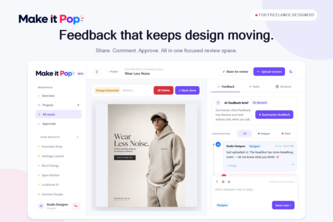
What the company appears to be: Make It Pop is a self-reported tool for designers to manage feedback, revisions, and approvals from clients in a structured way. The author states it focuses on the design review process rather than replacing tools like Figma or Google Drive.
What changed: This is a solo developer project submitted to an AI hackathon. No prior version or commercial history is evidenced.
Single most important open question: Is there evidence of real-world usage, customer feedback, or traction from freelance designers who would use this tool?
The description is self-reported and unverified. It does not contain any evidence of revenue, customers, adoption, or market validation beyond the author's own account. The project appears to be a proof-of-concept built in a short timeframe with no external validation.
What The Product Actually Is
The description states that Make It Pop:
- Gives designers one place to share work, collect feedback, manage revisions, and receive final decisions
- Allows designers to create projects, upload previews, and send private review links to clients
- Enables clients to comment, request changes, or approve designs without creating an account
- Saves each new upload as a separate version to avoid mixing old and new feedback
- Uses AI to summarize long feedback threads into revision checklists
- Is not meant to replace Figma, Google Drive, or local design files
- Focuses specifically on the feedback, revisions, and decisions around those files
The author describes it as an application built with FastAPI (backend), SQLAlchemy (database), Jinja templates (frontend), HTMX, Alpine.js, Tailwind CSS, and OpenAI APIs.
Positioning & Claim Evolution
The description states:
- The tool is positioned specifically for the designer-client review process
- It was inspired by the author's own experience working remotely as a graphic designer
- The name "Make It Pop" came from the common phrase used in design feedback
- It is not trying to be a general project management tool but a focused solution for design reviews
The claim evolution appears to be:
- Problem: Scattered design feedback across multiple platforms
- Solution: Centralized review process with version control and AI summarization
- Positioning: Focused tool for designers, not replacement for existing tools
Target Customer & ICP
The description states:
- The primary users are graphic designers working remotely
- Clients who review designs (without needing accounts)
- Freelance designers specifically mentioned as the target audience for beta testing
- The tool is designed for the designer-client review workflow
No specific customer segments, personas or market size data are provided.
Business Model & Pricing Evidence
Not evidenced. The description does not contain any information about pricing, monetization strategy, or business model.
Technical & Delivery Signals
The description states:
- Built with FastAPI (backend), SQLAlchemy (database), Alembic (migrations)
- Frontend: Jinja templates, HTMX, Alpine.js, Tailwind CSS
- Uses OpenAI APIs for AI features
- Containerized with Docker and deployed on Railway
- Authentication using JWT, bcrypt, Passlib
- Database: SQLite
- AI features include summarization and revision checklist generation
- Includes output limits, timeouts, retries, rate limits, fallback behavior
- Handles network failures, repeated submissions, duplicate comments via idempotency keys and database constraints
Traction & Maturity Signals
Not evidenced. The description contains no information about:
- Revenue or monetization
- Customers or user base
- Adoption metrics
- Product usage data
- Market traction
- Any form of customer feedback beyond the author's own experience
Competitive Context
The description states:
- It is not trying to replace Figma, Google Drive, Dropbox, or local design files
- The focus is on feedback, revisions, and decisions around those files
- No specific competitors are named
No competitive analysis or positioning against existing tools is provided.
Open Questions & Risks
Inferences based on the description:
- Single-person development: Only one team member (the author) is mentioned, which raises questions about scalability and long-term maintenance
- No commercial traction: No evidence of revenue, customers, or market adoption
- Limited validation: The project appears to be a hackathon submission with no external validation or user testing beyond the author's own experience
- AI dependency: Reliance on OpenAI APIs for core features may create operational risks and cost concerns
- Unproven market fit: No evidence that freelance designers actually struggle with the described problems or would pay for this solution
Questions the description leaves open
- What specific pain points do freelance designers experience in their current review workflows?
- Have you conducted any user interviews or surveys with actual designers?
- How many freelance designers have you shown this to, and what was their feedback?
- What is your plan for customer acquisition and retention?
- How do you intend to monetize this tool?
- What are the technical limitations of the current implementation that would prevent scaling?
- Have you considered how to handle multiple reviewers or stakeholders in a single project?
- What metrics would indicate success for this product?
Overall Assessment
Not evidenced. The description contains no information about:
- Financial performance
- Customer base
- Market opportunity size
- Competitive advantages
- Go-to-market strategy
- Team experience or track record
- Any form of commercial validation
The project appears to be a solo developer hackathon submission with no evidence of traction, revenue, or market validation. The author's own account describes it as a proof-of-concept built in a short timeframe without external validation.
User Stories BotA demo video on every pull request
Get a demo video on every new feature
GitHub App that watches your pull requests and records a narrated, captioned demo.
Save time on demo prep and make informed decisions faster with a video walkthrough of every new feature.
Source
Submitted to the OpenAI 2026 hackathon on Devpost. Project home on Devpost. Back to the full gallery on Devpost.
This competitive analysis was produced by top-founders.com (opens in a new tab)
Generated by a language model from this project's public Devpost page — its tagline, the author's own write-up and any built-with tags listed there — as captured in August 2026. Short quotations are the author's words. It is an opinion on the idea as a business, not on the people behind it, and it reflects the description as published then. If the project has moved on, request a correction below. The analysis is not independent research and contains no verified traction, revenue or customer data.
An independent guide by KFG International LLC — not affiliated with, endorsed by, or connected to Devpost or OpenAI.