

Archive position — measured, not model output
1 like on Devpost
505 of the 7,850 archived projects have more likes, and 1,758 share exactly 1 — so this project's #1,405 place in the like-ranked listing is a tie-break inside that group, not a ranking.
Projects (log scale)
Likes on Devpost. ▲ marks this project's group.
Show the figures
| Likes | Projects | Share of archive |
|---|---|---|
| 0 | 5,587 | 71.2% |
| 1 | 1,758 | 22.4% |
| 2 | 284 | 3.6% |
| 3–4 | 132 | 1.7% |
| 5–9 | 75 | 1.0% |
| 10+ | 14 | 0.2% |
 User Stories BotA demo video on every pull request
Get a demo video on every new feature
GitHub App that watches your pull requests and records a narrated, captioned demo.
Save time on demo prep and make informed decisions faster with a video walkthrough of every new feature.
Executive Summary
What the company appears to be
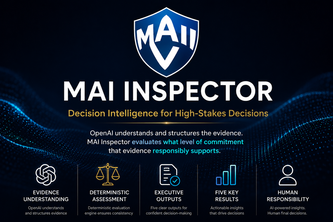
MAI Inspector, as described by its author, is a command-line tool that evaluates evidence in support of high-stakes decisions using a hybrid approach combining AI-assisted structuring and deterministic decision logic. It produces five standardized executive outputs related to a proposed decision.
What changed
The project was submitted as part of the OpenAI 2026 hackathon, indicating a transition from an internal research prototype to a public product repository with engineering documentation, tests, and sample execution.
Single most important open question
Is there evidence that MAI Inspector has been used beyond the hackathon context, or validated in real-world decision-making scenarios?
Note: This analysis is based entirely on self-reported information provided by the author. No external verification, traction data, revenue figures, or customer feedback are available.
What The Product Actually Is
The description states that MAI Inspector:
- Begins with a proposed decision
- Evaluates what level of commitment the available evidence can responsibly support
- Produces five standardized executive outputs:
- Decision Status
- Highest Responsible Commitment
- Critical Blockers
- Required Evidence
- Recommended Next Step
It uses a two-layer architecture:
- An optional OpenAI-assisted drafting layer for interpreting and structuring evidence
- A deterministic "MAI engine" that applies validated scoring rules, thresholds, category constraints, blocking conditions, and commitment-boundary logic without requiring another model call
The public implementation includes:
- A Python CLI
- Optional OpenAI-assisted session drafting
- Deterministic local assessment
- Structured JSON inputs and outputs
- Provenance and artifact-linkage controls
- A reproducible public sample
- Privacy and explicit-send guardrails
- Engineering documentation
- 45 passing automated tests
Inference: The product is described as a decision-support tool, not an autonomous decision-maker. It separates semantic interpretation from deterministic evaluation.
Positioning & Claim Evolution
The author claims that MAI Inspector moves from “Document Intelligence” to “Decision Intelligence.” This suggests a shift in focus from summarizing or understanding information to assessing whether the evidence supports a particular action.
It positions itself as:
- A tool for high-stakes decision-making
- Filling a gap between AI understanding and responsible commitment
- Supporting structured due diligence processes
Claim: The author states that MAI Inspector helps people understand what their evidence responsibly allows them to do next.
Inference: It is positioned as a decision-enabling tool rather than a decision-making one, emphasizing human authority and traceability.
Target Customer & ICP
The description does not explicitly name target customers or personas. However, it implies use cases in:
- High-stakes organizational decisions
- Due diligence processes
- Investment assessments (as demonstrated in the public example)
It is designed for users who need to evaluate evidence before committing to a decision and want structured outputs.
Inference: Likely targets include executives, investment analysts, legal teams, or project managers involved in risk-sensitive decision-making.
Not evidenced: No specific customer segments, buyer personas, or use cases beyond the example provided.
Business Model & Pricing Evidence
There is no evidence of a business model or pricing structure in the description. The product is presented as a public release with open-source components and engineering documentation.
Not evidenced: No mention of monetization strategy, licensing terms, SaaS offerings, or paid features.
Technical & Delivery Signals
The system is built using:
- Python CLI
- OpenAI-assisted drafting (Codex + GPT-5.6)
- Deterministic engine logic
- Structured JSON inputs/outputs
- Provenance controls and artifact-linkage
- 45 passing automated tests
- Engineering documentation
- Reproducible sample
It supports:
- Local execution without API keys or network access
- Privacy guardrails
- Explicit human decisions about scope, architecture, terminology, security boundaries, and release claims
Inference: The architecture is designed for trustworthiness through separation of AI interpretation from deterministic decision logic.
Traction & Maturity Signals
The description includes:
- A runnable CLI
- Public sample
- Machine-readable outputs
- 45 passing automated tests
- Engineering evidence package covering architecture, testing, security boundaries, deterministic assessment, and reproducibility
- Clean-clone reproduction of the tagged release confirmed tests and public sample independently
Not evidenced: No data on adoption, user feedback, or real-world usage beyond the hackathon submission.
Competitive Context
The description does not reference competitors directly. However, it implies a space involving:
- AI-powered decision support tools
- Due diligence platforms
- Risk assessment systems
- Document intelligence tools that go beyond summarization
Inference: MAI Inspector may compete with or complement existing tools in due diligence, risk analysis, and executive reporting.
Open Questions & Risks
Key risks identified from the description:
- Lack of real-world validation – The product is presented only as a hackathon submission.
- Limited scalability assumptions – No indication of how it scales beyond a single-user CLI or prototype.
- Unclear adoption path – No evidence of customer traction, market fit, or commercial interest.
- Dependency on OpenAI tools – While the core engine is deterministic, the optional drafting layer relies on external APIs.
- No pricing or monetization strategy – The product appears to be open-source or experimental.
Inference: Without evidence of usage beyond the hackathon, there is no clear indication of commercial viability or traction.
Questions the description leaves open
- Has MAI Inspector been used in any real-world decision-making contexts outside of this hackathon?
- What are the actual use cases where it has been applied, and how did those applications perform?
- How does the deterministic engine handle edge cases or ambiguous evidence?
- Are there plans to expand beyond the current CLI-based interface?
- What is the roadmap for integrating additional domains or decision types?
- Has the team considered how to make this product accessible to non-technical users?
Overall Assessment
Not evidenced: No financial data, revenue, customer base, or traction metrics are available.
Assessment: Based on the self-reported description alone, MAI Inspector appears to be a proof-of-concept tool developed for a hackathon. It demonstrates technical capability and architectural clarity but lacks evidence of commercial viability, real-world application, or market demand.
Confidence level: Low — this is based entirely on one author's account with no independent corroboration or external data.
User Stories BotA demo video on every pull request
Get a demo video on every new feature
GitHub App that watches your pull requests and records a narrated, captioned demo.
Save time on demo prep and make informed decisions faster with a video walkthrough of every new feature.
Source
Submitted to the OpenAI 2026 hackathon on Devpost. Project home on Devpost. Back to the full gallery on Devpost.
This competitive analysis was produced by top-founders.com (opens in a new tab)
Generated by a language model from this project's public Devpost page — its tagline, the author's own write-up and any built-with tags listed there — as captured in August 2026. Short quotations are the author's words. It is an opinion on the idea as a business, not on the people behind it, and it reflects the description as published then. If the project has moved on, request a correction below. The analysis is not independent research and contains no verified traction, revenue or customer data.
An independent guide by KFG International LLC — not affiliated with, endorsed by, or connected to Devpost or OpenAI.