

Archive position — measured, not model output
0 likes on Devpost
2,263 of the 7,850 archived projects have more likes, and 5,587 share exactly 0 — so this project's #5,331 place in the like-ranked listing is a tie-break inside that group, not a ranking.
Projects (log scale)
Likes on Devpost. ▲ marks this project's group.
Show the figures
| Likes | Projects | Share of archive |
|---|---|---|
| 0 | 5,587 | 71.2% |
| 1 | 1,758 | 22.4% |
| 2 | 284 | 3.6% |
| 3–4 | 132 | 1.7% |
| 5–9 | 75 | 1.0% |
| 10+ | 14 | 0.2% |
 User Stories BotA demo video on every pull request
Get a demo video on every new feature
GitHub App that watches your pull requests and records a narrated, captioned demo.
Save time on demo prep and make informed decisions faster with a video walkthrough of every new feature.
Executive Summary
What the company appears to be
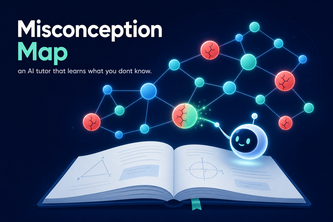
Misconception Map is a self-reported AI-powered tutoring tool for math education that uses GPT-5.6 to generate questions and lessons based on student misconceptions, visualizing those errors in a knowledge graph. The product is built by one person (Suwon Ham) and submitted as a project for the OpenAI 2026 hackathon.
What changed
The author states they are building this as part of an ongoing personal AI operation, tory.my, which includes a personalized knowledge graph. This project represents a specific application of that work to math learning, focusing on how students’ wrong answers can be used to inform instruction rather than discarded.
Single most important open question
Is there evidence of real-world usage or traction with learners or educators? The description contains no data on adoption, revenue, or customer feedback beyond the author’s own claims.
What The Product Actually Is
The description states that Misconception Map is an AI tutor designed to turn students' wrong answers into a "living map of misconceptions." It uses GPT-5.6 to generate questions and lessons tailored to individual student errors, with each incorrect choice tied to a documented misconception.
It includes:
- A knowledge graph visualization showing concepts (teal) and misconceptions (red).
- Daily micro-lessons generated from the most prevalent misconception.
- Teacher dashboard that highlights shared misconceptions among students.
- Native language support for Korean and Japanese through GPT-5.6.
The system is described as using three variants of GPT-5.6:
- sol (xhigh reasoning) for question/lesson generation.
- terra (xhigh) for live diagnosis of free-text answers.
- luna for taxonomy matching.
It also uses D3.js for graph rendering, Next.js for frontend, Node.js for backend logic, and SQLite for data storage. The UI is built with React and TailwindCSS, and the project is written in TypeScript with Zod validation.
The product is claimed to be built entirely from one Codex session, including debugging loops where Codex diagnosed and fixed issues in its own SDK.
Inference This is a proof-of-concept or prototype tool, not yet a commercial product. It has no evidence of being used by learners or schools.
Positioning & Claim Evolution
The author positions Misconception Map as an AI tutor that:
- Turns student errors into actionable learning insights.
- Models students' mental models through a knowledge graph.
- Provides personalized instruction based on actual misconceptions, not curriculum pages.
- Offers native language support for Korean and Japanese.
It claims to be different from traditional tools by focusing on the signal of wrong answers rather than just marking them as incorrect. The author suggests that good human tutors already do this — they pay attention to how a student is wrong — and Misconception Map aims to replicate that behavior at scale.
Inference This positioning reflects an intent to disrupt traditional math education tools by introducing AI-driven, misconception-aware tutoring. However, no evidence of market validation or competitive differentiation exists beyond the author’s own claims.
Target Customer & ICP
The description states that Misconception Map is designed for:
- Students learning middle-school fractions.
- Teachers who want to understand what their students misunderstand.
- Schools looking for tools to identify and address collective misconceptions.
It also mentions a potential future audience: “seat-based subscription” users, implying a shift toward institutional buyers like schools or districts.
Inference The current ICP appears to be individual learners in middle-school math, with a possible expansion into teacher-facing tools and educational institutions. No evidence of actual customers or usage data is provided.
Business Model & Pricing Evidence
There is no explicit mention of pricing or business model in the description. However, the author notes:
- The teacher dashboard may become a “seat-based subscription.”
- Schools don’t currently have this kind of instrument.
- Integration with LMS (Learning Management Systems) is listed as a next step.
Inference The business model seems to be evolving toward a B2B SaaS or subscription model for schools, but no pricing, revenue streams, or monetization strategy are described. The project is still in early development.
Technical & Delivery Signals
The product is built using:
- Cloudflare
- GPT-5.6 (three variants: sol, terra, luna)
- D3.js
- Next.js
- Node.js
- React
- SQLite
- TailwindCSS
- TypeScript
- Zod
It uses Codex for development and debugging, including fixing SDK issues autonomously via feedback loops.
The system is described as having:
- Deterministic behavior when students pick pre-tagged distractors.
- Degradation to recorded fixtures if LLM calls fail.
- A robust testing pipeline (34 commits gated by npm run build && npm test).
Inference There are signs of technical maturity in the architecture and development process, but no evidence of production deployment or scalability beyond a prototype.
Traction & Maturity Signals
The description states:
- The project was submitted to the OpenAI 2026 hackathon.
- It is part of a larger personal AI operation (tory.my), which is in App Store review.
- No revenue, customers, or user engagement data are provided.
Inference There is no evidence of traction, adoption, or real-world usage. The project appears to be a prototype or proof-of-concept with no demonstrated market impact.
Competitive Context
The author does not reference any competitors directly. However, the concept aligns with:
- AI-powered adaptive learning platforms.
- Tools that use knowledge graphs for personalized instruction.
- Educational technology focused on identifying and correcting misconceptions.
No mention of existing tools or platforms in this space is made.
Inference While the idea is not novel, there is no evidence of competitive analysis or awareness of existing solutions. The lack of references to competitors suggests either limited market research or an unproven niche.
Open Questions & Risks
- No traction or revenue: No data on users, customers, or monetization.
- Single-founder project: Only one person is involved in development.
- Prototype nature: Described as a hackathon submission and personal project with no production deployment.
- Limited scope: Taxonomy covers only middle-school fractions; no indication of expansion plans.
- Dependency on LLMs: Reliance on GPT-5.6 raises concerns about cost, availability, and consistency.
- Unverified claims: All descriptions are self-reported and unverified.
Inference This is a high-risk, early-stage idea with no commercial validation or proven market demand. It lacks any evidence of viability beyond the author’s own vision.
Questions the description leaves open
- What specific misconceptions were used to build the taxonomy? How was it validated?
- Has there been any testing with real students or teachers?
- What is the current status of tory.my, and how does this project relate to it?
- Are there plans for multi-subject support or LMS integration?
- What are the key assumptions behind the teacher dashboard’s value proposition?
- How would the system handle edge cases like ambiguous student responses or language variations beyond Korean/Japanese?
- What is the timeline for moving from prototype to a scalable product?
Overall Assessment
Confidence Level: Low
Misconception Map is described as a self-reported, hackathon-level project with no evidence of traction, revenue, or customer feedback. It is built by one person and lacks any indication of commercial viability or scalability.
The idea has potential in the AI tutoring space, but there is no demonstrated product-market fit, user engagement, or business model yet.
Assessment Not ready for investment or partnership at this stage. Requires further validation through pilot testing, user feedback, and proof-of-concept deployment before any serious consideration.
User Stories BotA demo video on every pull request
Get a demo video on every new feature
GitHub App that watches your pull requests and records a narrated, captioned demo.
Save time on demo prep and make informed decisions faster with a video walkthrough of every new feature.
Source
Submitted to the OpenAI 2026 hackathon on Devpost. Project home on Devpost. Back to the full gallery on Devpost.
This competitive analysis was produced by top-founders.com (opens in a new tab)
Generated by a language model from this project's public Devpost page — its tagline, the author's own write-up and any built-with tags listed there — as captured in August 2026. Short quotations are the author's words. It is an opinion on the idea as a business, not on the people behind it, and it reflects the description as published then. If the project has moved on, request a correction below. The analysis is not independent research and contains no verified traction, revenue or customer data.
An independent guide by KFG International LLC — not affiliated with, endorsed by, or connected to Devpost or OpenAI.