

Archive position — measured, not model output
0 likes on Devpost
2,263 of the 7,850 archived projects have more likes, and 5,587 share exactly 0 — so this project's #5,118 place in the like-ranked listing is a tie-break inside that group, not a ranking.
Projects (log scale)
Likes on Devpost. ▲ marks this project's group.
Show the figures
| Likes | Projects | Share of archive |
|---|---|---|
| 0 | 5,587 | 71.2% |
| 1 | 1,758 | 22.4% |
| 2 | 284 | 3.6% |
| 3–4 | 132 | 1.7% |
| 5–9 | 75 | 1.0% |
| 10+ | 14 | 0.2% |
 User Stories BotA demo video on every pull request
Get a demo video on every new feature
GitHub App that watches your pull requests and records a narrated, captioned demo.
Save time on demo prep and make informed decisions faster with a video walkthrough of every new feature.
Executive Summary
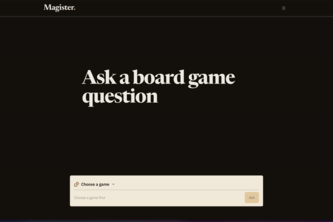
The company appears to be a solo project (1 person) named Magister, which self-reports as an AI-powered tool for answering questions about board game rules and helping players understand how to play. It was built for the OpenAI 2026 hackathon.
What changed: The author states that this is a prototype or proof-of-concept, built in a hackathon setting, with no evidence of commercial traction, revenue, or customers.
Single most important open question: Is there any evidence of product-market fit, user adoption, or monetization strategy beyond the hackathon submission?
What The Product Actually Is
The description states that Magister is an AI-powered tool that turns board game rulebooks and community forums into a searchable knowledge base and connects it to AI. It answers questions about board game rules and helps players understand how to play.
It also mentions a "game harness" built with Codex that automates game prep by ingesting metadata, rulebooks, expansions, and community forums for a given game.
Inference: The product is likely an AI chat interface or search engine over structured data derived from board game documentation. It is not a marketplace, SaaS platform, or commercial product as of the description provided.
Positioning & Claim Evolution
The author states that Magister aims to get answers from board game rules as fast as possible, addressing the pain point of interrupting play sessions to look up rules.
It also claims that it helps players understand how to play new games, and that it was built with a focus on accuracy and benchmarking.
Inference: The positioning is centered around speed, convenience, and accessibility for board game enthusiasts. It positions itself as a tool to reduce friction in the learning and playing process.
Target Customer & ICP
The description states that Magister is for "anyone who plays board games", with a specific focus on users who are frustrated by rulebook interruptions or time-consuming setup processes.
Inference: The target customer is likely board game enthusiasts or casual players. However, there is no evidence of segmentation, user personas, or specific buyer profiles.
Business Model & Pricing Evidence
There is no evidence in the description of a business model or pricing strategy.
The project was built for a hackathon and is not described as having any monetization, subscriptions, or paid features.
Technical & Delivery Signals
The author states that the product was built using:
- Codex
- Convex
- TanStack
It also mentions:
- Parsing complex PDFs
- Crawling community forums
- Benchmarking models and prompts
- Building a "game harness" to automate ingestion of game data
Inference: The technical stack suggests a modern, developer-focused approach using AI and data ingestion tools. However, there is no evidence of production deployment or scalability.
Traction & Maturity Signals
There is no evidence of traction, customers, or adoption beyond the hackathon submission.
The project is described as a prototype with no revenue, user base, or commercial activity.
Competitive Context
There is no mention in the description of competitors or existing solutions in the board game rulebook or knowledge management space.
No evidence of market analysis or differentiation from other tools.
Open Questions & Risks
- The project is a solo effort (1 person team) — raises questions about scalability and execution.
- No evidence of product-market fit, revenue, or user traction.
- The description is self-reported and unverified; no third-party validation.
- The use of AI for rule interpretation introduces risks around accuracy and reliability.
- No clear path to monetization or commercial viability.
Questions the description leaves open
- What is the current state of the product? Is it in production, or still a prototype?
- Have you validated the need for this tool with actual users?
- How do you plan to scale beyond the hackathon version?
- Are there any existing competitors or similar tools in the market?
- What is your monetization strategy, if any?
- How do you ensure accuracy of AI-generated answers from rulebooks?
Overall Assessment
Not evidenced — no information on valuation, funding, or commercial readiness.
The project is described as a hackathon prototype, built by one person, with no evidence of traction, revenue, or business model. It is not ready for investment or partnership at this stage.
The author states that the product is in its early stages and has not yet been tested beyond the hackathon environment.
Confidence: Low — based on self-reported, unverified information only.
User Stories BotA demo video on every pull request
Get a demo video on every new feature
GitHub App that watches your pull requests and records a narrated, captioned demo.
Save time on demo prep and make informed decisions faster with a video walkthrough of every new feature.
Source
Submitted to the OpenAI 2026 hackathon on Devpost. Project home on Devpost. Back to the full gallery on Devpost.
This competitive analysis was produced by top-founders.com (opens in a new tab)
Generated by a language model from this project's public Devpost page — its tagline, the author's own write-up and any built-with tags listed there — as captured in August 2026. Short quotations are the author's words. It is an opinion on the idea as a business, not on the people behind it, and it reflects the description as published then. If the project has moved on, request a correction below. The analysis is not independent research and contains no verified traction, revenue or customer data.
An independent guide by KFG International LLC — not affiliated with, endorsed by, or connected to Devpost or OpenAI.