

Archive position — measured, not model output
1 like on Devpost
505 of the 7,850 archived projects have more likes, and 1,758 share exactly 1 — so this project's #1,194 place in the like-ranked listing is a tie-break inside that group, not a ranking.
Projects (log scale)
Likes on Devpost. ▲ marks this project's group.
Show the figures
| Likes | Projects | Share of archive |
|---|---|---|
| 0 | 5,587 | 71.2% |
| 1 | 1,758 | 22.4% |
| 2 | 284 | 3.6% |
| 3–4 | 132 | 1.7% |
| 5–9 | 75 | 1.0% |
| 10+ | 14 | 0.2% |
 User Stories BotA demo video on every pull request
Get a demo video on every new feature
GitHub App that watches your pull requests and records a narrated, captioned demo.
Save time on demo prep and make informed decisions faster with a video walkthrough of every new feature.
Executive Summary
Hexkey is an AI-powered engineering copilot designed to generate, simulate, and validate direct-to-chip liquid cooling designs for data centers from natural language prompts. The system uses a modular monolith architecture with FastAPI backend, CadQuery geometry engine, OpenFOAM CFD solver, and GPT-5.6 for intent interpretation and communication.
The description states that Hexkey transforms user prompts like "Cool a 1200 W accelerator with water at 30 °C" into validated cold plate designs through an end-to-end workflow involving CAD generation, simulation, and validation. The author claims the system is deterministic in its engineering processes but uses AI only for language interpretation and explanation.
What changed: The project description presents a self-contained engineering workflow that combines AI with established physics-based tools to automate hardware design. It positions itself as an agent for direct-to-chip cooling rather than a general-purpose AI tool.
Key open question: Is there evidence of any real-world usage, customer feedback, or traction beyond the author's own development? The description contains no data on adoption, revenue, or user engagement.
What The Product Actually Is
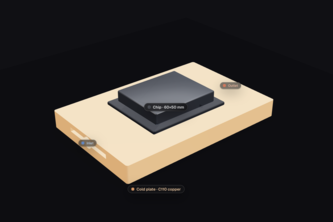
The description states that Hexkey is an AI copilot for direct-to-chip liquid cooling. It generates, simulates, and validates cold plate designs from natural language prompts such as "Cool a 1200 W accelerator with water at 30 °C".
It operates through:
- A modular monolith architecture using FastAPI backend, Next.js frontend
- CadQuery for geometry generation
- OpenFOAM for physics simulation
- GPT-5.6 for intent interpretation and explanation
- Codex for development assistance
The system is described as turning prompts into validated engineering workflows that include CAD model generation, simulation runs, validation checks, and report production.
Inference: The product appears to be a software tool built for engineers working on data center cooling systems, using AI to bridge natural language input and physics-based design outputs.
Positioning & Claim Evolution
The description states that Hexkey is positioned as an engineering agent for direct-to-chip liquid cooling. It claims to transform software engineering workflows through AI (like Codex) but applies this approach to hardware engineering, which it says has changed little in decades.
Key claims:
- Hardware engineering still relies on outdated workflows
- AI can transform hardware design by making deterministic engineering easier to use
- The system uses AI only for communication and intent interpretation, not for replacing physics-based tools
Inference: Hexkey positions itself as a specialized tool that applies AI to solve specific engineering problems in cooling systems, rather than a broad-purpose AI assistant.
Target Customer & ICP
The description states that Hexkey targets data center engineers working on direct-to-chip liquid cooling. It focuses on "cooling plates" for high-power accelerators (e.g., 1200 W) and mentions the increasing importance of thermal management in AI hardware.
It does not specify:
- Whether it targets specific industries or use cases beyond data centers
- If there are other potential customers beyond engineers
- Any segmentation strategy
Inference: The ICP appears to be engineers or design teams working on high-performance computing cooling solutions, particularly those using accelerators with thermal constraints.
Business Model & Pricing Evidence
The description does not provide any information about:
- Revenue model
- Pricing structure
- Monetization approach
- Customer acquisition strategy
Not evidenced: No evidence of business model or pricing exists in the provided text.
Technical & Delivery Signals
The system is described as a modular monolith built with:
- FastAPI backend
- Next.js frontend
- CadQuery for geometry
- OpenFOAM for CFD simulation
- GPT-5.6 for language processing
- Codex for development assistance
Key technical claims:
- Physics-based design using steady conjugate heat transfer equations
- Validation of results before presentation
- Containerized and reproducible workflows
- Handling of long-running jobs, cancellations, and revisions
- Deterministic engineering processes with AI used only for communication
Inference: The architecture suggests a robust, traceable system designed for reliability in engineering workflows.
Traction & Maturity Signals
The description states that this is a single-person project developed by Ilyass Afkir. It was submitted to the OpenAI 2026 hackathon on Devpost and includes no evidence of:
- Customers or users
- Revenue or monetization
- Product adoption or usage metrics
- Market traction
Not evidenced: No signs of traction, customer base, or commercial activity beyond the author's own development.
Competitive Context
The description does not mention any competitors or existing solutions in the space of AI-powered engineering tools for cooling systems. It does not reference:
- Other AI copilots for hardware design
- Existing cooling plate design software
- CFD simulation platforms
- Engineering automation tools
Not evidenced: No competitive landscape information provided.
Open Questions & Risks
Key risks and open questions based on the description:
- Single-person development: The entire project was built by one individual, raising questions about scalability, maintenance, and team capacity.
- No commercial traction: There is no evidence of customers, revenue, or product adoption beyond the author’s own use.
- Unverified claims: The system uses GPT-5.6 (which may not exist), and the physics implementation is self-reported without external validation.
- Limited scope: The project focuses only on direct-to-chip cooling and does not indicate expansion plans or broader applicability.
- Hackathon origin: The product was developed for a hackathon, suggesting it may be experimental or incomplete.
Questions the description leaves open
- What specific engineering problems are you solving that existing tools don’t address?
- How do you validate the accuracy of your simulations and results?
- Have you tested the system with real-world cooling challenges or customers?
- What is your plan for scaling beyond a single developer?
- Are there any regulatory or compliance considerations in using AI for engineering design?
- How does the system handle edge cases or failures during simulation?
- What are the performance and latency characteristics of running simulations?
Overall Assessment
The description presents Hexkey as an experimental, single-developer project submitted to a hackathon. It is not evidenced to have any commercial traction, revenue, customers, or market validation.
Assessment: Not ready for investment or partnership at this stage due to lack of evidence of product-market fit, customer engagement, or business model development. The technical approach appears sound but lacks real-world testing and adoption signals.
Confidence level: Low — based on self-reported description only, with no external verification or data on performance, usage, or market response.
User Stories BotA demo video on every pull request
Get a demo video on every new feature
GitHub App that watches your pull requests and records a narrated, captioned demo.
Save time on demo prep and make informed decisions faster with a video walkthrough of every new feature.
Source
Submitted to the OpenAI 2026 hackathon on Devpost. Project home on Devpost. Back to the full gallery on Devpost.
This competitive analysis was produced by top-founders.com (opens in a new tab)
Generated by a language model from this project's public Devpost page — its tagline, the author's own write-up and any built-with tags listed there — as captured in August 2026. Short quotations are the author's words. It is an opinion on the idea as a business, not on the people behind it, and it reflects the description as published then. If the project has moved on, request a correction below. The analysis is not independent research and contains no verified traction, revenue or customer data.
An independent guide by KFG International LLC — not affiliated with, endorsed by, or connected to Devpost or OpenAI.