

Archive position — measured, not model output
1 like on Devpost
505 of the 7,850 archived projects have more likes, and 1,758 share exactly 1 — so this project's #1,195 place in the like-ranked listing is a tie-break inside that group, not a ranking.
Projects (log scale)
Likes on Devpost. ▲ marks this project's group.
Show the figures
| Likes | Projects | Share of archive |
|---|---|---|
| 0 | 5,587 | 71.2% |
| 1 | 1,758 | 22.4% |
| 2 | 284 | 3.6% |
| 3–4 | 132 | 1.7% |
| 5–9 | 75 | 1.0% |
| 10+ | 14 | 0.2% |
 User Stories BotA demo video on every pull request
Get a demo video on every new feature
GitHub App that watches your pull requests and records a narrated, captioned demo.
Save time on demo prep and make informed decisions faster with a video walkthrough of every new feature.
Executive Summary
The description states that HeyMom is a voice-first caregiver check-in app built for family caregivers who want visibility into the daily wellness of loved ones. The product uses Twilio for outbound calls, OpenAI Realtime for natural conversation flow, and Supabase for data persistence. It aims to make check-ins feel as natural as answering a phone call by asking simple wellness questions during live voice conversations.
The author claims that HeyMom turns spoken answers into structured observations, stores transcripts, highlights uncertainty, and can raise alerts when something looks concerning. The project was built as part of an OpenAI 2026 hackathon submission and is described as a working end-to-end demo loop with no revenue or customer data.
The single most important open question is whether the product's approach to caregiver visibility — particularly around uncertainty, silence, and natural conversation — will translate into real-world utility and adoption among family caregivers. The description does not provide evidence of traction, pricing, or business model beyond self-reported claims.
What The Product Actually Is
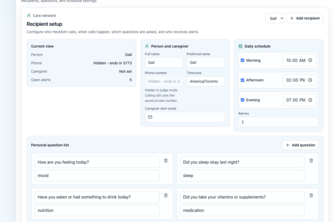
The description states that HeyMom is a voice-first caregiver check-in app. It makes outbound phone calls to loved ones using Twilio, asks simple wellness questions during live conversations, and captures spoken answers. After the call, it stores transcripts, extracts structured observations, highlights uncertainty, and displays status on a caregiver dashboard.
The author describes the technical implementation as a Next.js app with Supabase for persistence and Twilio for outbound phone calls. The live call flow uses Twilio Media Streams connected to OpenAI Realtime so that recipients can have a natural spoken conversation instead of rigid phone menus. A parser turns the transcript into structured wellness observations and alert candidates.
The product is described as not being a diagnostic tool or emergency response system, but rather a way to make check-ins feel natural and practical while still producing caregiver visibility.
Positioning & Claim Evolution
The description states that HeyMom was inspired by a caregiver problem: people who need daily check-ins are often least likely to open an app or fill out forms. The goal was to make check-ins feel as natural as answering a phone call.
The author claims the product turns natural conversation into caregiver visibility and alerts, using voice-first interaction to capture spoken answers instead of manual logging. It aims to be warm, short, and practical while still producing useful caregiver insight.
The positioning appears to have evolved from a simple idea — making check-ins less burdensome for caregivers — to a more specific approach: using voice-based AI agents that allow for natural conversation flow rather than rigid IVR menus.
Target Customer & ICP
The description states that HeyMom targets family caregivers who want visibility into the daily wellness of loved ones. These are people who need daily check-ins but often struggle with manual logging or app usage.
The author notes that the product is not intended for medical diagnostics or emergency response systems, but rather for practical, everyday caregiver oversight. The target audience seems to be family members or informal caregivers who want to stay informed about their loved ones' wellbeing without constant manual effort.
Business Model & Pricing Evidence
Not evidenced. The description does not contain any information about pricing models, revenue streams, or monetization strategies beyond the self-reported claims of what the product does.
Technical & Delivery Signals
The description states that HeyMom was built with Next.js, Supabase, Twilio, and OpenAI Realtime. It uses Twilio Media Streams connected to OpenAI Realtime for live voice conversations, with a parser that turns transcripts into structured observations.
The author notes that the technical challenge involved moving from step-by-step speech webhook flows to a real-time voice architecture involving phone audio, WebSocket streaming, transcript capture, and post-call parsing. The team used Codex to accelerate development by turning product concepts into implementation tasks.
Traction & Maturity Signals
Not evidenced. The description does not contain any information about users, customers, revenue, usage metrics, or adoption beyond the fact that it was built for a hackathon and is described as a working end-to-end demo loop.
Competitive Context
Not evidenced. The description does not mention any competitors, market positioning relative to existing solutions, or competitive landscape information.
Open Questions & Risks
The description states that one of the biggest challenges was making the experience feel useful without becoming medical, clinical, or overbuilt. This suggests a risk that the product may struggle to balance practicality with depth of care.
Another challenge mentioned is deciding what to leave out — specifically, the hackathon version focused on a working demo rather than full features like billing, compliance workflows, multi-recipient scheduling, or enterprise admin features. This raises questions about whether the current version represents a viable minimum product or if significant development remains.
The author also notes that they learned voice-first care tools need to treat uncertainty as a first-class state, suggesting potential complexity in data interpretation and alerting logic.
Questions the description leaves open
- What specific user research was conducted with family caregivers before building this tool?
- How does the team plan to handle privacy and consent compliance at scale?
- What are the key assumptions about caregiver behavior that drive the product design?
- How will the product differentiate itself from existing check-in tools or services?
- What is the roadmap for moving beyond a hackathon demo to a production-ready solution?
- How do you plan to validate the utility of structured observations vs. raw conversation data?
Overall Assessment
Not evidenced. The description provides no information about funding status, valuation, team experience, or any commercial due-diligence relevant factors beyond the self-reported product description and technical implementation details.
User Stories BotA demo video on every pull request
Get a demo video on every new feature
GitHub App that watches your pull requests and records a narrated, captioned demo.
Save time on demo prep and make informed decisions faster with a video walkthrough of every new feature.
Source
Submitted to the OpenAI 2026 hackathon on Devpost. Project home on Devpost. Back to the full gallery on Devpost.
This competitive analysis was produced by top-founders.com (opens in a new tab)
Generated by a language model from this project's public Devpost page — its tagline, the author's own write-up and any built-with tags listed there — as captured in August 2026. Short quotations are the author's words. It is an opinion on the idea as a business, not on the people behind it, and it reflects the description as published then. If the project has moved on, request a correction below. The analysis is not independent research and contains no verified traction, revenue or customer data.
An independent guide by KFG International LLC — not affiliated with, endorsed by, or connected to Devpost or OpenAI.