

Archive position — measured, not model output
0 likes on Devpost
2,263 of the 7,850 archived projects have more likes, and 5,587 share exactly 0 — so this project's #5,119 place in the like-ranked listing is a tie-break inside that group, not a ranking.
Projects (log scale)
Likes on Devpost. ▲ marks this project's group.
Show the figures
| Likes | Projects | Share of archive |
|---|---|---|
| 0 | 5,587 | 71.2% |
| 1 | 1,758 | 22.4% |
| 2 | 284 | 3.6% |
| 3–4 | 132 | 1.7% |
| 5–9 | 75 | 1.0% |
| 10+ | 14 | 0.2% |
 User Stories BotA demo video on every pull request
Get a demo video on every new feature
GitHub App that watches your pull requests and records a narrated, captioned demo.
Save time on demo prep and make informed decisions faster with a video walkthrough of every new feature.
Executive Summary
What the company appears to be
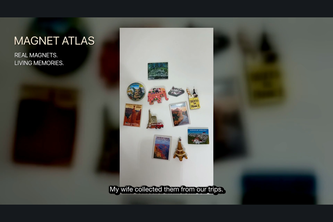
Magnet Atlas is an iOS application that allows users to digitize physical travel magnets by capturing them with a camera or photo library, extracting their foreground image on-device, refining it, and associating them with location and personal memory. The app supports local storage, manual backups, and private sharing without requiring an account or backend.
What changed
The project was built as part of the OpenAI 2026 hackathon using AI tools like Codex and GPT-5.6. It is described as a complete consumer product journey rather than a demo, with on-device processing, deterministic editing, and privacy-focused design decisions.
Single most important open question
Is there any evidence of user adoption or market traction beyond the single developer’s self-reported build?
What The Product Actually Is
The description states that Magnet Atlas is an iOS 26 UIKit application. It enables users to:
- Capture a magnet with Camera or Photos.
- Extract and refine the foreground image using on-device tools (Move, Erase, Restore, Undo, Reset, Smart Remove).
- Confirm city, country, and map location.
- Add private memories.
- Place and rearrange cutouts on a Magnetic Workshop board.
- Browse/search collection including private notes.
- Recall magnets by city through Map annotations or list view.
- Create share images that omit metadata and private details.
- Restore deleted magnets or create checksum-validated backups without an account.
The app uses Vision for foreground extraction, Core Data for local storage, MapKit for location resolution, and UIKit for UI architecture. It is built end-to-end with Codex and GPT-5.6 during OpenAI Build Week.
Evidence
- The author describes the full workflow from capture to sharing.
- Technical stack includes Vision, Core Data, MapKit, UIKit, XCTest, and Codex/GPT-5.6.
- The app supports deterministic 2.5D rendering across multiple views.
- It uses checksum-validated backups and local-first storage.
Inference The product is a single-user digital twin of physical travel magnets with privacy controls.
Positioning & Claim Evolution
The author positions Magnet Atlas as an alternative to traditional travel trackers that begin with checklists. Instead, it starts with the real object someone chose and brought home — preserving its artwork and personal memory.
Claims made
- “Travel magnets are small physical memories, but once they fill a refrigerator they become difficult to browse, reorganize, back up, or share.”
- “We wanted to begin with the real object someone chose and brought home, preserving its artwork and the personal memory attached to it.”
Evidence
- The write-up emphasizes the preservation of the physical magnet’s visual and emotional value.
- The product is described as a local-first, privacy-preserving solution.
Inference The positioning centers on nostalgia, ownership, and privacy — not scalability or monetization.
Target Customer & ICP
Not evidenced. The description does not state who the target customer is beyond a general “user” or “traveler.” No segmentation, persona, or market definition is provided.
Evidence needed
- Demographics.
- Use case scenarios.
- Geographic targeting.
- Behavioral patterns.
Business Model & Pricing Evidence
Not evidenced. There is no mention of pricing, monetization, or business model in the description.
Evidence needed
- Revenue streams.
- Subscription tiers.
- Freemium vs. paid features.
- Monetization strategy.
Technical & Delivery Signals
The app is built as an iOS 26 UIKit application using:
- Vision for foreground extraction.
- Core Data with canonical media files.
- MapKit for city resolution.
- UIKit coordinators and modular monolith architecture.
- Deterministic 2.5D rendering across views.
- Offscreen UIGraphicsImageRenderer for share output.
- Checksum-validated .magnetatlas archives.
- XCTest for testing.
Codex and GPT-5.6 were used to drive development, including design, implementation, integration, testing, and release preparation.
Evidence
- The app is described as fully local-first with no backend or account required.
- It supports manual backups and recovery.
- The UI journey is automated and testable without external accounts.
- AI tools were used for product contract maintenance, code generation, and verification.
Inference The technical approach prioritizes privacy, determinism, and on-device processing. AI was used to maintain consistency across development phases.
Traction & Maturity Signals
Not evidenced. No data on user adoption, retention, usage metrics, or market response is provided.
Evidence needed
- Number of users.
- Engagement rates.
- Customer feedback.
- Market validation.
Competitive Context
Not evidenced. The description does not mention competitors or the broader marketplace for travel tracking or digital magnet tools.
Evidence needed
- Direct competitors.
- Indirect substitutes.
- Market size and trends.
- Differentiation strategy.
Open Questions & Risks
- Single Developer Project:
- Only one team member is listed (준수 윤).
- No evidence of team expansion or support structure.
- No Revenue or Traction Data:
- The project is described as a hackathon submission.
- No indication of monetization, users, or market interest.
- AI Dependency Risk:
- Reliance on Codex and GPT-5.6 for development raises questions about scalability and reproducibility outside the current toolset.
- Limited Scope:
- The app is described as a single-user experience with no device-to-device transfer or community features.
- No evidence of plans to expand beyond personal use.
- Privacy Claims vs. Reality:
- While privacy is emphasized, there’s no independent verification of how the app enforces its privacy promises.
Questions the description leaves open
- What inspired you to build this as a standalone product rather than a prototype or demo?
- How do you plan to validate user demand beyond your own experience?
- Are you considering any monetization strategies in the future?
- What are the technical limitations of the current architecture that might prevent scaling?
- Do you have plans for expanding beyond iOS or adding multi-user features?
- How would you handle edge cases like low-quality photos, translucent magnets, or ambiguous city names?
Overall Assessment
Not evidenced. No financials, valuation, funding history, or partnership interest are provided.
Inference Given the self-reported nature of this project and its status as a hackathon submission, there is no evidence to support an investment or partnership decision at this time. The product shows potential for a niche audience but lacks traction, business model clarity, or market validation.
User Stories BotA demo video on every pull request
Get a demo video on every new feature
GitHub App that watches your pull requests and records a narrated, captioned demo.
Save time on demo prep and make informed decisions faster with a video walkthrough of every new feature.
Source
Submitted to the OpenAI 2026 hackathon on Devpost. Project home on Devpost. Back to the full gallery on Devpost.
This competitive analysis was produced by top-founders.com (opens in a new tab)
Generated by a language model from this project's public Devpost page — its tagline, the author's own write-up and any built-with tags listed there — as captured in August 2026. Short quotations are the author's words. It is an opinion on the idea as a business, not on the people behind it, and it reflects the description as published then. If the project has moved on, request a correction below. The analysis is not independent research and contains no verified traction, revenue or customer data.
An independent guide by KFG International LLC — not affiliated with, endorsed by, or connected to Devpost or OpenAI.