

Archive position — measured, not model output
0 likes on Devpost
2,263 of the 7,850 archived projects have more likes, and 5,587 share exactly 0 — so this project's #5,106 place in the like-ranked listing is a tie-break inside that group, not a ranking.
Projects (log scale)
Likes on Devpost. ▲ marks this project's group.
Show the figures
| Likes | Projects | Share of archive |
|---|---|---|
| 0 | 5,587 | 71.2% |
| 1 | 1,758 | 22.4% |
| 2 | 284 | 3.6% |
| 3–4 | 132 | 1.7% |
| 5–9 | 75 | 1.0% |
| 10+ | 14 | 0.2% |
 User Stories BotA demo video on every pull request
Get a demo video on every new feature
GitHub App that watches your pull requests and records a narrated, captioned demo.
Save time on demo prep and make informed decisions faster with a video walkthrough of every new feature.
Executive Summary
What the company appears to be
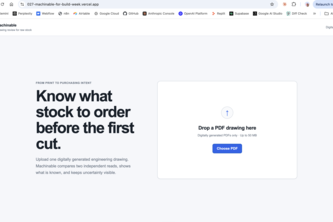
Machinable is a desktop web application that uses AI to parse 2D CNC part drawings (PDFs) and extract information needed to select raw material stock. It is built by one person, Garron Ware, and submitted as a project for the OpenAI 2026 hackathon.
What changed
The author describes building this tool after identifying a pain point in machining: the time spent determining correct stock size from part drawings. The tool uses two GPT models to read drawings and applies Python-based math for stock selection and yield calculations.
The single most important open question
Is there any evidence of traction, revenue or customer adoption beyond the author's own development work? The description states no such data exists.
What The Product Actually Is
- The description states that Machinable is a desktop web app built with Next.js, React, TypeScript, Python, and FastAPI.
- It takes digitally generated PDF drawings and identifies material, stock shape, finished part size, units, part number, and any existing stock callouts.
- It adds machining allowance and looks for standard stock sizes that will work.
- It can calculate cut length, drop length, saw kerf, end trim, and yield when sufficient data is present.
- The app shows the PDF alongside results so a machinist can review findings, correct fields, and recalculate without re-running models.
- The tool uses two GPT-5.6 models (Sol High and Terra High) to read drawings separately, comparing their outputs field-by-field.
- If models disagree on a dimension but agree on material/shape, it still displays the agreed-upon fields.
- Python handles all mathematical calculations including allowance, unit conversion, stock size selection, and yield.
Inference The product is described as a proof-of-concept or pilot tool, not yet integrated into any commercial workflow or vendor system.
Positioning & Claim Evolution
- The description states that Machinable aims to help CNC machinists get to a material decision faster.
- It is positioned as an AI-powered solution for pre-production processes in machining.
- The author claims it addresses a common pain point identified through scraping forums like Practical Machinist and Reddit.
- It is described as not meant to make final decisions without human review.
- The tool is framed as solving inefficiencies in the "pre-production" phase of manufacturing, particularly around material selection.
- The author notes that this was submitted for a hackathon, suggesting it's an early-stage prototype.
Inference The positioning is narrow and focused on a specific use case within CNC machining. It does not claim to be a general-purpose CAD or CAM tool.
Target Customer & ICP
- The description states that Machinable is designed for CNC machinists.
- It targets users who process part drawings and need to determine raw material stock sizes quickly.
- The author identifies a specific pain point in machining shops: time lost to pre-production tasks like processing drawings and ordering materials.
- It is intended for use by individuals working in machine shops, particularly those using 2D PDF drawings.
Inference The target customer segment appears to be small-scale or mid-sized machine shop operators who rely on manual processes for material planning. No evidence of segmentation beyond this.
Business Model & Pricing Evidence
- Not evidenced.
- There is no mention of pricing, licensing, subscription models, or monetization strategy in the description.
- The project is described as a hackathon submission and pilot, not a commercial product.
- No indication of whether it will be sold to end-users or integrated into larger platforms.
Technical & Delivery Signals
- Built with Next.js, React, TypeScript, Python, and FastAPI.
- Uses two GPT-5.6 models (Sol High and Terra High) for reading PDF drawings.
- Models are run independently and results compared field-by-field.
- If models disagree on dimensions but agree on material/shape, those fields are shown.
- Python handles all mathematical computations including machining allowance, unit conversion, stock size selection, and yield calculation.
- The interface keeps the PDF next to results for review and correction.
- The app allows users to correct a field and recalculate without re-running models.
- Challenges noted include confusion with dimension/extension lines and chained dimensions.
- The author mentions using Codex to build earlier versions and add features.
Inference The technical stack suggests a modern, full-stack web application. The reliance on two AI models for reading drawings implies an attempt at robustness through cross-validation.
Traction & Maturity Signals
- Not evidenced.
- No revenue data, customer base, or adoption metrics are provided.
- The project is described as a pilot and hackathon submission.
- There is no indication of any live users, feedback loops, or iterative improvements beyond the initial version.
- The author states that the tool is not yet connected to vendors like McMaster-Carr.
Competitive Context
- Not evidenced.
- No mention of existing tools in the marketplace for parsing CNC drawings or automating material selection.
- No competitive analysis or differentiation from other AI-based CAD/CAM tools.
- The description does not reference any competitors or market positioning relative to them.
Open Questions & Risks
- Unverified claims: All statements are self-reported and unverified. No third-party validation of performance, accuracy, or utility.
- No traction or revenue: There is no evidence of customers, users, or monetization.
- Limited scope: The tool is described as a pilot with future plans to connect with vendors — it's not yet integrated into real workflows.
- AI limitations acknowledged: The author admits that vision models struggle with complex drawings (e.g., chained dimensions), which could limit its practical value.
- Single-person team: Only one developer is listed, raising questions about scalability and long-term maintenance.
- Unclear path to market: No evidence of go-to-market strategy or business development plans.
Questions the description leaves open
- What specific feedback have you received from machinists who tested the tool?
- How does the tool handle ambiguous or incomplete drawings? Is there a mechanism for flagging unclear elements?
- Are there any pilot customers or partners currently testing the system?
- What are the current limitations of the AI models in real-world usage?
- How do you plan to monetize this tool, and what is your go-to-market strategy?
- Have you considered integrating with existing ERP or procurement systems used by machine shops?
- What is the timeline for connecting with vendors like McMaster-Carr?
Overall Assessment
- Not evidenced.
- No financials, valuation, funding history, or strategic fit information is provided.
- The project is described as a hackathon submission and pilot — not yet a commercial product.
- There is no evidence of traction, revenue, or customer adoption to support an investment or partnership decision.
Confidence Level Low. This analysis is based entirely on self-reported information with no external corroboration or data points indicating real-world usage or impact.
User Stories BotA demo video on every pull request
Get a demo video on every new feature
GitHub App that watches your pull requests and records a narrated, captioned demo.
Save time on demo prep and make informed decisions faster with a video walkthrough of every new feature.
Source
Submitted to the OpenAI 2026 hackathon on Devpost. Project home on Devpost. Back to the full gallery on Devpost.
This competitive analysis was produced by top-founders.com (opens in a new tab)
Generated by a language model from this project's public Devpost page — its tagline, the author's own write-up and any built-with tags listed there — as captured in August 2026. Short quotations are the author's words. It is an opinion on the idea as a business, not on the people behind it, and it reflects the description as published then. If the project has moved on, request a correction below. The analysis is not independent research and contains no verified traction, revenue or customer data.
An independent guide by KFG International LLC — not affiliated with, endorsed by, or connected to Devpost or OpenAI.