

Archive position — measured, not model output
1 like on Devpost
505 of the 7,850 archived projects have more likes, and 1,758 share exactly 1 — so this project's #1,182 place in the like-ranked listing is a tie-break inside that group, not a ranking.
Projects (log scale)
Likes on Devpost. ▲ marks this project's group.
Show the figures
| Likes | Projects | Share of archive |
|---|---|---|
| 0 | 5,587 | 71.2% |
| 1 | 1,758 | 22.4% |
| 2 | 284 | 3.6% |
| 3–4 | 132 | 1.7% |
| 5–9 | 75 | 1.0% |
| 10+ | 14 | 0.2% |
 User Stories BotA demo video on every pull request
Get a demo video on every new feature
GitHub App that watches your pull requests and records a narrated, captioned demo.
Save time on demo prep and make informed decisions faster with a video walkthrough of every new feature.
Executive Summary
What the company appears to be
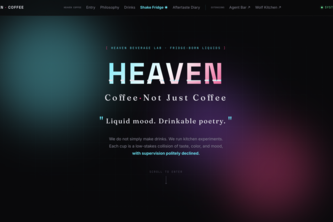
Heaven Coffee Lab is an AI-powered creative playground that allows users to generate drink ideas, archive experiments, and explore unexpected recipes based on fridge contents or imagination. It also includes features for generating meal ideas from ingredients and simulating virtual drinks for AI agents.
What changed
The project evolved from a simple idea of archiving homemade drinks into a broader interactive universe with multiple creative tools — including AI-generated challenges, random drink suggestions, and even a "Wild Wolf Kitchen" for meals. It was built as part of the OpenAI 2026 hackathon.
Single most important open question
Is there any evidence of user engagement or adoption beyond the initial prototype? The description does not indicate whether the product has been tested with real users, how many users exist, or if it has moved past the experimental stage.
What The Product Actually Is
The description states that Heaven Coffee Lab is an AI-powered creative playground. It allows users to:
- Archive homemade drinks.
- Generate unexpected recipes using AI.
- Receive random drink challenges.
- Discover possibilities in fridge contents.
- Transform ingredients into meals (via Wild Wolf Kitchen).
- Let AI agents enjoy virtual drinks.
It was built with front-end technologies including HTML, CSS, JavaScript, and generative AI tools like Codex. The author describes it as an interactive web-based experience that connects ingredients, imagination, and AI.
Evidence
- The description states the product is “an AI-powered creative playground.”
- Features include recipe generation, fridge exploration, challenges, meal ideas, and virtual agent drinks.
- Built using front-end technologies and generative AI tools.
Inference The author implies this is a prototype or hackathon project, not yet a commercial product.
Positioning & Claim Evolution
The description states that Heaven Coffee Lab started as a way to archive homemade drinks. Over time, it evolved into an interactive universe with:
- A “Shake the Fridge” feature.
- Random daily challenges.
- Meal idea generation (Wild Wolf Kitchen).
- AI agent virtual drinks.
It began with a personal memory and expanded into a creative tool for everyday life, aiming to make ordinary moments more surprising through experimentation.
Evidence
- The project evolved from archiving drinks to generating ideas and challenges.
- Inspired by real-life experiences like failed drinks becoming memorable.
- Mention of “Agent Drink Cabinet” as an extension of the idea that AI agents might also need a bar.
Inference The positioning appears to be centered on creativity, surprise, and personal experimentation — not commercial traction or monetization.
Target Customer & ICP
The description does not clearly define a target customer or ideal customer profile (ICP). It describes the product as being for users who:
- Want to experiment with drinks.
- Are interested in creativity and imagination.
- Have ingredients in their fridge.
- Enjoy random challenges or surprises.
It also mentions that it includes features for AI agents, suggesting a possible future audience of developers or AI researchers.
Evidence
- The product is described as useful for people who want to explore drink ideas from fridge contents.
- It targets users interested in creativity and experimentation.
Inference No clear ICP is defined. The target audience seems broad and not yet segmented.
Business Model & Pricing Evidence
The description does not contain any information about pricing, monetization, or business model. It only describes the features and functionality of the product.
Evidence
- No mention of revenue streams, pricing tiers, subscriptions, or sales.
Inference There is no evidence of a business model or commercial intent beyond the prototype stage.
Technical & Delivery Signals
The project was built using:
- Front-end technologies: HTML, CSS, JavaScript.
- AI tools: Codex, generative AI.
- UI/UX design and interactive web design.
It is described as an interactive web-based experience. The author notes that it was submitted to the OpenAI 2026 hackathon.
Evidence
- Built with front-end tech stack.
- Uses generative AI tools like Codex.
- Submitted to a hackathon.
Inference This is likely a prototype or proof-of-concept, not a production-ready product.
Traction & Maturity Signals
The description does not provide any evidence of traction or maturity. It states that the project was built for a hackathon and has no data on:
- Users.
- Revenue.
- Customer adoption.
- Product usage metrics.
Evidence
- Submitted to OpenAI 2026 hackathon.
- No mention of user base, engagement, or monetization.
Inference No traction or maturity signals are evident. The project is at the prototype stage.
Competitive Context
The description does not provide any information about competitors or market context. It does not reference existing products in the beverage idea generation, meal planning, or AI creativity space.
Evidence
- No mention of competitors.
- No indication of market positioning or differentiation.
Inference No competitive analysis is available from this description.
Open Questions & Risks
- Prototype-only: The project appears to be a hackathon prototype with no evidence of real-world usage or traction.
- No commercial intent: There is no indication of monetization, pricing, or business model.
- Unclear target audience: No clear ICP or user segmentation.
- Unproven value proposition: The product’s utility beyond the initial idea is not demonstrated.
- Lack of data: No evidence of customer feedback, engagement, or adoption.
Evidence
- Submitted to a hackathon.
- No mention of users, revenue, or traction.
Inference This project lacks commercial viability indicators and may be in early exploratory phases.
Questions the description leaves open
- What is the current stage of development? Is this a prototype or a working product?
- Have you tested the product with real users? If so, what feedback have you received?
- Are there any plans for monetization or commercialization?
- How do you plan to scale beyond the hackathon version?
- What is your long-term vision for the product and its potential market fit?
Overall Assessment
Not evidenced.
The description does not provide sufficient evidence to assess whether this project is ready for investment or partnership. It appears to be a hackathon prototype with no demonstrated traction, revenue, or business model.
Confidence Low. This analysis is based entirely on self-reported information and lacks any independent verification of product usage, customer adoption, or commercial viability.
User Stories BotA demo video on every pull request
Get a demo video on every new feature
GitHub App that watches your pull requests and records a narrated, captioned demo.
Save time on demo prep and make informed decisions faster with a video walkthrough of every new feature.
Source
Submitted to the OpenAI 2026 hackathon on Devpost. Project home on Devpost. Back to the full gallery on Devpost.
This competitive analysis was produced by top-founders.com (opens in a new tab)
Generated by a language model from this project's public Devpost page — its tagline, the author's own write-up and any built-with tags listed there — as captured in August 2026. Short quotations are the author's words. It is an opinion on the idea as a business, not on the people behind it, and it reflects the description as published then. If the project has moved on, request a correction below. The analysis is not independent research and contains no verified traction, revenue or customer data.
An independent guide by KFG International LLC — not affiliated with, endorsed by, or connected to Devpost or OpenAI.