

Archive position — measured, not model output
0 likes on Devpost
2,263 of the 7,850 archived projects have more likes, and 5,587 share exactly 0 — so this project's #5,103 place in the like-ranked listing is a tie-break inside that group, not a ranking.
Projects (log scale)
Likes on Devpost. ▲ marks this project's group.
Show the figures
| Likes | Projects | Share of archive |
|---|---|---|
| 0 | 5,587 | 71.2% |
| 1 | 1,758 | 22.4% |
| 2 | 284 | 3.6% |
| 3–4 | 132 | 1.7% |
| 5–9 | 75 | 1.0% |
| 10+ | 14 | 0.2% |
 User Stories BotA demo video on every pull request
Get a demo video on every new feature
GitHub App that watches your pull requests and records a narrated, captioned demo.
Save time on demo prep and make informed decisions faster with a video walkthrough of every new feature.
Executive Summary
What the company appears to be
M55 Control Plane is a self-reported developer tool designed to govern AI-assisted software development within repositories. It claims to provide guardrail checks and consistency verification to ensure that AI agents and human developers act in alignment with repository state, authority, and intent.
What changed
The project was built during OpenAI Build Week as an extension of an existing product repository. The author added a "Control Plane" layer to the existing codebase, using Node.js and Git-based logic, without external API calls or model inference at runtime.
Single most important open question
Is there evidence of real-world usage or adoption beyond the author’s own pilot? The description states no revenue, customers, or traction data — only self-reported development and testing outcomes.
Note: This analysis is based entirely on the self-reported project description provided by the author. No external verification, archived history, or third-party sources are available. All claims are labeled as such.
What The Product Actually Is
The description states that M55 Control Plane is a repository-native control layer for AI-assisted software development. It consists of two complementary parts:
- Guardrail: Checks whether an agent should begin work by evaluating Git state, repository authority, worktree registration, current-versus-target declarations, active lanes, human decisions, and prohibited actions. It returns an assessment such as READY, READY_WITH_WARNINGS, or HOLD, and generates a handoff packet.
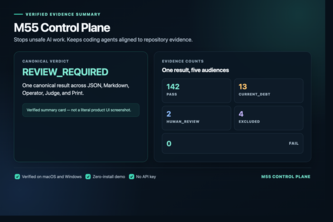
- Consistency: Ensures that encoded product intent remains aligned across repository surfaces. It produces deterministic evidence records, separates current debt from compliance, keeps human review explicit, and renders one canonical assessment for various audiences (JSON, Markdown, operator, judge, print).
The system is described as:
- Built with Node.js, using only built-ins.
- Not making any model or network calls at runtime.
- Generating evidence outside the repository to avoid modifying it.
- Supporting cross-platform path and output-boundary protections.
- Including test coverage, GitHub Actions workflow examples, and synthetic project templates.
Inference: The product appears to be a developer tool for managing AI agent behavior in Git-based repositories. It is not a SaaS offering or a hosted service but rather an open-source or internal tooling layer.
Positioning & Claim Evolution
The author positions M55 Control Plane as a solution to the problem of AI agents acting on stale data, conflicting documentation, or outdated assumptions in large repositories.
Key claims:
- It makes decisions explicit, deterministic, and portable across humans, AI agents, branches, and machines.
- It answers two core questions:
- Is it safe and authorized to act?
- Does the repository still represent the intended product contract?
- The system is designed to prevent superficially successful but untrustworthy results, such as treating unreadable files as proof of absence or stale worktrees producing contradictory findings.
Claim: The author claims this tool addresses a real need in AI-assisted development by enforcing alignment and safety.
Inference: This positioning suggests a niche in developer tooling for teams using AI agents in complex, long-running repositories.
Target Customer & ICP
The description does not state specific customer segments or personas.
However, the author implies:
- Teams working with AI-assisted development in large, long-running repositories.
- Developers or engineering teams that want to align AI agents with repository authority and human intent.
- Users who value explicit decision points, deterministic behavior, and evidence-based refusals to act.
Inference: The target is likely small to mid-sized engineering teams using AI tools in Git-based workflows, especially those managing complex or legacy codebases.
Business Model & Pricing Evidence
Not evidenced.
The description does not mention:
- Revenue streams
- Pricing models
- Subscription plans
- Licensing
- Monetization strategy
Note: The project is described as a developer tool built during a hackathon, with no indication of commercialization or monetization.
Technical & Delivery Signals
The author states:
- Built with Node.js using only built-ins.
- No API keys or dependency installations required at runtime.
- Makes no model or network calls at runtime.
- Uses Git-based logic and deterministic evidence generation.
- Includes test coverage (55/55 Guardrail tests, 80/80 Consistency tests).
- Supports macOS and Windows native execution.
- Generates semantic digests that are identical across runs.
- Does not modify Git status or create node_modules.
- Includes GitHub Actions workflow example.
Inference: The tool is lightweight, portable, and designed for internal use in development workflows. It emphasizes deterministic behavior and auditability.
Traction & Maturity Signals
Not evidenced.
The description does not mention:
- Customers
- Users
- Adoption metrics
- Product usage data
- Revenue
- Market traction
It does describe:
- A real-world pilot using the actual M55 development worktree.
- A narrow handoff improvement made after pilot feedback.
- Verification with multiple platforms and test suites.
Note: The only evidence of use is the author’s own testing, not external adoption or market validation.
Competitive Context
Not evidenced.
The description does not mention:
- Competitors
- Market landscape
- Prior art
- Differentiation from similar tools
Inference: Based on the description, this appears to be a novel approach to AI agent governance in Git repositories. No known competitors are referenced.
Open Questions & Risks
- No external validation or adoption — The project is described as self-built and tested only by the author.
- No commercialization strategy — No evidence of monetization, pricing, or business model.
- Limited scope — Built for one repository (M55), with no indication of scalability or generalizability.
- Self-reported maturity — The tool is described as a hackathon prototype, not a production-ready product.
- No third-party integration — No mention of integrations with CI/CD systems, AI platforms, or other tools.
Inference: The project lacks commercial viability or traction signals. It may be an experimental idea rather than a scalable product.
Questions the description leaves open
- What is the real-world use case for this tool beyond your own development workflow?
- Have you tested it with other repositories or teams?
- How would you scale this beyond a single developer or small team?
- Is there any plan to monetize or commercialize this tool?
- What are the key assumptions in your design, and how do they hold up under different repository structures?
- Are there any known edge cases or limitations that were not addressed in testing?
Overall Assessment
Not evidenced.
The description does not provide:
- Financials
- Revenue
- Customer base
- Market size
- Strategic fit for investors or partners
Inference: This project is described as a hackathon prototype with no commercial traction, revenue, or clear path to monetization. It may be an experimental idea or proof-of-concept, not a viable investment or partnership opportunity at this stage.
User Stories BotA demo video on every pull request
Get a demo video on every new feature
GitHub App that watches your pull requests and records a narrated, captioned demo.
Save time on demo prep and make informed decisions faster with a video walkthrough of every new feature.
Source
Submitted to the OpenAI 2026 hackathon on Devpost. Project home on Devpost. Back to the full gallery on Devpost.
This competitive analysis was produced by top-founders.com (opens in a new tab)
Generated by a language model from this project's public Devpost page — its tagline, the author's own write-up and any built-with tags listed there — as captured in August 2026. Short quotations are the author's words. It is an opinion on the idea as a business, not on the people behind it, and it reflects the description as published then. If the project has moved on, request a correction below. The analysis is not independent research and contains no verified traction, revenue or customer data.
An independent guide by KFG International LLC — not affiliated with, endorsed by, or connected to Devpost or OpenAI.