

Archive position — measured, not model output
1 like on Devpost
505 of the 7,850 archived projects have more likes, and 1,758 share exactly 1 — so this project's #1,179 place in the like-ranked listing is a tie-break inside that group, not a ranking.
Projects (log scale)
Likes on Devpost. ▲ marks this project's group.
Show the figures
| Likes | Projects | Share of archive |
|---|---|---|
| 0 | 5,587 | 71.2% |
| 1 | 1,758 | 22.4% |
| 2 | 284 | 3.6% |
| 3–4 | 132 | 1.7% |
| 5–9 | 75 | 1.0% |
| 10+ | 14 | 0.2% |
 User Stories BotA demo video on every pull request
Get a demo video on every new feature
GitHub App that watches your pull requests and records a narrated, captioned demo.
Save time on demo prep and make informed decisions faster with a video walkthrough of every new feature.
Executive Summary
What the company appears to be
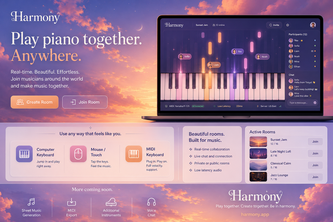
Harmony - Play Social is a browser-based multiplayer piano application that allows musicians to play together in real time. The project was submitted by a single founder, E. J. Moore, as part of the OpenAI 2026 hackathon.
What changed
The description indicates this is an early-stage beta product with limited functionality, focused on core real-time piano playing and chat features. No evidence suggests prior development or commercial traction beyond the initial submission.
Single most important open question
Is there any evidence of user engagement, retention, or monetization strategy beyond the author's stated intent?
Analysis basis
Self-reported only. No third-party verification, revenue data, customer names, or traction metrics are available. All claims are from the project description provided by the caller.
What The Product Actually Is
The description states that Harmony is a browser-based multiplayer piano application. It enables musicians to play together in real time using either a computer keyboard or a MIDI keyboard. Users can join public or private rooms and communicate via chat during sessions.
- The product supports real-time collaborative music-making.
- It includes basic interface elements like chat, visual design inspired by golden hour, and support for MIDI input.
- Features currently available in the beta include:
- Real-time piano playing with others
- Public/private room joining
- In-app chat
- Keyboard-based play
- MIDI keyboard connection
- Clean, modern interface
Inference The product is a browser-based tool for remote collaborative music creation. It is not evidenced to have any monetization features or advanced functionality beyond what is described.
Positioning & Claim Evolution
The author positions Harmony as more than just functional—it aims to be comforting and emotionally supportive, designed around feelings of care and connection. The tagline emphasizes global collaboration: “Harmony is a browser-based multiplayer piano that lets musicians around the world play together in real time.”
- The project claims to offer a calming, creative experience.
- It frames itself as an alternative to online conflict, promoting cooperation and emotional connection through music.
Claim vs Fact
These are self-reported positioning statements. No evidence of actual user feedback or market validation is provided.
Target Customer & ICP
The description does not explicitly define the target customer or ideal customer profile (ICP). However, it implies a focus on musicians who want to collaborate remotely and enjoy a peaceful, creative environment.
- The audience likely includes amateur and professional musicians interested in remote collaboration.
- Users may be drawn to the calming design and ease of use for casual or practice-based engagement.
Inference Based on the description, Harmony targets individuals seeking collaborative musical experiences online. No evidence of segmentation or specific user personas is available.
Business Model & Pricing Evidence
There is no evidence in the description regarding pricing models, monetization strategies, or business model assumptions.
- The project is described as a beta release.
- No mention of subscriptions, freemium tiers, or paid features.
- The author does not describe how they plan to generate revenue.
Inference There is no indication of any commercial structure beyond the initial development effort. This remains unproven.
Technical & Delivery Signals
The project was built using Codex (author-declared), which suggests a tool-assisted development approach, possibly AI-powered coding.
- The application runs in the browser.
- It supports both keyboard and MIDI input.
- Visual design is described as warm, peaceful, and welcoming.
- The author notes that this beta is only the beginning and plans to add more features over time.
Inference Technical delivery appears minimal but functional for a prototype. No evidence of scalability, infrastructure, or performance metrics.
Traction & Maturity Signals
There is no evidence of user traction, adoption, or product maturity beyond the initial beta launch.
- The project is described as a beta.
- It was submitted to a hackathon (OpenAI 2026).
- No data on active users, retention rates, or usage frequency is provided.
- The author mentions future feature development but does not reference current user engagement.
Inference This is an early-stage prototype with no demonstrated traction or market validation.
Competitive Context
The description provides no information about competitors or competitive positioning. It does not mention similar tools or platforms in the space of collaborative music-making or virtual piano applications.
Absence of evidence
No competitive analysis, benchmarking, or market comparison data is included.
Open Questions & Risks
Several key risks and open questions emerge from the lack of evidence:
- No revenue or monetization model—the project lacks any indication of how it will make money.
- Single founder—with only one team member, there may be limited capacity for scaling or rapid iteration.
- No traction or user data—no sign of real-world usage or engagement.
- Unproven market demand—the author’s intent is clear, but no evidence supports whether users actually want this product.
- Limited scope and features—the beta only includes core functionality; it's unclear if the roadmap will deliver value.
Inference The absence of any commercial or user data raises concerns about viability and scalability.
Questions the description leaves open
- What is your plan for monetization?
- How do you intend to grow user engagement beyond the current beta?
- Have you identified specific user segments or personas?
- Are there any existing users or feedback from the community?
- What are the key technical challenges in scaling this platform?
- Do you have a go-to-market strategy for reaching musicians?
- How do you plan to differentiate from other online music collaboration tools?
Note
These questions aim to probe beyond self-reported claims and uncover actual execution plans or traction.
Overall Assessment
Not evidenced.
The description does not provide sufficient information to assess whether this project warrants investment or partnership consideration. There is no evidence of revenue, customers, traction, or a clear path to monetization. The product appears to be an early-stage prototype with strong emotional positioning but no commercial foundation.
Confidence level Low. This analysis is based entirely on self-reported content and lacks any external validation or performance indicators.
User Stories BotA demo video on every pull request
Get a demo video on every new feature
GitHub App that watches your pull requests and records a narrated, captioned demo.
Save time on demo prep and make informed decisions faster with a video walkthrough of every new feature.
Source
Submitted to the OpenAI 2026 hackathon on Devpost. Project home on Devpost. Back to the full gallery on Devpost.
This competitive analysis was produced by top-founders.com (opens in a new tab)
Generated by a language model from this project's public Devpost page — its tagline, the author's own write-up and any built-with tags listed there — as captured in August 2026. Short quotations are the author's words. It is an opinion on the idea as a business, not on the people behind it, and it reflects the description as published then. If the project has moved on, request a correction below. The analysis is not independent research and contains no verified traction, revenue or customer data.
An independent guide by KFG International LLC — not affiliated with, endorsed by, or connected to Devpost or OpenAI.