

Archive position — measured, not model output
0 likes on Devpost
2,263 of the 7,850 archived projects have more likes, and 5,587 share exactly 0 — so this project's #5,088 place in the like-ranked listing is a tie-break inside that group, not a ranking.
Projects (log scale)
Likes on Devpost. ▲ marks this project's group.
Show the figures
| Likes | Projects | Share of archive |
|---|---|---|
| 0 | 5,587 | 71.2% |
| 1 | 1,758 | 22.4% |
| 2 | 284 | 3.6% |
| 3–4 | 132 | 1.7% |
| 5–9 | 75 | 1.0% |
| 10+ | 14 | 0.2% |
 User Stories BotA demo video on every pull request
Get a demo video on every new feature
GitHub App that watches your pull requests and records a narrated, captioned demo.
Save time on demo prep and make informed decisions faster with a video walkthrough of every new feature.
Executive Summary
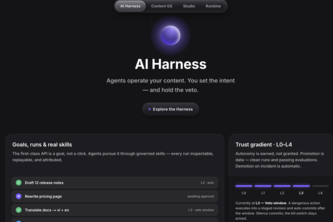
What the company appears to be: LumiBase, as described by its author, is a self-reported "Content Operating System" — a runtime environment where AI agents perform operational content work while humans set intent and hold the veto. It is built as a headless CMS with an edge-native, multi-tenant architecture, using AI agent orchestration to manage content according to declared SLOs (Service Level Objectives). The system includes governance features like earned autonomy (L0–L4), tenant constitutions, and provenance-first revisions.
What changed: The project pivoted from a traditional CMS optimized for human interaction to a "Content Operating System" where AI agents operate content under human-defined intent. This shift is described as the origin of LumiBase, driven by the idea that AI agents will do most operational work in content management.
The single most important open question: Is there any evidence of real-world usage or traction beyond the author's own development and self-reported features? The description contains no data on revenue, customers, adoption, or performance metrics — only claims about architecture and intent.
Note: This analysis is based entirely on the self-reported, unverified project description provided by the author. No external corroboration, historical data, or third-party evidence is available.
What The Product Actually Is
The description states that LumiBase is a "Content Operating System" — a runtime where AI agents operate content while humans declare desired state and hold the veto. It includes:
- A reconciliation loop that detects drift and converges content toward declared SLOs (e.g., image count, language requirements).
- Agent harness capabilities: goals → plans → tool calls → artifacts → evaluation → publish.
- Governance features like earned autonomy (L0–L4), tenant constitutions, and provenance-first revisions.
- Edge-first delivery using Cloudflare Workers with multi-tenancy.
- A studio for mission control that includes exception inbox, trust ledger, and kill switches.
Inference: The product is described as a runtime system for managing content via AI agents, not a traditional UI-based CMS. It emphasizes agent-driven workflows and governance over human interaction.
Positioning & Claim Evolution
The author describes LumiBase as evolving from a traditional CMS to a "Content Operating System" — a pivot driven by the idea that AI agents will do most operational work in content management.
- Original positioning: A headless CMS inspired by Directus, optimized for human interaction.
- New positioning: A system where humans set intent and accountability; AI agents perform operational tasks.
- Core claim: If AI agents are doing most of the work, then building another UI optimized for humans to click is inefficient. The new model is agent-native.
Claim vs Fact: This is a self-stated evolution and positioning. There is no evidence that this shift has been validated in practice or adopted by users.
Target Customer & ICP
The description does not explicitly name target customers or define an Ideal Customer Profile (ICP). However, it implies:
- Small businesses needing bilingual catalogs, SEO hygiene, tagging, and cleanup at scale.
- Agencies or SMBs that cannot afford dedicated editors, translators, or SEO specialists.
- Users who want to manage content with AI agents but retain human oversight.
Inference: The target appears to be small-to-medium enterprises (SMBs) or agencies managing multilingual, scalable content with limited human resources. No explicit ICP is stated.
Business Model & Pricing Evidence
The description does not include any information about pricing, monetization, or business model. It mentions:
- Managed hosting for SMBs and agencies (Hobby / Enterprise tiers).
- A path to v1.0 with release criteria including security audit and upgrade-path tests.
Not evidenced: No pricing structure, revenue model, or commercial strategy is described.
Technical & Delivery Signals
The author provides a detailed technical stack:
- Built with Turborepo + pnpm monorepo.
- API: Hono.js on Cloudflare Workers; Node/Docker path via runtime abstraction.
- Data: PostgreSQL + Drizzle ORM.
- Cache/storage/queue: CF KV / R2 / Queues ↔ Redis / MinIO / BullMQ.
- Auth: Logto (OIDC, multi-tenant orgs).
- Search: MeiliSearch.
- AI: Gemini / OpenAI / Anthropic / Workers AI behind AISecureHarness.
- Admin UI: React + Vite + Tailwind + shadcn/ui + CVA.
- Delivery demos: Next.js consumer apps.
Inference: The system is built for edge-native delivery, with multi-tenant support and runtime abstraction to enable both Cloudflare Workers and Docker deployments. It includes AI agent orchestration and governance features.
Traction & Maturity Signals
The description states:
- v0.5.0 foundation shipped: reconciliation loop, trust ledger, constitution publish-gate, multi-agent newsroom patterns, provenance-first revisions.
- v0.23.0 production-minded stack: Git integration, Change Feed / CDC, MCP surface, compliance suite, Flows, marketplace extensions — under Apache 2.0.
- Agent-native engineering: CLAUDE.md, AGENTS.md, .cursorrules, and machine-readable setup.
Not evidenced: No data on customers, revenue, usage metrics, or adoption is provided. The maturity level is described in terms of features and releases but not real-world traction.
Competitive Context
The description does not mention direct competitors or a competitive landscape. It references:
- Inspiration from Directus’s database-first DX.
- A distinction between “AI features bolted onto a CMS” and “a CMS designed as an agent control plane.”
Inference: The author positions LumiBase as distinct from traditional CMSs and AI-enhanced CMSs, but no competitive analysis or market positioning is provided.
Open Questions & Risks
- No traction evidence: The project is described as self-developed with no external validation or customer data.
- Unproven model: The shift to agent-native content management is a bold claim, but there’s no evidence that it works in practice or is adopted.
- High technical complexity: The system is built on edge-native tech (Cloudflare Workers), AI orchestration, and governance layers — all of which are complex to implement and maintain.
- Unclear monetization path: No pricing, business model, or revenue data is provided.
Inference: The project is in a very early stage with no commercial validation. It’s unclear whether the agent-native approach will scale or be adopted by users.
Questions the description leaves open
- What specific use cases have you validated with real users?
- How do you plan to monetize this system, and what is your pricing model?
- Have you tested the agent-native workflow in real-world scenarios beyond development?
- What are the key challenges in scaling governance across tenants?
- How do you ensure that AI agents don’t drift from human intent or introduce bias?
- What is your roadmap for v1.0, and how will you measure success?
Overall Assessment
Not evidenced: There is no evidence of revenue, customers, or traction to support an investment or partnership decision.
Confidence Level: Very low. The description is self-reported and unverified, with no data on commercial viability, adoption, or performance.
Conclusion: LumiBase appears to be a highly technical, early-stage project focused on AI agent orchestration in content management. It is not evidenced to have traction, customers, or revenue. The author’s claims about architecture and intent are self-reported and unverified. Any investment or partnership decision would require further evidence of real-world usage, adoption, or performance metrics.
User Stories BotA demo video on every pull request
Get a demo video on every new feature
GitHub App that watches your pull requests and records a narrated, captioned demo.
Save time on demo prep and make informed decisions faster with a video walkthrough of every new feature.
Source
Submitted to the OpenAI 2026 hackathon on Devpost. Project home on Devpost. Back to the full gallery on Devpost.
This competitive analysis was produced by top-founders.com (opens in a new tab)
Generated by a language model from this project's public Devpost page — its tagline, the author's own write-up and any built-with tags listed there — as captured in August 2026. Short quotations are the author's words. It is an opinion on the idea as a business, not on the people behind it, and it reflects the description as published then. If the project has moved on, request a correction below. The analysis is not independent research and contains no verified traction, revenue or customer data.
An independent guide by KFG International LLC — not affiliated with, endorsed by, or connected to Devpost or OpenAI.