

Archive position — measured, not model output
0 likes on Devpost
2,263 of the 7,850 archived projects have more likes, and 5,587 share exactly 0 — so this project's #5,090 place in the like-ranked listing is a tie-break inside that group, not a ranking.
Projects (log scale)
Likes on Devpost. ▲ marks this project's group.
Show the figures
| Likes | Projects | Share of archive |
|---|---|---|
| 0 | 5,587 | 71.2% |
| 1 | 1,758 | 22.4% |
| 2 | 284 | 3.6% |
| 3–4 | 132 | 1.7% |
| 5–9 | 75 | 1.0% |
| 10+ | 14 | 0.2% |
 User Stories BotA demo video on every pull request
Get a demo video on every new feature
GitHub App that watches your pull requests and records a narrated, captioned demo.
Save time on demo prep and make informed decisions faster with a video walkthrough of every new feature.
Executive Summary
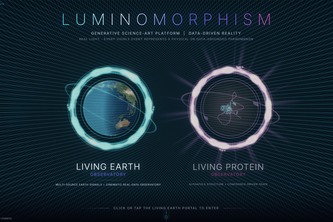
The author describes LUMINOMORPHISM — ORBITAL DATA ATLAS as an evidence-aware scientific observatory runtime that connects cinematic WebGL experiences with traceable data, models, predictions, and fallbacks across planetary and molecular scales. The project began as "Living Earth", a data-grounded Earth observatory, and was extended during OpenAI Build Week into a modular platform capable of hosting multiple observatories while maintaining provenance and failure semantics.
The description states this is a single-person project built with JavaScript ES Modules, WebGL, Three.js, and various NASA/USGS/NOAA data sources. It includes two working observatories: Living Earth (combining Earth data feeds) and Living Protein (combining protein structure prediction data). The author claims to have transformed the existing application into a reusable platform with shared lifecycle contracts, capability registries, and source-provenance tracking.
The single most important open question is whether this represents a viable product or service that could be commercialized, given its current self-reported scope, technical architecture, and lack of evidence for traction, customers, revenue, or market validation. The author's own account indicates no verified business model, customer base, or monetization strategy.
What The Product Actually Is
The description states LUMINOMORPHISM — ORBITAL DATA ATLAS is:
- An evidence-aware scientific observatory runtime
- A modular platform for hosting multiple observatories
- A system that connects cinematic WebGL experiences with traceable data, models, predictions, and fallbacks
- A runtime capable of handling planetary and molecular scale data
The author describes two working observatories within this system:
- Living Earth: combines NASA EONET natural-event data, USGS earthquake feeds, NOAA aurora data, NASA GIBS imagery, optional NASA FIRMS and GDACS data, astronomical lighting, Earth day/night state, Moon position and phase, ISS tracking
- Living Protein: combines AlphaFold predicted protein structures, per-residue pLDDT model confidence, UniProt functional annotations, curated protein model selection
The system includes:
- Shared observatory module contract
- Controlled module lifecycle and host
- Dynamic mounting of Earth and Protein observatories from the same Atlas
- Capability and source-provenance registries
- Unified data runtimes for Earth and Protein
- Persistent caching and request coalescing
- Retries, timeouts, and controlled stale fallback
- Source-time and diagnostic metadata
- Explicit classification of observed data, predictions, physical models, interpretations, and fallback output
The author states this is built with browser-based JavaScript ES Modules, WebGL, Three.js, and optional Node.js proxy for CORS support.
Positioning & Claim Evolution
The description states the project evolved from "Living Earth", a cinematic, data-grounded Earth observatory, to a modular scientific runtime capable of hosting multiple observatories while keeping provenance, capabilities, lifecycle boundaries, and failure states visible.
The author claims this transformation occurred during OpenAI Build Week, where they extended an existing project into a reusable platform. The original Living Earth was described as having been in existence before Build Week.
Key positioning claims:
- Scientific visualization that is visually impressive but not misleading
- Evidence-aware system that makes what was measured, predicted, modeled, interpreted, or generated as fallback visible to viewers
- Cinematic WebGL experiences connected with traceable data and models
- Modular platform for hosting multiple observatories with shared lifecycle contracts
The author states they defined a precise baseline and documented eligible contribution separately through seven Git commits created during the official submission period.
Target Customer & ICP
Not evidenced. The description does not state what customers or target users this system is intended for, nor does it describe any identified customer segments or personas. No evidence of market research, user interviews, or customer validation is provided.
Business Model & Pricing Evidence
Not evidenced. The description does not contain any information about pricing, revenue streams, monetization strategy, or business model. There is no mention of customers, sales cycles, contracts, or commercial arrangements.
Technical & Delivery Signals
The description states the system is built with:
- Browser-based JavaScript ES Modules
- WebGL and Three.js
- Optional Node.js proxy for CORS support and local H.264 conversion
- Codex with GPT-5.6 Sol for development assistance (not a runtime dependency)
- Various NASA, USGS, NOAA, GDACS, AlphaFold DB, UniProt, Astronomy Engine, and satellite.js data sources
Key technical elements:
- Shared observatory module contract
- Controlled module lifecycle and host
- Dynamic mounting of Earth and Protein observatories
- Capability and source-provenance registries
- Unified Earth and Protein data runtimes
- Persistent caching and request coalescing
- Retries, timeouts, and controlled stale fallback
- Source-time and diagnostic metadata
- Explicit classification of observed data, predictions, physical models, interpretations, and fallback output
The author states Codex was used for reasoning across a mature codebase to trace cross-module dependencies, define safe module boundaries, implement the shared lifecycle, consolidate data access, and validate behavior.
Traction & Maturity Signals
Not evidenced. The description does not contain any information about user adoption, customer base, revenue, ARR, usage metrics, or product maturity indicators. No evidence of traction, market validation, or business development is provided.
Competitive Context
Not evidenced. The description does not mention any competitors, competitive landscape, or positioning relative to other scientific visualization tools or platforms. No market analysis or competitive differentiation is described.
Open Questions & Risks
- Single-person development team (1 person)
- Self-reported nature of all information with no independent verification
- No evidence of traction, customers, revenue, or commercial viability
- No pricing model or business strategy described
- No mention of market validation or user feedback
- Technical complexity of scientific visualization with multiple data sources and provenance tracking may present significant development and maintenance challenges
- The system appears to be primarily a proof-of-concept or prototype rather than a production-ready product
- Lack of evidence for scalability, performance, or reliability in real-world usage scenarios
Questions the description leaves open
- What specific scientific use cases or domains are you targeting with this platform?
- How do you plan to monetize this system given its current scope and technical complexity?
- What is your timeline for developing additional observatories beyond the two currently implemented?
- Have you identified any potential customers or partners who might be interested in using this platform?
- What are the key technical challenges you anticipate scaling this platform to support more complex scientific domains?
- How do you plan to ensure data quality and reliability across multiple external providers?
- What is your approach to maintaining and updating the various data sources over time?
- Have you considered how this system would be deployed in enterprise or institutional environments?
- What are the key performance requirements for different types of scientific visualization tasks?
- How do you plan to handle edge cases where external data providers fail or become unavailable?
Overall Assessment
Not evidenced. The description does not contain any information about investment status, funding rounds, valuation, or partnership discussions. No evidence of commercial interest, financial backing, or strategic partnerships is provided.
The author's own account indicates this is a single-person project with no verified business model, customer base, or monetization strategy. The system appears to be primarily a technical demonstration or prototype rather than a commercial product. Without evidence of traction, customers, revenue, or market validation, it is not possible to assess the commercial viability or investment potential of this project.
User Stories BotA demo video on every pull request
Get a demo video on every new feature
GitHub App that watches your pull requests and records a narrated, captioned demo.
Save time on demo prep and make informed decisions faster with a video walkthrough of every new feature.
Source
Submitted to the OpenAI 2026 hackathon on Devpost. Project home on Devpost. Back to the full gallery on Devpost.
This competitive analysis was produced by top-founders.com (opens in a new tab)
Generated by a language model from this project's public Devpost page — its tagline, the author's own write-up and any built-with tags listed there — as captured in August 2026. Short quotations are the author's words. It is an opinion on the idea as a business, not on the people behind it, and it reflects the description as published then. If the project has moved on, request a correction below. The analysis is not independent research and contains no verified traction, revenue or customer data.
An independent guide by KFG International LLC — not affiliated with, endorsed by, or connected to Devpost or OpenAI.