

Archive position — measured, not model output
0 likes on Devpost
2,263 of the 7,850 archived projects have more likes, and 5,587 share exactly 0 — so this project's #5,089 place in the like-ranked listing is a tie-break inside that group, not a ranking.
Projects (log scale)
Likes on Devpost. ▲ marks this project's group.
Show the figures
| Likes | Projects | Share of archive |
|---|---|---|
| 0 | 5,587 | 71.2% |
| 1 | 1,758 | 22.4% |
| 2 | 284 | 3.6% |
| 3–4 | 132 | 1.7% |
| 5–9 | 75 | 1.0% |
| 10+ | 14 | 0.2% |
 User Stories BotA demo video on every pull request
Get a demo video on every new feature
GitHub App that watches your pull requests and records a narrated, captioned demo.
Save time on demo prep and make informed decisions faster with a video walkthrough of every new feature.
Executive Summary
What the company appears to be
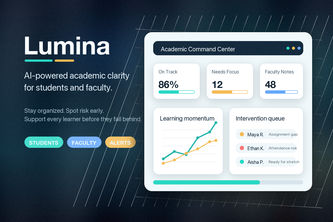
Lumina is an AI-powered learning management system (LMS) designed for academic environments. The platform allows faculty to upload course materials such as lectures, slides, and PDFs, which are then processed into a knowledge base. Students interact with an AI "Twin" that answers questions grounded in those specific course materials, using a teacher's profile to shape the explanation style. The system also provides analytics to faculty on student confusion patterns and attention alerts for at-risk students.
What changed
The project was submitted as part of the OpenAI 2026 hackathon. It is described as a prototype built over a few weeks by two team members, with no evidence of prior traction or commercial deployment.
Single most important open question
Is there any evidence that Lumina has been tested in real classrooms or used by actual students and faculty beyond the hackathon context?
What The Product Actually Is
The description states that Lumina is a role-based AI learning platform for faculty and students. It includes:
- A frontend dashboard built with Next.js + TypeScript.
- A backend built with FastAPI + PostgreSQL, using SQLAlchemy for ORM and Alembic migrations.
- An asynchronous content ingestion pipeline supporting:
- Lecture + slides
- Lecture-only (transcript segmentation)
- AI Twin that retrieves course-specific information and generates responses in various formats (teacher style, simple, step-by-step, visual).
- Teacher profile system to determine explanation tone without compromising factual grounding.
- Faculty dashboard for doubt analytics and attention alerts.
Inference The product is a prototype built for a hackathon, not a production-ready SaaS offering. It uses role-based access control, JWT authentication, and provider abstractions for AI services (e.g., Google Gemini, Hugging Face).
Positioning & Claim Evolution
The description states that Lumina aims to:
- Preserve continuity of teaching beyond class hours.
- Create an "AI Classroom Twin" grounded in course materials.
- Provide personalized teaching assistance without replacing teachers.
- Enable faculty to gain real-time insight into student learning.
Inference The positioning is centered on teacher-centered AI, emphasizing factual grounding, privacy, and educational integrity. It positions itself as a tool that enhances rather than replaces human instruction.
Claim vs Fact
The claim that Lumina "keeps students organized", "provides personalized teaching assistance", and "gives faculty real-time insight" is self-reported and unverified. No evidence of adoption, usage metrics, or customer feedback is provided.
Target Customer & ICP
The description identifies two main user roles:
- Faculty: who create courses, upload materials, and use dashboards for analytics.
- Students: who ask questions to the AI Twin and receive explanations tailored to their learning style.
Inference The target market appears to be academic institutions or educators using LMS platforms. The ICP is likely K–12 or higher education environments where instructors want to support student learning with AI tools while maintaining pedagogical control.
Not evidenced No information on specific school types, grade levels, or institutional size is provided.
Business Model & Pricing Evidence
The description does not mention any pricing model or business model. It states that the team plans to implement:
- A production-ready AI quota or paid API plan
- Multilingual support
- Richer lecture playback linked to citations
Inference The authors intend to monetize the platform in the future, but no current revenue streams or pricing structure are described.
Technical & Delivery Signals
The system is built with:
- Frontend: Next.js + TypeScript
- Backend: FastAPI + PostgreSQL
- AI Layer: Provider abstractions for Google Gemini and Hugging Face
- Content Ingestion Pipeline:
- Asynchronous processing of lecture media, slides, PDFs
- Transcript segmentation into concept-level knowledge records
- Slide-to-transcript matching
- Security & Privacy Features:
- Course-isolated retrieval
- Citations linking to source material
- Guardrails and intent checks
- Teacher-profile separation from factual content
Inference The architecture is modular, engineered for safety and traceability. It includes asynchronous jobs, idempotency checks, and fallbacks.
Not evidenced No information on scalability, infrastructure costs, or deployment history beyond Vercel + FastAPI + PostgreSQL stack.
Traction & Maturity Signals
The project was submitted to the OpenAI 2026 hackathon. It is described as a prototype built by two people over a short period.
Not evidenced
- No revenue data
- No customer base
- No usage metrics
- No production deployment
- No user feedback or adoption beyond the hackathon
Competitive Context
The description does not reference existing competitors directly. However, it implies a niche in AI-enhanced LMS platforms, particularly those focused on:
- Course-specific AI assistance
- Teacher-informed AI styles
- Privacy-conscious analytics
- Personalized learning modes
Inference Lumina competes with general-purpose educational AI tools or LMS platforms that integrate AI features, but it differentiates itself through course isolation, teacher profile integration, and grounded generation.
Open Questions & Risks
- No commercial traction: The project is a hackathon submission with no evidence of real-world use.
- Limited scalability: Vercel-based frontend limits large file uploads; current API quota constraints (e.g., Gemini) may hinder sustained usage.
- Prototype nature: No production-ready features or infrastructure described beyond initial development.
- Dependency on AI providers: Reliance on free quotas and external services may become a bottleneck.
- Unclear monetization path: No pricing, business model, or go-to-market strategy is evident.
Questions the description leaves open
- What was the actual scope of testing in the hackathon? Was it piloted with real students/faculty?
- How does the system handle edge cases like ambiguous or off-topic questions?
- Are there plans to integrate with existing LMS platforms (e.g., Canvas, Moodle)?
- What is the current status of the AI quota issue and how are you planning to resolve it?
- Is there any internal feedback from educators on the value of the teacher profile feature?
- How do you plan to scale content ingestion for large lecture files and video processing?
- What are your thoughts on privacy compliance (e.g., FERPA, GDPR) in a real-world deployment?
Overall Assessment
Not evidenced: No financials, revenue, or customer data exist beyond the self-reported project description.
Confidence Level: Low — this is a hackathon prototype with no commercial evidence. The authors describe an ambitious vision but provide no proof of traction, adoption, or scalability.
Assessment Summary:
Lumina is an early-stage concept with strong technical design and clear educational intent. However, it lacks any evidence of real-world use, revenue, or customer validation. It may be a promising idea for further development, but it is not yet a viable investment or partnership opportunity based on the provided information.
User Stories BotA demo video on every pull request
Get a demo video on every new feature
GitHub App that watches your pull requests and records a narrated, captioned demo.
Save time on demo prep and make informed decisions faster with a video walkthrough of every new feature.
Source
Submitted to the OpenAI 2026 hackathon on Devpost. Project home on Devpost. Back to the full gallery on Devpost.
This competitive analysis was produced by top-founders.com (opens in a new tab)
Generated by a language model from this project's public Devpost page — its tagline, the author's own write-up and any built-with tags listed there — as captured in August 2026. Short quotations are the author's words. It is an opinion on the idea as a business, not on the people behind it, and it reflects the description as published then. If the project has moved on, request a correction below. The analysis is not independent research and contains no verified traction, revenue or customer data.
An independent guide by KFG International LLC — not affiliated with, endorsed by, or connected to Devpost or OpenAI.