

Archive position — measured, not model output
1 like on Devpost
505 of the 7,850 archived projects have more likes, and 1,758 share exactly 1 — so this project's #1,389 place in the like-ranked listing is a tie-break inside that group, not a ranking.
Projects (log scale)
Likes on Devpost. ▲ marks this project's group.
Show the figures
| Likes | Projects | Share of archive |
|---|---|---|
| 0 | 5,587 | 71.2% |
| 1 | 1,758 | 22.4% |
| 2 | 284 | 3.6% |
| 3–4 | 132 | 1.7% |
| 5–9 | 75 | 1.0% |
| 10+ | 14 | 0.2% |
 User Stories BotA demo video on every pull request
Get a demo video on every new feature
GitHub App that watches your pull requests and records a narrated, captioned demo.
Save time on demo prep and make informed decisions faster with a video walkthrough of every new feature.
Executive Summary
What the company appears to be
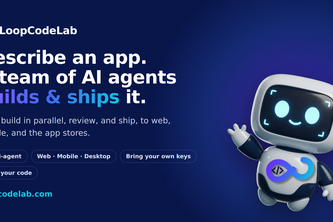
LoopCodeLab is a self-hosted platform that enables users to describe software projects in plain language and have AI agents autonomously build, review, and iterate on them. The system uses tmux sessions for persistent terminal access, Git worktrees for isolation, and a multi-agent orchestration engine to coordinate parallel development tasks.
What changed
The author describes an evolution from traditional AI coding tools that require constant user presence to a system where agents work autonomously while the user is offline, visible through a persistent web terminal. This represents a shift toward distributed, asynchronous AI-assisted software development.
The single most important open question
Does LoopCodeLab actually function as described, or is this a conceptual prototype with limited real-world utility? The description lacks evidence of working code, customer feedback, or performance metrics to validate its claims.
What The Product Actually Is
The description states that LoopCodeLab is:
- A self-hosted platform for AI-assisted software development
- Built around persistent tmux sessions accessible through a web terminal
- Uses Git worktrees and branches for agent isolation
- Includes an autonomous orchestrator (Ralph) that converts prompts into implementation plans
- Features multiple AI agents working in parallel on isolated branches
- Has a supervising agent that reviews changes before merging
- Operates with user-provided AI credentials from supported providers (Claude Code, Codex, Qwen)
- Runs on user infrastructure for data control and privacy
The system is described as converting project descriptions into structured development stories assigned to AI agents working in isolated Git worktrees.
Positioning & Claim Evolution
The author states that LoopCodeLab addresses a gap in current AI coding tools: "AI coding tools are powerful, but they assume you are at your desk or tethered to a single interface." This positioning evolved from a personal need during travel to create a system where agents can work autonomously while the user is offline.
The platform claims to resemble how engineering teams actually build software by enabling:
- Autonomous parallel work
- Clear boundaries between agents
- Review gates
- Persistent observation through terminal access
The evolution shows a move from "solitary assistants" to "coordinated teams of AI agents" working in isolation with clear oversight.
Target Customer & ICP
Not evidenced. The description does not identify specific customer segments, use cases, or target personas beyond the author's own experience as a developer traveling and needing autonomous AI assistance.
Business Model & Pricing Evidence
Not evidenced. The description makes no claims about pricing models, monetization strategies, or commercial arrangements. It only describes the technical architecture and functionality.
Technical & Delivery Signals
The description states that LoopCodeLab uses:
- Backend: Node.js, Express, WebSockets
- Frontend: React, Vite, Tailwind CSS, xterm.js, node-pty, tmux
- Orchestration engine: Git worktrees, tmux sessions, WebSockets for terminal bridging
- AI integration: Support for Claude Code, Codex, Qwen providers through abstraction layer
- Key technical features:
- Persistent web terminal connected to tmux sessions
- Git-tracked codebase with isolated branches and worktrees
- Autonomous agent coordination with review gates
- Failure recovery with monitoring and bounded retries
- Shared project logbook for consistency across builds
Traction & Maturity Signals
Not evidenced. The description lacks any evidence of revenue, customers, user adoption, or market traction beyond the author's personal development experience.
Competitive Context
Not evidenced. The description does not mention existing competitors, market positioning, or competitive advantages relative to other AI coding tools or development platforms.
Open Questions & Risks
- Unproven functionality: The description is entirely self-reported and lacks evidence of working software or real-world performance
- Technical complexity gap: The described system involves complex coordination of multiple agents, Git operations, and AI providers that may not integrate smoothly in practice
- Limited validation: No customer feedback, usage data, or performance metrics are provided to validate the claims
- Self-hosted assumption: The platform assumes users have infrastructure capabilities for self-hosting, which may limit adoption
- Single-person development: The team size is listed as 1, raising questions about scalability and maintenance of such a complex system
Questions the description leaves open
- What specific technical challenges remain in implementing the multi-agent coordination described?
- How does the system handle conflicts between agents working on the same codebase?
- What are the actual performance characteristics and reliability of the Git worktree isolation approach?
- Can you demonstrate a working prototype or proof-of-concept?
- What is the current state of integration with the supported AI providers (Claude Code, Codex, Qwen)?
- How does the system handle edge cases in agent failures or misinterpretations?
- What are the actual resource requirements for running LoopCodeLab on typical infrastructure?
Overall Assessment
Not evidenced. The description provides no information about financial performance, market opportunity, competitive positioning, or strategic fit that would inform an investment or partnership decision. The platform appears to be a conceptual prototype with limited evidence of commercial viability or traction.
User Stories BotA demo video on every pull request
Get a demo video on every new feature
GitHub App that watches your pull requests and records a narrated, captioned demo.
Save time on demo prep and make informed decisions faster with a video walkthrough of every new feature.
Source
Submitted to the OpenAI 2026 hackathon on Devpost. Project home on Devpost. Back to the full gallery on Devpost.
This competitive analysis was produced by top-founders.com (opens in a new tab)
Generated by a language model from this project's public Devpost page — its tagline, the author's own write-up and any built-with tags listed there — as captured in August 2026. Short quotations are the author's words. It is an opinion on the idea as a business, not on the people behind it, and it reflects the description as published then. If the project has moved on, request a correction below. The analysis is not independent research and contains no verified traction, revenue or customer data.
An independent guide by KFG International LLC — not affiliated with, endorsed by, or connected to Devpost or OpenAI.