

Archive position — measured, not model output
1 like on Devpost
505 of the 7,850 archived projects have more likes, and 1,758 share exactly 1 — so this project's #1,391 place in the like-ranked listing is a tie-break inside that group, not a ranking.
Projects (log scale)
Likes on Devpost. ▲ marks this project's group.
Show the figures
| Likes | Projects | Share of archive |
|---|---|---|
| 0 | 5,587 | 71.2% |
| 1 | 1,758 | 22.4% |
| 2 | 284 | 3.6% |
| 3–4 | 132 | 1.7% |
| 5–9 | 75 | 1.0% |
| 10+ | 14 | 0.2% |
 User Stories BotA demo video on every pull request
Get a demo video on every new feature
GitHub App that watches your pull requests and records a narrated, captioned demo.
Save time on demo prep and make informed decisions faster with a video walkthrough of every new feature.
Executive Summary
The description states that Loplat DOOH Audience Intelligence is a deployed geospatial product connecting 126 real digital billboards in Seoul with cell-level footfall and demographic insights. The author claims the project was built using OpenAI Codex, which assisted in data engineering, statistical modeling, validation, product design, security, and deployment — all by a single CEO over 7–10 days. The system supports audience analysis and media planning but does not claim direct campaign attribution.
This is a self-reported account of a proof-of-concept product built with AI assistance. No evidence of revenue, customers, or traction beyond the author’s own description is provided. The most important open question is whether this represents a scalable commercial offering or remains an experimental prototype.
What The Product Actually Is
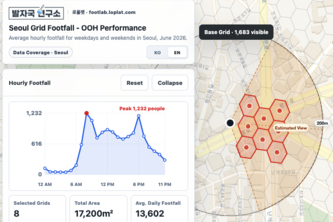
The description states that Loplat DOOH Audience Intelligence is a deployed geospatial product that connects 126 real digital billboards in Seoul with cell-level footfall and demographic insights. Users can select a billboard, inspect its image and media details, and choose nearby H3 cells to analyze:
- Hourly weekday and weekend footfall
- Estimated age and gender distributions
- Combined audiences across multiple selected cells
- Billboard dimensions, street context, and estimated viewing direction
The product serves approximately 336,000 weekday footfall cells, 323,000 weekend cells, and 55,000 demographic cells per period.
Positioning & Claim Evolution
The description states that the project began as a response to a real business question: whether Loplat’s mobility data could help solve the audience measurement gap in digital out-of-home advertising. It positions itself as a tool for media planning and audience analysis rather than campaign attribution.
It evolved from an initial feasibility study into a full product, integrating footfall and demographic data into one interface with real billboard imagery and viewing context. The author notes that Codex helped accelerate development across multiple domains without losing the original business objective.
Target Customer & ICP
The description states that the target users are advertisers and media owners who need better evidence about who is present around a screen, when footfall peaks, and how audiences change over time. It supports audience analysis and media planning rather than direct campaign attribution.
No explicit customer segments or personas are defined beyond this general use case.
Business Model & Pricing Evidence
Not evidenced. The description does not state any pricing model, monetization strategy, or business model details.
Technical & Delivery Signals
The description states that the product was built using GPT-5.6 (Codex) and involved:
- BigQuery extraction and filtering
- H3 footfall and demographic modeling
- Automated and human validation
- Protected aggregation API
- Interactive dashboard
- Browser QA and Cloud Run deployment
It also mentions challenges such as distinguishing presence from movement, estimating demographics responsibly, and combining spatial resolutions. The system maps H3 resolution 11 cells for footfall and H3 resolution 10 for demographics.
Traction & Maturity Signals
The description states that the product is deployed and serves approximately 336,000 weekday footfall cells, 323,000 weekend cells, and 55,000 demographic cells per period. It was built in 7–10 days by one CEO with Codex assistance.
No evidence of revenue, customer adoption, or usage metrics beyond the author’s own account is provided.
Competitive Context
Not evidenced. The description does not mention competitors or market positioning relative to other solutions in the digital out-of-home (DOOH) audience intelligence space.
Open Questions & Risks
- The product is described as built by a single person using AI tools, raising questions about scalability and institutional knowledge.
- No evidence of revenue, customers, or traction beyond the author’s own description.
- The system uses raw mobility data from Loplat, which may raise privacy or data governance concerns if not properly anonymized or governed.
- The use of Codex for full-stack development raises uncertainty around quality control, reproducibility, and long-term maintainability.
Questions the description leaves open
- What is the source of the mobility data used? Is it anonymized and compliant with privacy regulations?
- How was the demographic modeling validated beyond human review?
- Are there plans to expand this product beyond Seoul or to other markets?
- What are the key assumptions underlying the footfall and demographic estimates?
- Has the team considered how to scale beyond a single person working with AI tools?
Overall Assessment
Not evidenced. The description does not provide sufficient information about financials, traction, or commercial viability to assess investment or partnership potential. The product appears to be an experimental prototype built quickly using AI assistance, but there is no evidence of market validation or scalability beyond the initial deployment in Seoul.
User Stories BotA demo video on every pull request
Get a demo video on every new feature
GitHub App that watches your pull requests and records a narrated, captioned demo.
Save time on demo prep and make informed decisions faster with a video walkthrough of every new feature.
Source
Submitted to the OpenAI 2026 hackathon on Devpost. Project home on Devpost. Back to the full gallery on Devpost.
This competitive analysis was produced by top-founders.com (opens in a new tab)
Generated by a language model from this project's public Devpost page — its tagline, the author's own write-up and any built-with tags listed there — as captured in August 2026. Short quotations are the author's words. It is an opinion on the idea as a business, not on the people behind it, and it reflects the description as published then. If the project has moved on, request a correction below. The analysis is not independent research and contains no verified traction, revenue or customer data.
An independent guide by KFG International LLC — not affiliated with, endorsed by, or connected to Devpost or OpenAI.