

Archive position — measured, not model output
0 likes on Devpost
2,263 of the 7,850 archived projects have more likes, and 5,587 share exactly 0 — so this project's #5,066 place in the like-ranked listing is a tie-break inside that group, not a ranking.
Projects (log scale)
Likes on Devpost. ▲ marks this project's group.
Show the figures
| Likes | Projects | Share of archive |
|---|---|---|
| 0 | 5,587 | 71.2% |
| 1 | 1,758 | 22.4% |
| 2 | 284 | 3.6% |
| 3–4 | 132 | 1.7% |
| 5–9 | 75 | 1.0% |
| 10+ | 14 | 0.2% |
 User Stories BotA demo video on every pull request
Get a demo video on every new feature
GitHub App that watches your pull requests and records a narrated, captioned demo.
Save time on demo prep and make informed decisions faster with a video walkthrough of every new feature.
Executive Summary
What the company appears to be
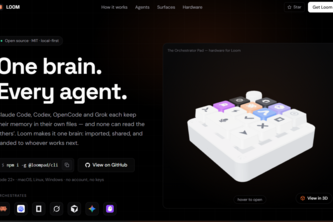
LoomPad.tech is a self-reported project by one individual (Nivesh Gajengi) that describes itself as an "orchestrator" for Agentic Development Environments (ADEs), such as Claude Code, Codex, and others. It aims to provide shared memory across these tools and a physical hardware device — the Orchestrator Pad — to interact with them via voice and key presses.
What changed
The project was submitted to the OpenAI 2026 hackathon. The author states it was built in a short timeframe, using Codex for development, and includes both software (daemon, CLI, GUIs) and hardware (ESP32-S3-based macropad). It is described as local-first, open source, and designed to allow switching between ADEs with voice or key input.
Single most important open question
Is there any evidence of real usage, adoption, or traction beyond the author’s own development and demo?
What The Product Actually Is
The description states that LoomPad.tech is a local-first orchestrator for Agentic Development Environments (ADEs). It claims to:
- Provide a shared brain across multiple ADEs by importing their native memory into shared units.
- Enable real handoffs between agents, visualized in a shared thread.
- Offer multiple surfaces: CLI, TUI, web GUI, desktop app, and mobile app — all connected to the same live thread.
- Include a hardware companion, the Orchestrator Pad (LoomPad), which is an ESP32-S3-based voice macropad with a key matrix and microphone.
The software core is built in TypeScript/Node.js with Express and WebSocket. The hardware is described as parametric CAD in Python, firmware in Arduino/C++, and uses components like I²S mic, Tailscale for networking, and TLS security.
Inference: The product appears to be a proof-of-concept or prototype built for a hackathon, not yet a commercial offering.
Positioning & Claim Evolution
The author states that the project was inspired by frustration with switching between ADEs, which each maintain their own memory. The core claim is:
- One shared brain across multiple ADEs.
- Physical handoffs via a hardware pad using voice or key presses.
The positioning evolves from a developer tool to a local-first, open-source solution for managing agent interactions in coding environments. It also implies a multi-surface experience, with web, desktop, and mobile apps.
Inference: The positioning is focused on developer workflow optimization and interoperability between ADEs, but no evidence of market traction or customer feedback is provided.
Target Customer & ICP
The description states that the project targets users of Agentic Development Environments (ADEs) such as Claude Code, Codex, OpenCode, Grok Code, Antigravity, and Kiro. It also mentions a focus on developers who use these tools in their workflow.
It does not state whether the target is individual developers or teams, nor does it define specific personas or use cases beyond general ADE users.
Inference: The ICP appears to be early-stage developers or power users of ADEs, but no evidence of customer segmentation or feedback exists.
Business Model & Pricing Evidence
The description does not provide any information about pricing, monetization, or business model. It is described as local-first and open source, with no mention of paid features or services.
Inference: No commercial model is evident from the self-reported description.
Technical & Delivery Signals
The project is built using a wide range of technologies:
- Backend: TypeScript, Node.js, Express, WebSocket
- Frontend: React, React Native, Next.js, Electron, Three.js, WebGL
- Hardware: ESP32-S3, Arduino/C++, I²S mic, Python (Shapely + NumPy), GLTF
- Voice backend: Groq (Whisper STT + LLM), Deepgram (TTS)
- Networking: Tailscale, WiFiManager, TLS with pinned root cert
The author notes that the project was largely built using Codex itself — including CAD, CLI, GUI, and mobile app.
Inference: The technical stack is diverse and cross-platform, but there is no evidence of production deployment or scalability beyond a hackathon prototype.
Traction & Maturity Signals
The description states:
- It was submitted to the OpenAI 2026 hackathon.
- A live site exists at loompad.tech with an interactive 3D model and STLs for printing.
- The CLI can be installed via
npm i -g threadloom. - There is a waitlist for future features.
- It includes demo video, GitHub repos, and downloadable assets.
However, there is no evidence of:
- Revenue
- Customers or users
- Adoption metrics
- Product usage data
Inference: The project shows maturity in prototype form but lacks any traction or user validation.
Competitive Context
The description does not mention competitors. It focuses on the interoperability challenge between ADEs, which is a growing space with tools like:
- Agent frameworks (e.g., AutoGen, CrewAI)
- IDE integrations
- Memory management systems (e.g., mem0)
But no direct comparison or competitive positioning is made.
Inference: The competitive landscape is not described, and there is no evidence of market analysis or differentiation from existing tools.
Open Questions & Risks
- No revenue or customer data: The project is self-reported and lacks any evidence of commercial traction.
- Single-person team: Only one member (Nivesh Gajengi) is listed, raising questions about scalability.
- Hackathon prototype: Built for a hackathon, not yet validated in production use.
- Hardware complexity: The ESP32-S3-based hardware faced issues like brownouts and power management — suggesting potential reliability concerns.
- Open-source and local-first: While appealing, this may limit monetization and adoption without clear commercial incentives.
Inference: The project is a prototype with no evidence of real-world use or commercial viability.
Questions the description leaves open
- What is the actual user base or feedback from developers using this?
- How does the shared memory system handle conflicts or data loss between ADEs?
- Is there any plan to monetize or scale beyond a hackathon prototype?
- What are the technical challenges in scaling the hardware and software for real-world use?
- Are there any partnerships or integrations with existing ADEs or platforms?
- How does the local-first approach handle security and compliance at scale?
Overall Assessment
The project is described as a hackathon prototype built by one person, with no evidence of revenue, customers, or traction. It is local-first, open-source, and multi-surface, but lacks commercial validation.
Assessment: Not ready for investment or partnership at this stage. The product shows technical ambition and potential in a growing space, but there is no demonstrated market need or adoption.
Confidence level: Low — based on self-reported evidence only, with no external validation or traction data.
User Stories BotA demo video on every pull request
Get a demo video on every new feature
GitHub App that watches your pull requests and records a narrated, captioned demo.
Save time on demo prep and make informed decisions faster with a video walkthrough of every new feature.
Source
Submitted to the OpenAI 2026 hackathon on Devpost. Project home on Devpost. Back to the full gallery on Devpost.
This competitive analysis was produced by top-founders.com (opens in a new tab)
Generated by a language model from this project's public Devpost page — its tagline, the author's own write-up and any built-with tags listed there — as captured in August 2026. Short quotations are the author's words. It is an opinion on the idea as a business, not on the people behind it, and it reflects the description as published then. If the project has moved on, request a correction below. The analysis is not independent research and contains no verified traction, revenue or customer data.
An independent guide by KFG International LLC — not affiliated with, endorsed by, or connected to Devpost or OpenAI.