

Archive position — measured, not model output
0 likes on Devpost
2,263 of the 7,850 archived projects have more likes, and 5,587 share exactly 0 — so this project's #5,043 place in the like-ranked listing is a tie-break inside that group, not a ranking.
Projects (log scale)
Likes on Devpost. ▲ marks this project's group.
Show the figures
| Likes | Projects | Share of archive |
|---|---|---|
| 0 | 5,587 | 71.2% |
| 1 | 1,758 | 22.4% |
| 2 | 284 | 3.6% |
| 3–4 | 132 | 1.7% |
| 5–9 | 75 | 1.0% |
| 10+ | 14 | 0.2% |
 User Stories BotA demo video on every pull request
Get a demo video on every new feature
GitHub App that watches your pull requests and records a narrated, captioned demo.
Save time on demo prep and make informed decisions faster with a video walkthrough of every new feature.
Executive Summary
What the company appears to be
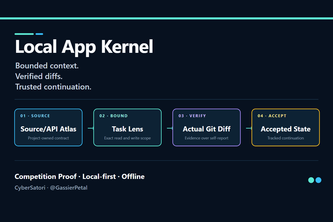
The author describes Local App Kernel as a system designed to help coding agents work within bounded, task-specific contexts in software projects. It aims to prevent misalignment between agent actions and project structure by enforcing architectural boundaries, verifying Git diffs, and ensuring that changes are scoped correctly.
What changed
This submission is a "clean-room Competition Proof" of one lifecycle slice of what the author envisions as a broader system — Local App Kernel V1. It represents an executable demonstration of core concepts but not a complete product or versioned release.
Single most important open question
Is there evidence that this concept has traction, adoption, or commercial viability beyond the author’s own experience and prototype?
Note: This analysis is based entirely on self-reported information from the project description. No external validation, revenue data, customer names, or third-party sources are available.
What The Product Actually Is
The description states that Local App Kernel turns a configured Source/API Atlas into a bounded route for a coding agent. It includes:
- A real source scan
- A bounded Task Lens
- Controlled code change
- Actual Git diff discovery
- Architecture and focused checks
- Accepted local commit
- Completion Log and Current Block Summary
- Continuation from a fresh process or clone
It is described as not trusting the agent’s self-report of changes, instead deriving actual changed-file sets from Git.
Inference: The system appears to be a developer tool that enforces context boundaries for AI agents working on codebases. It is built in JavaScript using Node.js and Git, with no third-party runtime dependencies.
Positioning & Claim Evolution
The author claims the product addresses a personal problem: confusion during development due to mixed sources of truth and lack of context. The evolution from that initial pain point led to:
- A system that prevents project responsibilities from becoming mixed
- A focus on limited context for coding agents
- An emphasis on task-specific views over full repository exploration
The author also notes that the solution is not to place an entire large repository inside one context window, but rather to give the agent a small, project-owned, task-specific view answering three questions:
- What already exists?
- Where is the project now?
- What exactly should happen next?
Claim: The positioning centers on solving AI agent drift and misalignment in software development workflows.
Target Customer & ICP
The description does not explicitly name target customers or personas. However, it implies a user base of:
- Developers working with coding agents (e.g., ChatGPT)
- Teams managing complex codebases where context and architectural integrity matter
- Anyone who has experienced confusion or misalignment when using AI tools in development environments
Inference: The ICP likely includes developers or engineering teams seeking to integrate AI into their workflows while maintaining control over project structure and change scope.
Business Model & Pricing Evidence
No evidence of pricing, monetization strategy, or business model is provided. The submission is a proof-of-concept for a hackathon competition.
Not evidenced
Technical & Delivery Signals
The system is implemented in JavaScript using Node.js ESM, Git, and node:test. It has no third-party runtime dependencies, requires no API key, and does not need network access during normal execution.
Key technical decisions include:
- Use of a project-owned Source/API Atlas
- Bounded Task Lens instead of broad repository exploration
- Discovery of actual diff through Git rather than agent self-report
- Permitting only one bounded active task
- Failure on duplicate implementation, scope violations, forbidden dependencies, and stale verification
- Persistence of accepted project state in Git-tracked records
Inference: The system is designed to be local-first, offline-capable, and free of cloud dependencies. It emphasizes correctness over convenience.
Traction & Maturity Signals
There is no evidence of revenue, customers, or adoption beyond the author’s own experience and prototype development.
The submission is described as a "clean-room Competition Proof" of one lifecycle slice — not a full system or versioned release.
Not evidenced
Competitive Context
No mention of competitors or competitive landscape. The description does not reference similar tools or platforms in the AI-assisted development space.
Not evidenced
Open Questions & Risks
- Unproven commercial viability: No evidence of traction, customers, or revenue.
- Limited scope: This is a proof-of-concept for one lifecycle slice; the full system remains unspecified.
- Self-reported only: All claims are unverified and based on author’s own account.
- No external validation: No third-party reviews, audits, or user feedback.
- Single-person team: The project is built by one individual, raising questions about scalability and long-term maintenance.
Inference: The risk of misalignment between stated goals and real-world utility is high due to lack of evidence.
Questions the description leaves open
- What specific problems in current AI-assisted development workflows does Local App Kernel aim to solve?
- How does the system handle edge cases or unexpected behavior beyond those covered in the demo?
- Are there any plans for integrating with existing IDEs, CI/CD pipelines, or version control systems?
- Has the author tested this concept with other developers or teams outside of personal use?
- What are the key assumptions underlying the design choices (e.g., reliance on Git, local-first approach)?
- How does the system scale to larger projects or more complex architectures?
Overall Assessment
There is no evidence of a functioning product, revenue, customers, or market traction. The submission is a proof-of-concept for a hackathon competition and represents only one slice of what may become a larger system.
Confidence Level: Low
Assessment: Not ready for investment or partnership consideration without further demonstration of traction, validation, or product-market fit.
User Stories BotA demo video on every pull request
Get a demo video on every new feature
GitHub App that watches your pull requests and records a narrated, captioned demo.
Save time on demo prep and make informed decisions faster with a video walkthrough of every new feature.
Source
Submitted to the OpenAI 2026 hackathon on Devpost. Project home on Devpost. Back to the full gallery on Devpost.
This competitive analysis was produced by top-founders.com (opens in a new tab)
Generated by a language model from this project's public Devpost page — its tagline, the author's own write-up and any built-with tags listed there — as captured in August 2026. Short quotations are the author's words. It is an opinion on the idea as a business, not on the people behind it, and it reflects the description as published then. If the project has moved on, request a correction below. The analysis is not independent research and contains no verified traction, revenue or customer data.
An independent guide by KFG International LLC — not affiliated with, endorsed by, or connected to Devpost or OpenAI.