

Archive position — measured, not model output
0 likes on Devpost
2,263 of the 7,850 archived projects have more likes, and 5,587 share exactly 0 — so this project's #4,997 place in the like-ranked listing is a tie-break inside that group, not a ranking.
Projects (log scale)
Likes on Devpost. ▲ marks this project's group.
Show the figures
| Likes | Projects | Share of archive |
|---|---|---|
| 0 | 5,587 | 71.2% |
| 1 | 1,758 | 22.4% |
| 2 | 284 | 3.6% |
| 3–4 | 132 | 1.7% |
| 5–9 | 75 | 1.0% |
| 10+ | 14 | 0.2% |
 User Stories BotA demo video on every pull request
Get a demo video on every new feature
GitHub App that watches your pull requests and records a narrated, captioned demo.
Save time on demo prep and make informed decisions faster with a video walkthrough of every new feature.
Executive Summary
What the company appears to be: Lineage is a self-reported local-first visual workspace designed for creative teams working with AI agents. The author states it enables humans and agents to collaborate on visual work, maintaining a shared, durable creative state that preserves history and provides precise context for agents.
What changed: This project was submitted as part of the OpenAI 2026 hackathon. It represents an early-stage concept or prototype focused on human-agent collaboration in creative workflows. The description indicates development using Codex/GPT-5.6 Sol, React, Node.js, and SQLite.
Single most important open question: Is there evidence of traction, revenue, or customer adoption beyond the author's own account? The self-reported nature of all information makes it impossible to assess commercial viability or market demand without further data.
What The Product Actually Is
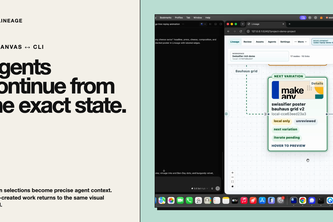
The description states that Lineage is a local-first TypeScript and React application with a Node.js/Express backend and SQLite-backed workspace state. It includes:
- Visual lineage graphs
- Re-roll history
- Target-scoped agent claims
- Task queues
- Durable selection packets
- Isolated stable, preview, and development runtime channels
It is described as a shared visual workspace where humans and agents create, review, and evolve creative assets together.
The author also notes that it was built using Codex with GPT-5.6 Sol, which helped in designing, implementing, testing, and hardening the human-agent workflow.
Confidence: Low — this is entirely self-reported, and no independent verification exists.
Positioning & Claim Evolution
The author states:
- Creative teams increasingly work with AI agents, but context behind assets gets scattered across chats, folders, prompts, and disconnected iterations.
- Lineage aims to provide a workspace where creative work stays understandable to people while remaining precise enough for an agent to continue accurately.
- It allows humans to trace an asset from origin through branches, re-roll attempts, selections, and final formats.
- Agents can retrieve exact asset, prompt, relationships, selections, and instructions via CLI rather than restarting from vague chat summaries.
Inference: The positioning appears to be a solution for human-agent collaboration in creative workflows, particularly around visual design or content creation. It claims to address fragmentation in current AI-assisted creative processes by offering a structured, shared workspace.
Confidence: Low — this is a claim made by the author, not verified.
Target Customer & ICP
The description states that Lineage targets creative teams working with AI agents, particularly those who need:
- A durable creative history
- Precise context for agents
- Shared visual records of work
It also mentions that humans can trace assets through branches and iterations, while agents access exact context via CLI.
Inference: The ICP likely includes designers, content creators, or creative professionals who collaborate with AI tools in local environments, especially those using generative AI for visual output.
Confidence: Low — no explicit customer segmentation or market data provided.
Business Model & Pricing Evidence
Not evidenced. No mention of pricing, monetization strategy, or business model in the self-reported description.
Technical & Delivery Signals
The author states:
- Built with Node.js/Express, React, SQLite, TypeScript
- Uses Codex with GPT-5.6 Sol for development
- Includes features like:
- Visual lineage graphs
- Re-roll history
- Task queues
- Durable selection packets
- Isolated runtime channels
The project is described as a local-first application, suggesting it does not rely on cloud infrastructure or SaaS delivery.
Inference: The technical stack and architecture suggest a developer-focused, local-first tool with potential for integration into creative workflows involving AI agents.
Confidence: Low — this is self-reported, and no independent validation of the tech stack or delivery model exists.
Traction & Maturity Signals
Not evidenced. No data on:
- Revenue
- Customers
- Usage metrics
- Product adoption
- Market traction
The project was submitted to a hackathon, indicating early-stage development.
Confidence: Very low — no evidence of traction or maturity beyond the author's own account.
Competitive Context
Not evidenced. No mention of competitors, market positioning, or competitive landscape in the self-reported description.
Open Questions & Risks
- Self-reported only: All information is unverified and lacks third-party corroboration.
- No traction or revenue data: The project appears to be a prototype or hackathon submission with no evidence of commercial adoption.
- Limited team size: Only one member (Jeremy Watt) is listed, raising questions about execution capacity or scalability.
- Unproven market demand: No indication that the described need for such a tool has been validated by users or customers.
- Unclear monetization path: No business model or pricing structure provided.
Confidence: Medium — based on the lack of evidence and limited scope of the project, these are likely real risks, but they cannot be confirmed without further data.
Questions the description leaves open
- What specific creative workflows does Lineage aim to improve? Can you describe a typical user journey?
- How do you plan to validate market demand for this tool?
- Are there any early adopters or pilot users of the product?
- What is your roadmap for moving from prototype to scalable product?
- How do you intend to monetize Lineage, if at all?
- What are the key technical challenges that remain unresolved in the current version?
- What are the main differences between Lineage and existing tools in this space?
Overall Assessment
Not evidenced.
The self-reported description indicates a concept or prototype submitted to a hackathon, with no evidence of traction, revenue, or customer adoption. The author’s claims about product functionality and positioning are unverified.
Confidence: Very low — this is not a commercial entity or product with demonstrated market fit or viability. It may be an idea in early development, but there is no basis to assess its potential for investment or partnership at this stage.
User Stories BotA demo video on every pull request
Get a demo video on every new feature
GitHub App that watches your pull requests and records a narrated, captioned demo.
Save time on demo prep and make informed decisions faster with a video walkthrough of every new feature.
Source
Submitted to the OpenAI 2026 hackathon on Devpost. Project home on Devpost. Back to the full gallery on Devpost.
This competitive analysis was produced by top-founders.com (opens in a new tab)
Generated by a language model from this project's public Devpost page — its tagline, the author's own write-up and any built-with tags listed there — as captured in August 2026. Short quotations are the author's words. It is an opinion on the idea as a business, not on the people behind it, and it reflects the description as published then. If the project has moved on, request a correction below. The analysis is not independent research and contains no verified traction, revenue or customer data.
An independent guide by KFG International LLC — not affiliated with, endorsed by, or connected to Devpost or OpenAI.