

Archive position — measured, not model output
0 likes on Devpost
2,263 of the 7,850 archived projects have more likes, and 5,587 share exactly 0 — so this project's #4,999 place in the like-ranked listing is a tie-break inside that group, not a ranking.
Projects (log scale)
Likes on Devpost. ▲ marks this project's group.
Show the figures
| Likes | Projects | Share of archive |
|---|---|---|
| 0 | 5,587 | 71.2% |
| 1 | 1,758 | 22.4% |
| 2 | 284 | 3.6% |
| 3–4 | 132 | 1.7% |
| 5–9 | 75 | 1.0% |
| 10+ | 14 | 0.2% |
 User Stories BotA demo video on every pull request
Get a demo video on every new feature
GitHub App that watches your pull requests and records a narrated, captioned demo.
Save time on demo prep and make informed decisions faster with a video walkthrough of every new feature.
Executive Summary
What the company appears to be
LineageReceipt is a self-reported developer tool for ML release governance that integrates with DataHub. It reads model lineage, applies deterministic rules, and writes immutable receipts back to DataHub. The project was built as a submission to the OpenAI Build Week 2026 hackathon.
What changed
The author states this was developed during the OpenAI Build Week 2026 period using Codex and GPT-5.6. It is presented as a proof-of-concept for an ML release decision system that writes evidence-based receipts back to DataHub.
Single most important open question
Is there any evidence of real-world adoption, usage or traction beyond the hackathon submission?
What The Product Actually Is
The description states that LineageReceipt:
- Reads a model's DataHub lineage
- Checks deterministic release rules
- Produces an immutable receipt
- Writes assessment, receipt ID, digest, and gap IDs back to DataHub ML model custom properties
- Reads them back for verification
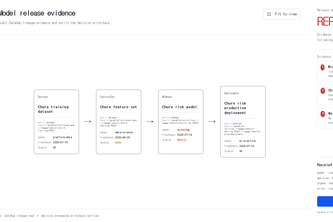
- Renders a four-node lineage chain (training dataset, feature set, ML model, production deployment)
- Uses the official acryl-datahub SDK to upsert a synthetic DataHub graph
- Contains a dependency-free deterministic rule engine
- Is built with React/Vite UI and Python adapter
The product is described as a tool for "evidence-first" ML release decisions. It is presented as a system that makes release decisions auditable by preserving URNs and verifying write-back properties from DataHub.
Evidence strength The description provides a technical breakdown of how the system works, but no evidence of actual use or adoption beyond the hackathon submission.
Positioning & Claim Evolution
The author states:
- ML release decisions often fail at the last mile due to scattered evidence around training data, freshness, ownership, and rollback path
- LineageReceipt turns that evidence into a small, inspectable release decision
- It blocks unsafe releases and writes deterministic repair receipts back to the model
- The system is built for "evidence-first" ML governance
The positioning appears to be:
- A solution to the problem of scattered ML release evidence
- An audit-ready system that makes decisions inspectable
- A tool that prevents unsafe releases by enforcing rules
- A deterministic approach to model release decisions
Evidence strength The claims are self-reported and focused on a conceptual framework rather than demonstrated traction or results.
Target Customer & ICP
The description does not state who the target customer is, nor does it define an Ideal Customer Profile (ICP). It implies that the tool is for ML teams using DataHub, but no specific customer segments are identified.
Evidence strength Not evidenced. No information on target customers or personas.
Business Model & Pricing Evidence
The description does not provide any evidence of a business model or pricing structure. The project is presented as a hackathon submission with no mention of monetization, licensing, or commercial use cases.
Evidence strength Not evidenced. No indication of how the tool would be sold or used commercially.
Technical & Delivery Signals
The description states:
- Built with React/Vite UI
- Uses Python adapter and JavaScript engine
- Integrates with DataHub via acryl-datahub SDK
- Contains a dependency-free deterministic rule engine
- Repository is public under Apache-2.0 license
- No production data or credentials included
- The system uses synthetic fixtures for testing
- The demo intentionally returns REPAIR when model owner is missing, feature set is stale, or no rollback runbook is linked
The project is described as a proof-of-concept built during a hackathon period with Codex and GPT-5.6.
Evidence strength Some technical details provided, but no evidence of production readiness or scalability.
Traction & Maturity Signals
There is no evidence of traction, revenue, customers, or adoption beyond the hackathon submission. The project is described as a demo for OpenAI Build Week 2026 and contains no information about usage in real-world environments or production systems.
Evidence strength Not evidenced. No signs of product-market fit or real-world use.
Competitive Context
The description does not mention any competitors or competitive landscape. It does not state how LineageReceipt compares to other tools in the ML governance or DataHub space.
Evidence strength Not evidenced. No competitive positioning or market analysis provided.
Open Questions & Risks
- The project is a hackathon submission with no evidence of real-world usage
- No revenue, customer, or traction data available
- The system uses synthetic fixtures and does not include production credentials
- The tool is described as a proof-of-concept, not a production-ready solution
- No indication of how it would scale or integrate into existing workflows beyond DataHub
Evidence strength Inferences based on the lack of evidence for real-world use.
Questions the description leaves open
- What specific ML release problems are you solving in practice?
- How does LineageReceipt differ from existing tools in the ML governance space?
- Have you tested this system with real production data or workflows?
- What is your plan for transitioning from a hackathon demo to a commercial product?
- Are there any customers or users currently using this tool?
- How do you intend to monetize this solution?
Evidence strength These are questions that would help clarify the lack of evidence in the description.
Overall Assessment
The project is presented as a hackathon submission with no evidence of traction, revenue, or customer adoption. It is described as a proof-of-concept for an ML release decision system that integrates with DataHub. There is no indication of commercial viability or scalability beyond the demo.
Evidence strength Not evidenced. No signs of product-market fit, revenue, or real-world usage. The tool appears to be in early-stage development and lacks any commercial signals.
User Stories BotA demo video on every pull request
Get a demo video on every new feature
GitHub App that watches your pull requests and records a narrated, captioned demo.
Save time on demo prep and make informed decisions faster with a video walkthrough of every new feature.
Source
Submitted to the OpenAI 2026 hackathon on Devpost. Project home on Devpost. Back to the full gallery on Devpost.
This competitive analysis was produced by top-founders.com (opens in a new tab)
Generated by a language model from this project's public Devpost page — its tagline, the author's own write-up and any built-with tags listed there — as captured in August 2026. Short quotations are the author's words. It is an opinion on the idea as a business, not on the people behind it, and it reflects the description as published then. If the project has moved on, request a correction below. The analysis is not independent research and contains no verified traction, revenue or customer data.
An independent guide by KFG International LLC — not affiliated with, endorsed by, or connected to Devpost or OpenAI.