

Archive position — measured, not model output
1 like on Devpost
505 of the 7,850 archived projects have more likes, and 1,758 share exactly 1 — so this project's #1,075 place in the like-ranked listing is a tie-break inside that group, not a ranking.
Projects (log scale)
Likes on Devpost. ▲ marks this project's group.
Show the figures
| Likes | Projects | Share of archive |
|---|---|---|
| 0 | 5,587 | 71.2% |
| 1 | 1,758 | 22.4% |
| 2 | 284 | 3.6% |
| 3–4 | 132 | 1.7% |
| 5–9 | 75 | 1.0% |
| 10+ | 14 | 0.2% |
 User Stories BotA demo video on every pull request
Get a demo video on every new feature
GitHub App that watches your pull requests and records a narrated, captioned demo.
Save time on demo prep and make informed decisions faster with a video walkthrough of every new feature.
Executive Summary
What the company appears to be
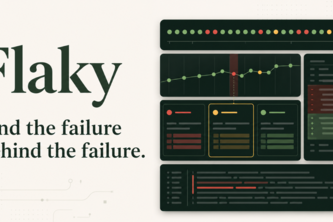
Flaky is a developer tool designed to identify and explain the root causes of "flaky" (nondeterministic) tests in CI environments. The product is described as a single-page, locally installable web application built with Next.js, TypeScript, and Tailwind CSS, using AI (Gemini 3.5) for diagnosis and fix generation.
What changed
The project was submitted to the OpenAI 2026 hackathon by one developer, Sahil Das. It is a self-contained prototype that simulates CI run data and uses AI to analyze test failures and suggest fixes. No commercial product or customer base is evidenced.
The single most important open question
Is there evidence of real-world usage, traction, or demand for this tool beyond the hackathon prototype?
Note: This analysis is based entirely on the self-reported description provided by the author. All claims are unverified and should be treated as stated by the project owner, not proven facts.
What The Product Actually Is
The description states that Flaky is a developer tool for analyzing CI run history to detect tests that produce inconsistent outcomes on the same commit. It combines test source code, error output, timing, execution order, and parallel-run metadata to identify likely causes such as race conditions or shared state.
It uses AI (Gemini 3.5 Flash) to explain evidence, recommend fixes, and generate quarantine PR descriptions when needed. The dashboard tracks flakiness scores and trends across commits.
The tool is built as a single Next.js App Router application using TypeScript and Tailwind CSS. It runs locally with seeded CI data and does not require an external database setup.
Inference: Based on the description, Flaky appears to be a local prototype for developers to simulate and analyze flaky tests in their CI pipeline. It is not described as a hosted SaaS product or integrated into existing CI systems.
Positioning & Claim Evolution
The author states that most CI tools only report test failures without explaining why they behave nondeterministically. Flaky aims to turn inconsistent test results into actionable root-cause investigations.
It positions itself as a tool for engineering teams to reduce time spent on flaky tests by providing AI-powered diagnostics and concrete next steps.
Inference: The positioning is focused on solving a specific pain point in CI workflows—flaky tests—and leveraging AI to automate diagnosis. However, the description does not indicate any prior market validation or customer feedback beyond the hackathon context.
Target Customer & ICP
The description implies that Flaky targets software engineers and development teams working with continuous integration pipelines, particularly those dealing with flaky tests.
It is described as a tool for developers to analyze test behavior locally, suggesting it may be aimed at individual developers or small engineering teams rather than enterprise-level CI/CD platforms.
Inference: The ICP likely includes developers or DevOps engineers in small to mid-sized teams who encounter flaky tests and want automated help diagnosing them. No evidence of segmentation or targeting larger enterprises is provided.
Business Model & Pricing Evidence
There is no evidence in the description of a business model, pricing strategy, or monetization approach.
The tool is described as a local prototype with seeded data, and there are no mentions of subscriptions, usage fees, or paid features.
Claim: The author does not state how Flaky would be sold or whether it will be commercialized beyond the hackathon submission.
Technical & Delivery Signals
Flaky is built as a single-page Next.js application using TypeScript and Tailwind CSS. It uses local JSON storage and requires no external database setup.
AI processing is powered by Gemini 3.5 Flash, with fallback to Gemini 3.1 Flash-Lite during overloads. The AI outputs are structured via JSON schemas, validated, and attributed to the model used.
The app includes a deterministic demo mode that allows it to run without an API key.
Inference: The technical stack suggests a lightweight, developer-focused tool built for ease of use and reproducibility. It is not described as scalable or integrated into CI systems beyond simulation.
Traction & Maturity Signals
There is no evidence of traction, revenue, customers, or adoption beyond the hackathon submission.
The project is described as a prototype with seeded data and simulated runs. No real-world usage or performance metrics are provided.
Claim: The tool has not been deployed in production environments or used by external users.
Competitive Context
The description does not mention competitors or similar tools in the market for flaky test detection or CI diagnostics.
It is unclear whether other tools exist that address this specific problem, or if Flaky fills a gap in the current market.
Inference: No competitive analysis is provided. The tool may be unique or part of a niche within CI/CD tooling, but no evidence supports either claim.
Open Questions & Risks
- No commercial traction or product-market fit evidence: The project is described as a hackathon submission with no real-world usage.
- Limited scope and integration: It runs locally and simulates data; no integration with CI systems is mentioned.
- Unproven AI reliability: While structured outputs are described, there is no evidence of how reliable or accurate the AI diagnostics are in practice.
- Single-person team: The project was built by one developer, which may limit scalability or long-term development capacity.
Inference: The tool is unproven and lacks any commercial or user validation. It appears to be a proof-of-concept rather than a product ready for market.
Questions the description leaves open
- What real-world CI environments have you tested Flaky against? Have you seen it used by actual engineering teams?
- How does Flaky handle edge cases or ambiguous test failures that are not clearly flaky?
- Are there any plans to integrate with existing CI platforms like GitHub Actions, Jenkins, or CircleCI?
- What is the expected user journey from detecting a flaky test to applying a fix? Is this fully automated or still requires manual intervention?
- How do you plan to scale beyond the current local prototype and make it accessible for teams?
Overall Assessment
Not evidenced: There is no evidence of revenue, traction, or market validation to support an investment or partnership decision.
This project appears to be a hackathon prototype with limited commercial potential at this stage. It lacks any indication of product-market fit, customer demand, or scalability beyond its current form.
Inference: Without further development, user feedback, or integration into real CI pipelines, Flaky is not ready for investment or partnership consideration.
User Stories BotA demo video on every pull request
Get a demo video on every new feature
GitHub App that watches your pull requests and records a narrated, captioned demo.
Save time on demo prep and make informed decisions faster with a video walkthrough of every new feature.
Source
Submitted to the OpenAI 2026 hackathon on Devpost. Project home on Devpost. Back to the full gallery on Devpost.
This competitive analysis was produced by top-founders.com (opens in a new tab)
Generated by a language model from this project's public Devpost page — its tagline, the author's own write-up and any built-with tags listed there — as captured in August 2026. Short quotations are the author's words. It is an opinion on the idea as a business, not on the people behind it, and it reflects the description as published then. If the project has moved on, request a correction below. The analysis is not independent research and contains no verified traction, revenue or customer data.
An independent guide by KFG International LLC — not affiliated with, endorsed by, or connected to Devpost or OpenAI.