

Archive position — measured, not model output
1 like on Devpost
505 of the 7,850 archived projects have more likes, and 1,758 share exactly 1 — so this project's #1,076 place in the like-ranked listing is a tie-break inside that group, not a ranking.
Projects (log scale)
Likes on Devpost. ▲ marks this project's group.
Show the figures
| Likes | Projects | Share of archive |
|---|---|---|
| 0 | 5,587 | 71.2% |
| 1 | 1,758 | 22.4% |
| 2 | 284 | 3.6% |
| 3–4 | 132 | 1.7% |
| 5–9 | 75 | 1.0% |
| 10+ | 14 | 0.2% |
 User Stories BotA demo video on every pull request
Get a demo video on every new feature
GitHub App that watches your pull requests and records a narrated, captioned demo.
Save time on demo prep and make informed decisions faster with a video walkthrough of every new feature.
Executive Summary
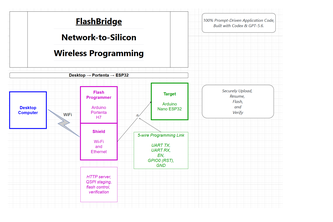
What the company appears to be: FlashBridge is a self-reported embedded hardware project that turns an Arduino Portenta H7 into a network-connected remote programmer for ESP32-family devices. The system allows firmware to be pushed over Ethernet or WiFi, staged, validated, and flashed into target silicon without direct PC-to-ESP32 cables.
What changed: The project evolved from a practical need identified by the author — a coworker needing safer, easier remote programming of ESP32 hardware — into a multi-weekend build that combined embedded engineering with AI-assisted development. It was submitted to an OpenAI hackathon and includes documentation of how AI tools (Codex & GPT-5.6) were used in its creation.
Single most important open question: Is there evidence of real-world adoption or traction beyond the author's own use case, or any indication that this project will scale into a product with customers?
What The Product Actually Is
The description states that FlashBridge is a network-to-silicon programming solution for ESP32-family devices. It uses an Arduino Portenta H7 as a secure network-facing control plane to stage and flash firmware over Ethernet or WiFi into target ESP32s via UART, using reset and boot-control lines.
It supports:
- Staging firmware artifacts
- Flashing and verifying firmware over Ethernet/WiFi
- Resuming interrupted flashes
- Managing flash sequencing
- Validating staged files
The system is built with PlatformIO in VS Code, using C++ and Python components. It leverages AI tools (Codex & GPT-5.6) for code generation, testing, documentation, and project synchronization.
Inference: The product appears to be a prototype or proof-of-concept rather than a commercial offering — based on the lack of pricing, customers, revenue, or market data in the description.
Positioning & Claim Evolution
The author claims that FlashBridge addresses a real-world friction point in embedded development workflows: the difficulty of reliably moving firmware from developer machines to silicon without physical access. It positions itself as an improvement over traditional local serial tools.
It also frames itself as:
- A test of AI-assisted engineering
- A demonstration of how modern coding agents can help accelerate embedded builds
- An experiment in prompt-first development
The project evolved from a "one-afternoon idea" into a multi-weekend build, suggesting that the original claim was more ambitious than initially imagined.
Inference: The positioning is rooted in solving a practical problem, but there's no evidence of market validation or customer feedback beyond the author’s own experience.
Target Customer & ICP
The description implies that FlashBridge targets:
- Embedded developers working with ESP32-family hardware
- Teams needing remote programming capabilities for hardware not easily accessible
- Users who want to avoid manual handling of local serial tools
It does not specify whether it's aimed at individual makers, enterprise teams, or embedded system integrators.
Inference: The ICP is likely embedded developers or engineers working in IoT or embedded systems, but no explicit segmentation or customer personas are provided.
Business Model & Pricing Evidence
There is no evidence of a business model or pricing structure. The description does not mention:
- Revenue streams
- Subscription plans
- Licensing fees
- Product pricing
- Market pricing comparisons
The project is described as a hackathon submission, and no commercialization strategy or monetization plan is evident.
Inference: No business model has been established, and the project appears to be in early-stage development with no indication of commercial intent.
Technical & Delivery Signals
Key technical details:
- Built using Arduino Portenta H7 as control plane
- Uses UART + reset/boot-control lines for ESP32 interaction
- Firmware uploaded in chunks, staged on Portenta, validated, then flashed via ROM bootloader
- Supports Ethernet or WiFi communication
- Includes chunked upload, resume, verification, and error recovery features
AI tools (Codex & GPT-5.6) were used for:
- Code generation
- Testing
- Documentation
- Git operations
- Simulator builds
- Video narration
The system includes:
- A Portenta simulator
- Automated test coverage (22 tests)
- Hash verification
- Session recovery and resume logic
Inference: The technical implementation shows a solid understanding of embedded systems, but the delivery is limited to a prototype or hackathon project.
Traction & Maturity Signals
There is no evidence of traction or adoption beyond the author’s own use case. The description states:
- No revenue
- No customers
- No market data
- No product usage metrics
The project was submitted to a hackathon, and the maturity level appears to be that of a working prototype.
Inference: There is no indication of traction or product-market fit, and the system has not been validated in a real-world commercial setting.
Competitive Context
There is no evidence of competitive analysis or market positioning against other embedded programming tools. The description does not mention:
- Competitors
- Alternative solutions
- Market share
- Pricing or feature comparisons
The author notes that the problem they're solving — remote ESP32 programming — is still "much harder than it should be," but does not elaborate on existing tools or platforms.
Inference: No competitive context is provided, and there’s no indication of how FlashBridge compares to other embedded development tools or workflows.
Open Questions & Risks
- No commercial traction or revenue: The project is described as a hackathon submission with no evidence of market adoption.
- Unverified AI claims: While the author states that AI tools were used, there’s no independent verification of their role or effectiveness.
- Limited scope: The system only supports ESP32-family devices and uses specific hardware (Portenta H7).
- No scalability plan: There is no indication of how the solution would scale beyond a single developer or prototype use case.
- Self-reported only: All information is self-reported, unverified, and lacks third-party corroboration.
Inference: The project is at a very early stage with no commercial viability or market validation.
Questions the description leaves open
- What specific embedded workflows or use cases drove the development of FlashBridge?
- Have you tested this system in real-world environments beyond your own lab?
- Are there any plans to expand support for other chip families or platforms?
- How do you intend to monetize or commercialize this solution?
- What are the key technical limitations or risks of scaling this system?
- Can you provide evidence of any user feedback or testing beyond personal experience?
- What is your long-term roadmap for FlashBridge, and how does it align with market needs?
Overall Assessment
Not evidenced: There is no evidence of a viable business model, customer traction, or commercial readiness.
The project is described as a self-contained hackathon submission, built with AI tools to solve a real-world embedded development problem. It shows technical capability and process discipline but lacks any indication of market validation, scalability, or commercial intent.
Confidence level: Low — based on self-reported evidence only, with no external verification or traction data.
Assessment: Not ready for investment or partnership at this stage. The project is a prototype with potential, but requires further development, market testing, and commercialization planning before it can be considered a viable opportunity.
User Stories BotA demo video on every pull request
Get a demo video on every new feature
GitHub App that watches your pull requests and records a narrated, captioned demo.
Save time on demo prep and make informed decisions faster with a video walkthrough of every new feature.
Source
Submitted to the OpenAI 2026 hackathon on Devpost. Project home on Devpost. Back to the full gallery on Devpost.
This competitive analysis was produced by top-founders.com (opens in a new tab)
Generated by a language model from this project's public Devpost page — its tagline, the author's own write-up and any built-with tags listed there — as captured in August 2026. Short quotations are the author's words. It is an opinion on the idea as a business, not on the people behind it, and it reflects the description as published then. If the project has moved on, request a correction below. The analysis is not independent research and contains no verified traction, revenue or customer data.
An independent guide by KFG International LLC — not affiliated with, endorsed by, or connected to Devpost or OpenAI.