

Archive position — measured, not model output
0 likes on Devpost
2,263 of the 7,850 archived projects have more likes, and 5,587 share exactly 0 — so this project's #4,998 place in the like-ranked listing is a tie-break inside that group, not a ranking.
Projects (log scale)
Likes on Devpost. ▲ marks this project's group.
Show the figures
| Likes | Projects | Share of archive |
|---|---|---|
| 0 | 5,587 | 71.2% |
| 1 | 1,758 | 22.4% |
| 2 | 284 | 3.6% |
| 3–4 | 132 | 1.7% |
| 5–9 | 75 | 1.0% |
| 10+ | 14 | 0.2% |
 User Stories BotA demo video on every pull request
Get a demo video on every new feature
GitHub App that watches your pull requests and records a narrated, captioned demo.
Save time on demo prep and make informed decisions faster with a video walkthrough of every new feature.
Executive Summary
What the company appears to be: Lineage Nook is a self-reported personal project built by one developer (Poppy_Bumpkin Vang) as part of an OpenAI 2026 hackathon submission. It is described as a private, evidence-grounded tool for preserving family history and relationships between generations. The author states it supports mapping family relationships, preserving claims with sources, visualizing lineage through a graph, and exporting structured data.
What changed: This is a self-reported development effort submitted to a hackathon. No prior version or evolution is described; this is the first public manifestation of the idea.
Single most important open question: Is there any evidence that Lineage Nook has been used by anyone beyond its creator, or that it has achieved any traction or adoption?
What The Product Actually Is
The description states that Lineage Nook helps users:
- Create and organize people and family records
- Map relationships across generations
- Preserve claims alongside their supporting sources
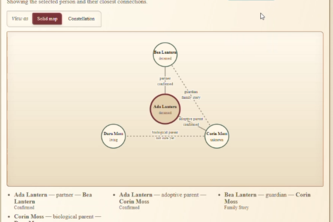
- Explore lineage information through a visual relationship graph
- Keep separate family trees and user records securely isolated
- Export structured lineage information for long-term preservation
The author describes it as a private workspace that preserves connections without pretending every claim is equally certain or fully resolved. It is designed to distinguish evidence from interpretation.
Evidence: The project write-up explicitly lists these features.
Inference: Based on the description, Lineage Nook appears to be a personal tool for family history management with an emphasis on preserving uncertainty and source integrity.
Positioning & Claim Evolution
The author states that Lineage Nook was designed as a place where people can map family relationships, preserve supporting sources, distinguish evidence from interpretation, and carry family knowledge forward without flattening it into a simple family tree.
It is positioned as a tool for preserving family history in a way that acknowledges complexity, uncertainty, and the importance of source documentation.
Evidence: The project write-up describes this positioning directly.
Inference: The product's positioning reflects an attempt to address limitations in traditional genealogy tools by emphasizing evidence-based storytelling over simplified lineage structures.
Target Customer & ICP
The description does not name specific target customers or personas. It implies a general audience interested in preserving family history and relationships, particularly those who value accuracy and source documentation over simplistic genealogical trees.
Evidence: No explicit customer segments or personas are mentioned.
Inference: The tool likely targets individuals or families who want to maintain detailed and nuanced records of their lineage, possibly including genealogists, historians, or people with complex family histories.
Business Model & Pricing Evidence
There is no evidence in the description of any business model or pricing structure. The project is described as a personal hackathon submission.
Evidence: Not evidenced.
Inference: If this evolves into a commercial product, it would likely be priced for individual users or small family groups, but no such indication exists.
Technical & Delivery Signals
The author built Lineage Nook using:
- React and TypeScript
- Supabase and PostgreSQL
- Row-level security and scoped database privileges for user isolation
- Deterministic exports for portable lineage records
- Automated tests, type checking, production builds, and browser verification
- Git commits and an evidence ledger to preserve a traceable build history
The development process involved using Codex (an AI coding agent) in a repository-based session. The author provided intent, privacy requirements, decision boundaries, and approval gates while Codex implemented features, ran tests, documented evidence, and stopped when new authorization or verification boundaries appeared.
Evidence: The project write-up details the tech stack and development approach.
Inference: The use of AI coding tools suggests a modern, automated development process. The emphasis on security and testability indicates attention to robustness and privacy.
Traction & Maturity Signals
There is no evidence of any traction or adoption beyond the author's own development effort. No customers, users, revenue, or usage metrics are mentioned.
Evidence: Not evidenced.
Inference: As a hackathon submission, it has not yet reached a stage where user engagement or market validation can be assessed.
Competitive Context
The description does not mention any competitors or existing solutions in the family history or genealogy space. No comparison to other tools is made.
Evidence: Not evidenced.
Inference: Given the focus on privacy, evidence preservation, and uncertainty handling, Lineage Nook may aim to differentiate from traditional genealogy platforms that often simplify or flatten historical information.
Open Questions & Risks
- No traction or user base: The project is described as a solo effort with no evidence of adoption.
- Unverified claims: All descriptions are self-reported and unverified; there is no independent confirmation of functionality or performance.
- Limited scope: As a hackathon project, it may not reflect long-term viability or scalability.
- Unclear commercialization path: No indication of how the tool might evolve into a sustainable business.
Evidence: Not evidenced.
Inference: The lack of any external validation or user feedback raises concerns about real-world applicability and potential market demand.
Questions the description leaves open
- What specific use cases drove the design decisions around privacy, source documentation, and uncertainty handling?
- Has anyone other than yourself used Lineage Nook? If so, what feedback did you receive?
- How do you plan to scale beyond a single-user model if this becomes a product?
- Are there any known technical limitations or edge cases that have not been addressed in the current version?
- What is your vision for monetization or long-term sustainability of the project?
Overall Assessment
There is no evidence of revenue, customers, or traction to support an investment or partnership decision at this time.
Evidence: Not evidenced.
Inference: This appears to be a prototype or proof-of-concept rather than a developed product with market readiness. Any potential value would depend on future development and user adoption, which are not yet evident.
User Stories BotA demo video on every pull request
Get a demo video on every new feature
GitHub App that watches your pull requests and records a narrated, captioned demo.
Save time on demo prep and make informed decisions faster with a video walkthrough of every new feature.
Source
Submitted to the OpenAI 2026 hackathon on Devpost. Project home on Devpost. Back to the full gallery on Devpost.
This competitive analysis was produced by top-founders.com (opens in a new tab)
Generated by a language model from this project's public Devpost page — its tagline, the author's own write-up and any built-with tags listed there — as captured in August 2026. Short quotations are the author's words. It is an opinion on the idea as a business, not on the people behind it, and it reflects the description as published then. If the project has moved on, request a correction below. The analysis is not independent research and contains no verified traction, revenue or customer data.
An independent guide by KFG International LLC — not affiliated with, endorsed by, or connected to Devpost or OpenAI.