

Archive position — measured, not model output
0 likes on Devpost
2,263 of the 7,850 archived projects have more likes, and 5,587 share exactly 0 — so this project's #4,988 place in the like-ranked listing is a tie-break inside that group, not a ranking.
Projects (log scale)
Likes on Devpost. ▲ marks this project's group.
Show the figures
| Likes | Projects | Share of archive |
|---|---|---|
| 0 | 5,587 | 71.2% |
| 1 | 1,758 | 22.4% |
| 2 | 284 | 3.6% |
| 3–4 | 132 | 1.7% |
| 5–9 | 75 | 1.0% |
| 10+ | 14 | 0.2% |
 User Stories BotA demo video on every pull request
Get a demo video on every new feature
GitHub App that watches your pull requests and records a narrated, captioned demo.
Save time on demo prep and make informed decisions faster with a video walkthrough of every new feature.
Executive Summary
What the company appears to be
LifePilot — Newcomer Action Plan is a self-reported static web tool designed to help newcomers in Ireland (initially Limerick) navigate life-admin tasks through structured, bilingual checklists. It was built as a submission for the OpenAI 2026 hackathon and does not appear to have any revenue, customers or traction beyond its own author’s claims.
What changed
The project is presented as a new feature added to an existing static website, using JSON templates, JavaScript logic, and local storage. It was built during a hackathon with no backend infrastructure, accounts, or payments required.
Single most important open question
Is there any evidence of user adoption or feedback from actual newcomers in Ireland beyond the author’s self-reported claims?
What The Product Actually Is
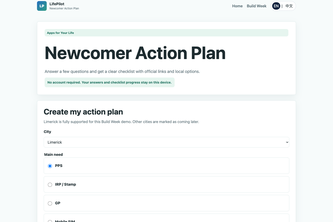
The description states that LifePilot — Newcomer Action Plan is a static web tool built for newcomers to Ireland. It asks users a few short questions about their city, main need, urgency, budget, preferred language, and context. Based on these inputs, it generates a bilingual checklist with:
- What to do today
- What to do this week
- What to prepare
- Document checklists
- Official links
- Caution notes
- Local options where verified
- Completion checkboxes
- Copy/print/save support
- Local progress restore after refresh
The supported city for this Build Week version is Limerick, and the supported needs are:
- PPS
- IRP / Stamp
- GP
- Mobile SIM
- Bank Account
- Moving
It uses structured JSON plan templates, a deterministic JavaScript plan engine, and localStorage for checklist progress. It does not require accounts, payments, or backend databases.
Evidence
- The author states: “LifePilot — Newcomer Action Plan asks a few short questions...”
- The tool is built into the existing static website.
- It uses JSON templates, JavaScript, and localStorage.
- No backend or API keys are used.
Inference The tool is not a SaaS product but a static web application, likely hosted on a simple web server or CDN.
Positioning & Claim Evolution
The author states that LifePilot was built for newcomers to Ireland who need a clear next step, not another confusing search result. It aims to reduce stress by offering structured, verified information in bilingual format (English and Simplified Chinese).
It is positioned as an alternative to chatbots or unverified online sources, emphasizing:
- Deterministic structure
- Verified links
- Clear uncertainty labels
The author also notes that the tool avoids harmful misinformation by using structured data and clearly marking incomplete information as not yet verified.
Evidence
- “LifePilot was built for newcomers to Ireland who need a clear next step, not another confusing search result.”
- “A life-admin product does not need to act like a chatbot to be useful.”
- “It avoids harmful misinformation by using structured data and clearly marking incomplete information as not yet verified.”
Inference The positioning is focused on trust, simplicity, and local-first privacy, rather than scalability or monetization.
Target Customer & ICP
The description states that the tool is built for newcomers to Ireland, specifically in Limerick. It targets users who are navigating life-admin tasks such as PPS, IRP / Stamp, GP, Mobile SIM, Bank Account, and Moving.
It also mentions support for bilingual English and Simplified Chinese, suggesting a multilingual audience, possibly including international migrants or expats.
Evidence
- “LifePilot was built for newcomers to Ireland who need a clear next step...”
- Supported needs: PPS, IRP / Stamp, GP, Mobile SIM, Bank Account, Moving.
- Supported city: Limerick.
- Bilingual support: English and Simplified Chinese.
Inference The ICP is likely newcomers to Ireland, with a focus on those who are multilingual or from non-English-speaking backgrounds. The tool is not yet scalable beyond Limerick or the listed needs.
Business Model & Pricing Evidence
There is no evidence of any pricing, monetization, or business model in the description. The tool does not require accounts, payments, or backend infrastructure. It is described as a static web application with no indication of user onboarding, subscriptions, or transactions.
Evidence
- “It does not require accounts, payments, a backend database, or exposed API keys.”
- No mention of pricing, subscriptions, or monetization.
- The tool is hosted on a static website.
Inference The project appears to be non-commercial, possibly a prototype or hackathon submission. There is no evidence of any revenue-generating mechanism.
Technical & Delivery Signals
The tool is built using:
- HTML, CSS, JavaScript
- Structured JSON plan templates
- Deterministic JavaScript engine
- localStorage for progress tracking
- No backend, API keys, or external services
It was built during the OpenAI Build Week hackathon and uses GPT-5.6 and Codex for design, implementation, validation, testing, deployment, and documentation.
The runtime is described as deterministic and privacy-friendly, with no live AI at runtime.
Evidence
- “Built with (author-declared): htmlcjjslcov”
- “Uses structured JSON plan templates, a deterministic JavaScript plan engine, and localStorage for checklist progress.”
- “It does not require accounts, payments, a backend database, or exposed API keys.”
- “The runtime page is deterministic and privacy-friendly; it does not claim to use live AI at runtime.”
Inference The technical stack is minimal and self-contained. It is likely a static site with client-side logic, built for demonstration rather than production use.
Traction & Maturity Signals
There is no evidence of traction, customers, or usage beyond the author’s own claims. The tool was submitted as a hackathon project and does not appear to have any user base or adoption metrics.
Evidence
- “This project was submitted to the OpenAI 2026 hackathon on Devpost.”
- No mention of users, downloads, or engagement.
- No data on how many people used it or what feedback they gave.
Inference The tool is in a pre-product-market-fit stage, likely a prototype or proof-of-concept. There is no evidence of any traction or user validation.
Competitive Context
There is no mention of competitors or market analysis in the description. The author does not reference existing tools for newcomer life-admin support, nor does it compare itself to other platforms.
Evidence
- No competitor names, products, or market positioning mentioned.
- No discussion of how this differs from or competes with other services.
Inference The competitive context is unknown, and there is no evidence that the author has researched or positioned the tool against existing solutions.
Open Questions & Risks
- No traction or user feedback: The project is presented as a hackathon submission with no evidence of real-world adoption.
- Limited scope: Only supports one city (Limerick) and a limited set of needs.
- No monetization model: No indication of how the tool will be sustained or scaled.
- Self-reported only: All claims are unverified, and there is no third-party validation.
- Static nature: The tool is not scalable beyond its current implementation.
Evidence
- No user data, feedback, or adoption metrics.
- Only one city and limited needs supported.
- No mention of monetization or sustainability.
Inference The project is a proof-of-concept, not a commercial product. It may not be ready for real-world deployment or investment.
Questions the description leaves open
- What was the process for validating the accuracy of the information in the checklists?
- How were the local service options and official links verified?
- Are there plans to expand beyond Limerick and the current list of needs?
- Has there been any user testing or feedback from actual newcomers?
- What is the long-term vision for scaling this tool beyond a hackathon prototype?
Overall Assessment
Not evidenced.
There is no evidence of revenue, customers, traction, or commercial viability to support an investment or partnership decision. The project is described as a hackathon submission, likely a prototype with no monetization model or user base.
The tool is not ready for commercial deployment, and there is no indication that it has moved beyond the idea or proof-of-concept stage.
Inference This is a pre-product-market-fit project. It may be of interest as a conceptual prototype or for future development, but not for investment or partnership at this time.
User Stories BotA demo video on every pull request
Get a demo video on every new feature
GitHub App that watches your pull requests and records a narrated, captioned demo.
Save time on demo prep and make informed decisions faster with a video walkthrough of every new feature.
Source
Submitted to the OpenAI 2026 hackathon on Devpost. Project home on Devpost. Back to the full gallery on Devpost.
This competitive analysis was produced by top-founders.com (opens in a new tab)
Generated by a language model from this project's public Devpost page — its tagline, the author's own write-up and any built-with tags listed there — as captured in August 2026. Short quotations are the author's words. It is an opinion on the idea as a business, not on the people behind it, and it reflects the description as published then. If the project has moved on, request a correction below. The analysis is not independent research and contains no verified traction, revenue or customer data.
An independent guide by KFG International LLC — not affiliated with, endorsed by, or connected to Devpost or OpenAI.