

Archive position — measured, not model output
1 like on Devpost
505 of the 7,850 archived projects have more likes, and 1,758 share exactly 1 — so this project's #1,362 place in the like-ranked listing is a tie-break inside that group, not a ranking.
Projects (log scale)
Likes on Devpost. ▲ marks this project's group.
Show the figures
| Likes | Projects | Share of archive |
|---|---|---|
| 0 | 5,587 | 71.2% |
| 1 | 1,758 | 22.4% |
| 2 | 284 | 3.6% |
| 3–4 | 132 | 1.7% |
| 5–9 | 75 | 1.0% |
| 10+ | 14 | 0.2% |
 User Stories BotA demo video on every pull request
Get a demo video on every new feature
GitHub App that watches your pull requests and records a narrated, captioned demo.
Save time on demo prep and make informed decisions faster with a video walkthrough of every new feature.
Executive Summary
What the company appears to be
LifeOS Career – Your AI Career Decision Memory is a self-reported platform designed to help students and professionals record, reflect on, and learn from past career decisions using AI. It is described as an MVP built during a hackathon, with no evidence of revenue, customers or traction.
What changed
The project was submitted to the OpenAI 2026 hackathon, indicating a focus on rapid prototyping and AI integration in career decision-making tools. The author states it was built using React, Firebase, and GPT-5.6 via Codex, with an emphasis on AI-ready architecture.
Single most important open question
Is there any evidence of user adoption or commercial traction beyond the hackathon MVP?
What The Product Actually Is
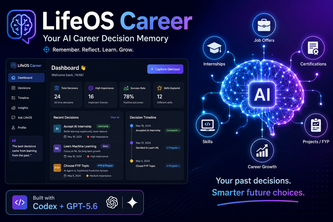
The description states that LifeOS Career is a platform where users can:
- Record career decisions
- View them in a timeline
- Track insights through a dashboard
- Search previous decisions
- Generate AI-ready reflections and recommendations
- Organize internships, jobs, certifications, FYPs, and skills
It is described as an AI-powered tool that helps users make smarter future choices by learning from their own experiences.
Evidence
- The author states the platform enables recording, timeline viewing, dashboard tracking, search, AI-generated reflections, and organization of career-related data.
- Built with React + Vite, Tailwind CSS, Firebase Authentication, Cloud Firestore, Codex with GPT-5.6, Git & GitHub.
Inference The product is a web-based application for personal career decision memory management, using AI to assist in reflection and recommendation generation.
Positioning & Claim Evolution
The author positions LifeOS Career as:
- An AI-powered career decision memory
- A tool that helps users remember why they made past decisions
- A platform that enables learning from one’s own career journey instead of generic advice
Evidence
- Tagline: “An AI-powered career decision memory that helps students and professionals record, reflect on, and learn from past career decisions to make smarter future choices.”
- Inspiration: Inspired by the idea of creating an AI-powered career memory that helps users remember, reflect on, and learn from their own career journey instead of relying on generic advice.
Inference The positioning is centered on personalization and self-learning through AI, aiming to differentiate from generic career advice tools.
Target Customer & ICP
The description states:
- The platform targets students and professionals
- It helps users make smarter future career decisions based on their own experiences
Evidence
- “Helps students and professionals record, reflect on, and learn from past career decisions”
- “Designed to help users make smarter future career decisions based on their own experiences”
Inference The target customer is individuals navigating career transitions or seeking structured reflection on their professional journey.
Business Model & Pricing Evidence
No evidence of pricing, monetization, or business model is provided in the description.
Evidence
- The project is described as an MVP built during a hackathon.
- No mention of revenue streams, subscriptions, or pricing tiers.
Inference The business model remains undefined. It is unclear if the platform intends to be free, freemium, or paid.
Technical & Delivery Signals
The author states:
- Built using React + Vite, Tailwind CSS, Firebase Authentication, Cloud Firestore
- Codex with GPT-5.6 was used for development
- AI-ready architecture designed to connect to LLMs in the future
- Git and GitHub were used for version control
Evidence
- “Built with (author-declared): ai, authentication, cloud, codex, css, firebase, firestore, git, github, gpt-5.6, javascript, llm, openai, react, tailwind, vite, web”
- “Codex accelerated development by helping with project architecture, React components, Firebase integration, debugging, and documentation.”
- “Designed an AI-ready architecture that can easily connect to an LLM in the future while keeping the application fully functional.”
Inference The platform is built on modern frontend and backend stacks, with a focus on AI integration. The architecture suggests scalability toward full LLM connectivity.
Traction & Maturity Signals
No evidence of traction or maturity beyond the hackathon MVP is provided.
Evidence
- “Delivered a working MVP within the hackathon timeline”
- “Future improvements include: 🤖 GPT-powered career coaching, 🔎 Semantic search using vector embeddings, 📄 Resume and interview assistance, 📈 Career growth analytics, 🎯 Personalized skill gap analysis, ☁️ Cross-device synchronization”
Inference The project is at an early stage. No data on user engagement, retention, or adoption exists.
Competitive Context
No evidence of competitive landscape is provided in the description.
Evidence
- The author does not mention competitors or market positioning relative to existing tools.
- No reference to similar platforms or services in the career decision-making space.
Inference The competitive context is unknown. It is unclear whether this addresses a gap in the market or overlaps with existing solutions.
Open Questions & Risks
Key risks and open questions include:
- MVP-only status, no commercial traction
- No evidence of monetization or pricing model
- No user data, adoption, or feedback
- AI features are described as future enhancements, not implemented
- No indication of team scalability or long-term roadmap beyond hackathon
Evidence
- “Delivered a working MVP within the hackathon timeline”
- “Future improvements include: 🤖 GPT-powered career coaching” (not yet implemented)
- No mention of revenue, customers, or user base
Inference The platform is unproven in real-world use and lacks commercial viability indicators.
Questions the description leaves open
- What is the current status of AI features beyond the MVP? Are they live or planned?
- Have you conducted any user research or gathered feedback from students/professionals?
- Is there a plan for monetization or revenue model?
- How do you intend to scale beyond the hackathon team and prototype?
- What is your roadmap for product development beyond the MVP?
Overall Assessment
Assessment Not evidenced.
Explanation
There is no evidence of commercial traction, revenue, customer base or business model. The project is described as an MVP built during a hackathon with no indication of real-world adoption or monetization strategy. The AI features are described as future enhancements, not implemented. No data supports the viability or scalability of this platform for investment or partnership.
Confidence Low. The evidence provided is limited to self-reported claims and MVP-level development.
User Stories BotA demo video on every pull request
Get a demo video on every new feature
GitHub App that watches your pull requests and records a narrated, captioned demo.
Save time on demo prep and make informed decisions faster with a video walkthrough of every new feature.
Source
Submitted to the OpenAI 2026 hackathon on Devpost. Project home on Devpost. Back to the full gallery on Devpost.
This competitive analysis was produced by top-founders.com (opens in a new tab)
Generated by a language model from this project's public Devpost page — its tagline, the author's own write-up and any built-with tags listed there — as captured in August 2026. Short quotations are the author's words. It is an opinion on the idea as a business, not on the people behind it, and it reflects the description as published then. If the project has moved on, request a correction below. The analysis is not independent research and contains no verified traction, revenue or customer data.
An independent guide by KFG International LLC — not affiliated with, endorsed by, or connected to Devpost or OpenAI.