

Archive position — measured, not model output
1 like on Devpost
505 of the 7,850 archived projects have more likes, and 1,758 share exactly 1 — so this project's #1,363 place in the like-ranked listing is a tie-break inside that group, not a ranking.
Projects (log scale)
Likes on Devpost. ▲ marks this project's group.
Show the figures
| Likes | Projects | Share of archive |
|---|---|---|
| 0 | 5,587 | 71.2% |
| 1 | 1,758 | 22.4% |
| 2 | 284 | 3.6% |
| 3–4 | 132 | 1.7% |
| 5–9 | 75 | 1.0% |
| 10+ | 14 | 0.2% |
 User Stories BotA demo video on every pull request
Get a demo video on every new feature
GitHub App that watches your pull requests and records a narrated, captioned demo.
Save time on demo prep and make informed decisions faster with a video walkthrough of every new feature.
Executive Summary
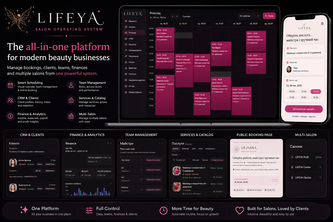
The author states that LIFEYA is a self-developed SaaS platform for beauty businesses, built as a personal project to support their wife’s salon and later expanded into a full operating system. The description indicates it includes features like booking, CRM, finance, team management, and multi-salon support. It was submitted to the OpenAI 2026 hackathon by a single developer using AI tools such as GPT-5.6 and Codex.
The platform is described as being in active use, with continuous improvement underway, but no evidence of revenue, customers, or traction beyond self-reporting.
Key open question
Is there any evidence that the platform has achieved product-market fit or begun generating revenue from users outside the founder’s immediate network?
What The Product Actually Is
The description states that LIFEYA is an all-in-one SaaS platform for beauty businesses. It includes:
- Smart appointment scheduling
- Online booking websites
- Client CRM
- Finance and reporting
- Team management
- Services & pricing
- Staff permissions
- Multi-salon management
- Analytics
- Data export and backup tools
It was built as a full-stack web application using technologies such as Next.js, React, Node.js, PostgreSQL, Supabase, and AI tools like GPT-5.6 and Codex.
Not evidenced: The actual functionality or UI of the platform; whether it is live or accessible to users beyond the founder’s network.
Positioning & Claim Evolution
The author claims that LIFEYA began as a personal gift for one salon owner and evolved into a complete operating system for multiple salons. It positions itself as an integrated solution for managing all aspects of beauty business operations, from client booking to financial reporting.
It also states that the platform supports multi-salon management and is designed with scalability in mind.
The author notes that the platform was built during OpenAI Build Week and used AI tools extensively to improve development speed and solve complex engineering problems.
Not evidenced: How the product differentiates from existing solutions; whether it has a competitive advantage or unique value proposition beyond being custom-built for salons.
Target Customer & ICP
The description states that LIFEYA targets salon owners, beauty professionals, and multi-location businesses. It is positioned specifically for "beauty businesses" and includes features tailored to those needs.
Not evidenced: Specific customer segments; whether the platform addresses different types of beauty businesses (e.g., nail salons, spas, hairdressers); how many customers exist or what their size or geographic distribution might be.
Business Model & Pricing Evidence
The description does not provide any information about pricing models, monetization strategies, or revenue streams. It only mentions that the platform is a SaaS offering with features like finance and reporting.
Not evidenced: How the product will generate revenue; if there are paid tiers, subscriptions, or usage-based charges.
Technical & Delivery Signals
The platform was built using modern web technologies including Next.js, React, Node.js, PostgreSQL, Supabase, and TailwindCSS. It uses AI tools such as GPT-5.6 and Codex for development assistance.
It is described as a full-stack application designed with scalability in mind and includes multi-salon architecture and RBAC (Role-Based Access Control).
Not evidenced: Deployment environment or infrastructure details; whether the platform has been tested at scale; how performance or reliability are measured.
Traction & Maturity Signals
The author states that LIFEYA is actively used, continuously improved, and prepared for expansion to additional salons. It was submitted to a hackathon and is described as having evolved from a personal project into a full platform.
Not evidenced: Customer base; user engagement metrics; revenue data; adoption rate or retention figures; whether the product has moved past MVP stage.
Competitive Context
The description does not mention competitors or how LIFEYA compares to existing salon management systems. It implies that generic booking platforms were inadequate for salon owners, but does not name specific alternatives.
Not evidenced: Market landscape; competitive positioning; differentiation from other tools in the space.
Open Questions & Risks
- The platform is described as a single-developer project with no evidence of team expansion or external validation.
- There is no mention of customer feedback, user testing, or product-market fit beyond personal use.
- No financial data, revenue, or traction metrics are provided.
- The author’s own account suggests the product was built primarily for personal use and later generalized — this raises questions about early-stage market validation.
Inference: If LIFEYA is only used by the founder's wife and a few other salons, it may not yet have achieved meaningful market traction or proven scalability.
Questions the description leaves open
- What is the current number of active users or salons using LIFEYA?
- How do you plan to monetize the platform? Are there any existing paying customers?
- What specific problems in the salon management space are you solving that other platforms don’t?
- Have you conducted any user research or interviews with salon owners outside your personal network?
- What is the timeline for scaling beyond the initial set of users?
- How do you intend to handle data privacy and compliance (e.g., GDPR, CCPA)?
- Are there any technical limitations or bottlenecks currently in place that could hinder growth?
Overall Assessment
The description indicates that LIFEYA is a self-developed platform with early-stage traction, built by one person using AI tools. It includes core features for salon management and has been submitted to a hackathon.
However, there is no evidence of revenue, customer data, or market validation beyond the founder’s personal experience.
Assessment Not evidenced. The project appears to be in an early development phase with limited commercial proof. A deeper due-diligence review would require access to actual usage data, financials, and customer feedback.
User Stories BotA demo video on every pull request
Get a demo video on every new feature
GitHub App that watches your pull requests and records a narrated, captioned demo.
Save time on demo prep and make informed decisions faster with a video walkthrough of every new feature.
Source
Submitted to the OpenAI 2026 hackathon on Devpost. Project home on Devpost. Back to the full gallery on Devpost.
This competitive analysis was produced by top-founders.com (opens in a new tab)
Generated by a language model from this project's public Devpost page — its tagline, the author's own write-up and any built-with tags listed there — as captured in August 2026. Short quotations are the author's words. It is an opinion on the idea as a business, not on the people behind it, and it reflects the description as published then. If the project has moved on, request a correction below. The analysis is not independent research and contains no verified traction, revenue or customer data.
An independent guide by KFG International LLC — not affiliated with, endorsed by, or connected to Devpost or OpenAI.