

Archive position — measured, not model output
1 like on Devpost
505 of the 7,850 archived projects have more likes, and 1,758 share exactly 1 — so this project's #1,364 place in the like-ranked listing is a tie-break inside that group, not a ranking.
Projects (log scale)
Likes on Devpost. ▲ marks this project's group.
Show the figures
| Likes | Projects | Share of archive |
|---|---|---|
| 0 | 5,587 | 71.2% |
| 1 | 1,758 | 22.4% |
| 2 | 284 | 3.6% |
| 3–4 | 132 | 1.7% |
| 5–9 | 75 | 1.0% |
| 10+ | 14 | 0.2% |
 User Stories BotA demo video on every pull request
Get a demo video on every new feature
GitHub App that watches your pull requests and records a narrated, captioned demo.
Save time on demo prep and make informed decisions faster with a video walkthrough of every new feature.
Executive Summary
Company: Lily Hop
Self-reported basis: The description is entirely self-reported and unverified, based on a Devpost submission to the OpenAI 2026 hackathon. No external corroboration exists.
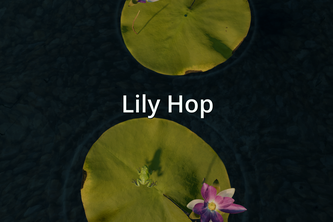
What it appears to be: A top-down 3D game in development by one person (lightfinesthour Westerhof), featuring a frog character navigating a pond environment with ambient sound design and realistic graphics.
What changed: The project was submitted as part of a hackathon, indicating an early-stage prototype or proof-of-concept.
Single most important open question: Is there any evidence of revenue, user engagement, or product-market fit beyond the author's own account?
What The Product Actually Is
The description states:
- Lily Hop is a top-down 3D game.
- The player controls a frog trying to cross a pond without falling into the water.
- It includes ambient sounds and music.
- There is no time limit.
- The game features realistic graphics and sound design with a natural feel.
Inference: The author describes it as a “game with realistic graphics and sound design” and mentions using tools like Sketchfab, Quixel, and Godot — suggesting this is a visual and audio-rich experience, likely built for a niche audience interested in ambient or nature-based games.
Positioning & Claim Evolution
The description states:
- The game is inspired by nature.
- It aims to make players feel real danger for the creatures they control.
- It also makes players feel relaxed while being eaten by a fish — suggesting a blend of tension and calm.
Inference: The positioning appears to be on the edge of “relaxing” and “challenging,” possibly targeting fans of ambient or meditative games, with a twist of existential risk.
Target Customer & ICP
The description does not state:
- Who the target customer is.
- What segment or persona this game is aimed at.
Not evidenced: No evidence of user personas, demographics, or market segmentation.
Business Model & Pricing Evidence
The description states:
- The author plans to release it on Itch.io and later Steam.
- There is no mention of pricing, monetization strategy, or revenue model.
Inference: If released on Itch.io, the game might be freemium, pay-what-you-want, or a one-time purchase — but this is not stated.
Technical & Delivery Signals
The description states:
- Built with Godot (game engine), ChatGPT, Codex, FL Studio, Quixel, Sketchfab.
- The author used OpenAI Sol 5.6 Extra-High for most programming.
- It was built in one day, with a hackathon deadline.
Inference: The project is a prototype or early-stage demo, likely built quickly using AI-assisted tools and existing assets. The use of AI for coding and asset creation suggests a fast iteration approach.
Traction & Maturity Signals
The description states:
- It was submitted to the OpenAI 2026 hackathon.
- The author found out about the hackathon on the 18th, and built it in one day.
- Accomplishments include “it looks and feels amazing, after just one day.”
- Future plans include a full demo for Itch.io and Steam.
Inference: This is an early-stage prototype with no evidence of traction or user adoption. The project has not yet reached a market-ready state.
Competitive Context
The description does not state:
- What similar products exist in the market.
- Whether there are comparable games or platforms.
Not evidenced: No competitive analysis or market positioning is provided.
Open Questions & Risks
- The project is a one-person effort, with no team or external support.
- It was built in one day, suggesting limited scope and maturity.
- No evidence of revenue, user feedback, or monetization strategy.
- The author acknowledges compromises due to time constraints and availability of assets.
- No clear path to market or distribution beyond Itch.io and Steam.
Inference: The risk of failure is high due to lack of traction, team size, and unclear business model. The project may not be ready for commercial release or investment.
Questions the description leaves open
- What is your plan for monetization and pricing?
- Have you tested the game with any users or played it yourself beyond the hackathon?
- How do you intend to scale beyond a single-person development effort?
- Are there any existing competitors in this space, and how does Lily Hop differentiate?
- What are the key metrics you would track for product success?
Overall Assessment
Not evidenced: No evidence of revenue, customer base, or traction is provided. The project is described as a hackathon prototype with no commercial viability or market validation.
Inference: At this stage, there is no compelling reason to pursue investment or partnership — the project lacks product-market fit, team capacity, and business model clarity. It may be a promising idea in concept but not yet a viable business.
User Stories BotA demo video on every pull request
Get a demo video on every new feature
GitHub App that watches your pull requests and records a narrated, captioned demo.
Save time on demo prep and make informed decisions faster with a video walkthrough of every new feature.
Source
Submitted to the OpenAI 2026 hackathon on Devpost. Project home on Devpost. Back to the full gallery on Devpost.
This competitive analysis was produced by top-founders.com (opens in a new tab)
Generated by a language model from this project's public Devpost page — its tagline, the author's own write-up and any built-with tags listed there — as captured in August 2026. Short quotations are the author's words. It is an opinion on the idea as a business, not on the people behind it, and it reflects the description as published then. If the project has moved on, request a correction below. The analysis is not independent research and contains no verified traction, revenue or customer data.
An independent guide by KFG International LLC — not affiliated with, endorsed by, or connected to Devpost or OpenAI.