

Archive position — measured, not model output
0 likes on Devpost
2,263 of the 7,850 archived projects have more likes, and 5,587 share exactly 0 — so this project's #3,327 place in the like-ranked listing is a tie-break inside that group, not a ranking.
Projects (log scale)
Likes on Devpost. ▲ marks this project's group.
Show the figures
| Likes | Projects | Share of archive |
|---|---|---|
| 0 | 5,587 | 71.2% |
| 1 | 1,758 | 22.4% |
| 2 | 284 | 3.6% |
| 3–4 | 132 | 1.7% |
| 5–9 | 75 | 1.0% |
| 10+ | 14 | 0.2% |
 User Stories BotA demo video on every pull request
Get a demo video on every new feature
GitHub App that watches your pull requests and records a narrated, captioned demo.
Save time on demo prep and make informed decisions faster with a video walkthrough of every new feature.
Executive Summary
What the company appears to be
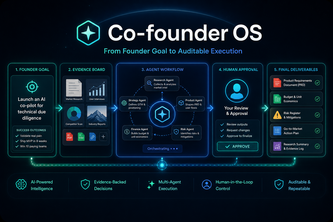
Co-founder OS — Founder Mission Control is described as an AI-native operating system for solo founders and small teams. The author states it organizes multiple models, agents, tools, and human decisions into executable, recoverable, and auditable workflows.
What changed
The project description indicates development during a hackathon (OpenAI 2026), with a focus on building a structured system for solo founders to manage tasks across product, engineering, finance, and risk. It includes a local-first, cloud-enhanced architecture, explicit agent registry, task lifecycle state machine, and model routing logic.
Single most important open question
Is there evidence of traction or early adoption by solo founders or small teams that would suggest real-world utility beyond the author’s prototype?
Note: This analysis is based solely on the self-reported project description provided. All claims are unverified and should be treated as stated by the author.
What The Product Actually Is
The description states:
- Co-founder OS is an AI-native operating system for solo founders.
- It turns goals and evidence into auditable workflows.
- It coordinates product, engineering, finance, and risk agents with human approval.
- It outputs working artifacts such as product requirements documents, technical execution plans, budgets, risk registers, prioritized action plans, and model-routing records.
It is not described as a chatbot or generative tool but rather as a system that organizes AI agents into structured workflows with defined roles, dependencies, and auditability.
Claim: The system uses an Executive Orchestrator to break goals into bounded tasks with dependencies.
Inferred from author's own write-up.
Claim: It applies a Policy Gate before high-risk actions.
Inferred from author’s own write-up.
Positioning & Claim Evolution
The description states:
- Solo founders need more than ideas or another chatbot — they need a system that helps them move work forward.
- The product is positioned as an AI-native operating system, not just a simulated “AI co-founder.”
- It aims to organize multiple models, agents, and human decisions into executable workflows.
The author frames this as a shift from isolated AI outputs to a structured, recoverable, and auditable workflow engine — emphasizing control, traceability, and deliverables over generative text or code.
Claim: The system is not just an interface but an early operating system for founder execution.
Evidenced directly in the write-up.
Claim: Founders want decision support and deliverables, not longer answers.
Inferred from author’s reflection on accomplishments.
Target Customer & ICP
The description states:
- The primary user is a solo founder or small team.
- The system supports tasks spanning product definition, engineering execution, budgeting, risk assessment, research synthesis, and sequencing of next actions.
There is no mention of specific verticals, industries, or personas beyond solo founders. The positioning implies it targets individuals who are not part of a full team but want access to organizational capabilities.
Claim: The system supports solo founders and small teams.
Evidenced directly in the write-up.
Claim: It addresses real startup work — product definition, engineering execution, budgeting, risk, etc.
Inferred from author’s framing of what founders actually need.
Business Model & Pricing Evidence
Not evidenced.
The description does not include any information about pricing models, monetization strategies, or business model assumptions. No mention of subscriptions, usage fees, or enterprise licensing.
Absence of evidence: No indication of how the product will be sold or funded.
Technical & Delivery Signals
The description states:
- Built with Python and FastAPI.
- Uses Pydantic data models for Runs, Tasks, Artifacts, Approvals, and Audit Events.
- Implements local-first, cloud-enhanced control-plane architecture.
- Includes atomic task claiming, idempotent execution, bounded retries, terminal failure states, approval pause/resume, file-based artifact storage, append-only audit events, and replayable task lifecycles.
It also mentions:
- A unified model gateway with deterministic routing rules.
- An explicit Agent Registry and Executive Orchestrator.
- Structured outputs from specialized agents.
- Artifact Store, Policy Gate, and audit-event pipeline.
Claim: The system uses a task lifecycle state machine.
Evidenced directly in the write-up.
Claim: Model routing decisions are recorded as formal audit events.
Inferred from author’s explanation of routing logic.
Traction & Maturity Signals
Not evidenced.
There is no mention of customers, users, revenue, or adoption. The project is described as a hackathon submission and prototype, with no indication of prior traction or market validation.
Absence of evidence: No data on usage, customers, or product-market fit.
Competitive Context
Not evidenced.
The description does not reference competitors, existing tools, or market positioning relative to other AI tools for solo founders or task management systems. It does not describe how it differs from or relates to similar offerings.
Absence of evidence: No competitive analysis or differentiation strategy provided.
Open Questions & Risks
Inferences based on the description:
- Risk of over-engineering: The system is described as highly structured and formalized, which may be premature for a solo founder use case.
- Open question: Solo builder limitation: The author notes that they built everything themselves — this raises questions about scalability or long-term maintainability.
- Open question: Prototype vs. product gap: The project is explicitly labeled as a hackathon prototype; there’s no evidence of transition to a production-ready system.
- Risk of complexity for end-users: The described architecture includes many technical components (state machines, audit trails, model routing) that may not be intuitive for solo founders.
Inference: The system may be too complex or formalized for its target audience.
Based on description of internal architecture and user-facing goals.
Questions the description leaves open
- What specific problems do solo founders face in managing tasks across product, engineering, finance, and risk that this system solves?
- How does the system handle conflicting outputs from different agents?
- Can you demonstrate how a founder would interact with the system using a real-world example?
- Is there any feedback or testing from actual solo founders or small teams?
- What are the key assumptions about user behavior and adoption that underpin this product?
- How does the system scale beyond the current prototype, especially in terms of agent coordination and task complexity?
Overall Assessment
Not evidenced.
There is no indication of funding rounds, valuation, or investment interest. The project is described as a hackathon submission with no mention of commercial traction, partnerships, or investor engagement.
Absence of evidence: No data on financials, investors, or strategic partners.
User Stories BotA demo video on every pull request
Get a demo video on every new feature
GitHub App that watches your pull requests and records a narrated, captioned demo.
Save time on demo prep and make informed decisions faster with a video walkthrough of every new feature.
Source
Submitted to the OpenAI 2026 hackathon on Devpost. Project home on Devpost. Back to the full gallery on Devpost.
This competitive analysis was produced by top-founders.com (opens in a new tab)
Generated by a language model from this project's public Devpost page — its tagline, the author's own write-up and any built-with tags listed there — as captured in August 2026. Short quotations are the author's words. It is an opinion on the idea as a business, not on the people behind it, and it reflects the description as published then. If the project has moved on, request a correction below. The analysis is not independent research and contains no verified traction, revenue or customer data.
An independent guide by KFG International LLC — not affiliated with, endorsed by, or connected to Devpost or OpenAI.