

Archive position — measured, not model output
0 likes on Devpost
2,263 of the 7,850 archived projects have more likes, and 5,587 share exactly 0 — so this project's #4,941 place in the like-ranked listing is a tie-break inside that group, not a ranking.
Projects (log scale)
Likes on Devpost. ▲ marks this project's group.
Show the figures
| Likes | Projects | Share of archive |
|---|---|---|
| 0 | 5,587 | 71.2% |
| 1 | 1,758 | 22.4% |
| 2 | 284 | 3.6% |
| 3–4 | 132 | 1.7% |
| 5–9 | 75 | 1.0% |
| 10+ | 14 | 0.2% |
 User Stories BotA demo video on every pull request
Get a demo video on every new feature
GitHub App that watches your pull requests and records a narrated, captioned demo.
Save time on demo prep and make informed decisions faster with a video walkthrough of every new feature.
Executive Summary
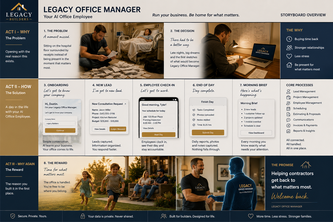
The company appears to be a solo-project, self-reported AI-powered office assistant for small business owners, built as part of an OpenAI hackathon. The author states the product aims to help small business owners organize schedules, communications, leads, and priorities through natural voice interaction. It is described as a prototype using OpenAI technologies (Codex, GPT-5.6), n8n workflows, SvelteKit, GitHub, and Cloudflare Pages.
What changed: The author reports building a working prototype over the course of a hackathon, integrating voice interaction and business workflows into an interface they describe as a "Command Center". No evidence of prior development or product-market fit is provided.
Single most important open question: Is there any evidence of real-world usage, customer feedback, or traction beyond the author's own account?
Analysis basis: Self-reported only. The description is unverified and contains no data on revenue, customers, adoption, or performance metrics. All claims are from the author’s own submission.
What The Product Actually Is
The description states that Legacy Office Manager is an AI-powered office manager designed for small business owners. It organizes schedules, communications, leads, and daily priorities through natural voice interaction. The system integrates with business workflows and allows human confirmation of important decisions.
It was built using OpenAI technologies including Codex and GPT-5.6, along with n8n workflows, SvelteKit, GitHub, and Cloudflare Pages.
Inference: The product is described as a prototype, not a commercial offering. No evidence of deployment or live usage exists in the description.
Positioning & Claim Evolution
The author positions Legacy Office Manager as an AI-powered office employee for small businesses, aiming to help them reclaim time by automating administrative tasks. It is framed as more than a chatbot — it is described as a Command Center that organizes business information and allows human control over key decisions.
Claim: The product helps entrepreneurs "reclaim their time so they can focus on growing their businesses and spending more time with the people who matter most."
Inference: This positioning reflects a shift from generic AI tools to a specific, task-oriented assistant tailored for small business owners. No evidence of prior market research or competitor analysis is provided.
Target Customer & ICP
The description states that Legacy Office Manager targets "small business owners", particularly those who spend too much time managing emails, phone calls, scheduling, estimates, and paperwork — such as general contractors.
Claim: The product is aimed at busy entrepreneurs who want to reduce administrative burden.
Inference: The ICP appears to be small business owners with limited time and high administrative overhead. No segmentation or customer personas are described.
Business Model & Pricing Evidence
No evidence of a business model or pricing structure is provided in the description. The author does not mention monetization, subscriptions, licensing, or any commercial framework.
Not evidenced: There is no indication of how the product would be sold or priced.
Technical & Delivery Signals
The project was built using:
- OpenAI technologies (Codex, GPT-5.6)
- n8n workflows
- SvelteKit
- GitHub
- Cloudflare Pages
It includes voice interaction and integrates business workflows into a single interface.
Inference: The use of multiple tools suggests a technical prototype with integration capabilities. No evidence of scalability or production-grade infrastructure is provided.
Traction & Maturity Signals
The description states that the product was built during a hackathon, iterated on user experience, and refined into a working prototype. It does not mention any users, customers, or real-world adoption.
Not evidenced: No data on traction, usage, or customer feedback is provided.
Competitive Context
No information about competitors or market positioning is included in the description. The author does not reference existing tools or platforms that address similar needs.
Not evidenced: There is no competitive analysis or awareness of the marketplace.
Open Questions & Risks
- Solo project: Only one team member is listed, which raises questions about execution capacity and scalability.
- Prototype only: The product is described as a prototype with no evidence of real-world usage or feedback.
- No commercial framework: No pricing, monetization, or business model is discussed.
- Unverified claims: All descriptions are self-reported and unverifiable.
Inference: The lack of traction, customers, or revenue data makes it difficult to assess viability or market demand.
Questions the description leaves open
- What specific administrative tasks do you believe the product solves for small business owners?
- Have you tested the prototype with real users? If so, what feedback did you receive?
- How does the product differentiate from existing tools like Calendly, Slack, or Notion?
- What is your plan to monetize this tool?
- Are there any technical limitations that prevent scaling beyond a prototype?
Overall Assessment
Not evidenced: No data on revenue, customers, traction, or commercial viability exists in the description.
Inference: The project appears to be an early-stage prototype with no demonstrated market fit or business model. It is not ready for investment or partnership without further evidence of traction, user feedback, or product-market alignment.
User Stories BotA demo video on every pull request
Get a demo video on every new feature
GitHub App that watches your pull requests and records a narrated, captioned demo.
Save time on demo prep and make informed decisions faster with a video walkthrough of every new feature.
Source
Submitted to the OpenAI 2026 hackathon on Devpost. Project home on Devpost. Back to the full gallery on Devpost.
This competitive analysis was produced by top-founders.com (opens in a new tab)
Generated by a language model from this project's public Devpost page — its tagline, the author's own write-up and any built-with tags listed there — as captured in August 2026. Short quotations are the author's words. It is an opinion on the idea as a business, not on the people behind it, and it reflects the description as published then. If the project has moved on, request a correction below. The analysis is not independent research and contains no verified traction, revenue or customer data.
An independent guide by KFG International LLC — not affiliated with, endorsed by, or connected to Devpost or OpenAI.