

Archive position — measured, not model output
1 like on Devpost
505 of the 7,850 archived projects have more likes, and 1,758 share exactly 1 — so this project's #1,017 place in the like-ranked listing is a tie-break inside that group, not a ranking.
Projects (log scale)
Likes on Devpost. ▲ marks this project's group.
Show the figures
| Likes | Projects | Share of archive |
|---|---|---|
| 0 | 5,587 | 71.2% |
| 1 | 1,758 | 22.4% |
| 2 | 284 | 3.6% |
| 3–4 | 132 | 1.7% |
| 5–9 | 75 | 1.0% |
| 10+ | 14 | 0.2% |
 User Stories BotA demo video on every pull request
Get a demo video on every new feature
GitHub App that watches your pull requests and records a narrated, captioned demo.
Save time on demo prep and make informed decisions faster with a video walkthrough of every new feature.
Executive Summary
What the company appears to be
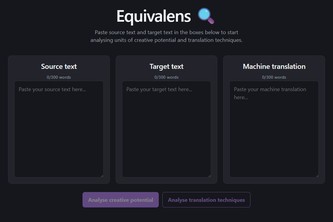
Equivalens is a self-reported research-based human-in-the-loop annotation assistant for literary translation. The author states it is built to help language students and researchers analyse translation techniques by identifying units of creative potential in source texts, labelling them with types of translation challenges, and then mapping how those challenges were handled in target translations (human or machine). It uses a taxonomy from a co-authored academic paper and integrates with the Mistral API.
What changed
The project was built during OpenAI Build Week as a full-stack web application. The author reports using Codex and GPT 5.6 to guide development, including debugging, architecture planning, and deployment. It is described as a personal accomplishment overcoming perfectionism and ADHD-related barriers to coding.
Single most important open question
Is there any evidence of actual use by students or researchers beyond the author's own academic context? The description does not provide any data on adoption, feedback, or traction — only claims about intent and design.
What The Product Actually Is
The description states that Equivalens is a human-in-the-loop annotation assistant for literary translation. It allows users to upload a source text and one or more target texts (human or machine translations). The system identifies “units of creative potential” — words or phrases that pose translation challenges — and labels them according to the type of problem they present (e.g., cultural variants, metaphors, colloquial language).
It then maps how these units were addressed in the target text(s), assigning a label describing the translation technique used, rationale for the choice, and a confidence score (low, medium, high). This is intended to give students and researchers a structured starting point for analysis.
The tool uses a taxonomy derived from a co-authored academic paper published in 2025. It was built as a full-stack web application using Python (FastAPI backend), React/Vite frontend, and integrates with the Mistral API for runtime annotation requests. Deployment was done via Render.
Evidence Self-reported by the author; no independent verification or demonstration of functionality beyond the project write-up.
Positioning & Claim Evolution
The author positions Equivalens as a research tool for translation students and scholars, aiming to make the annotation process easier and more scalable than manual methods. It is described as helping users understand how both humans and machines approach translation decisions, especially in light of GenAI advancements that blur the lines between intentional craft and machine output.
The project evolved from an academic research paper co-authored by the author, where she and her team had to manually hire annotators due to time and cost constraints. The tool was developed to address this inefficiency while also supporting deeper analysis of translation workflows.
Claims made
- To help students and researchers understand translation techniques.
- To make annotation scalable for under-resourced academic settings.
- To support the visibility of human vs. machine creativity in translation.
- To be grounded in real research (from a 2025 paper).
Evidence All claims are self-reported; no external validation or user feedback provided.
Target Customer & ICP
The author states that Equivalens is intended for:
- Language students
- Researchers studying translation workflows
- Translation scholars who may use it to analyze their own work or teach others
It is also positioned as useful in under-resourced academic environments, where manual annotation is prohibitively expensive or time-consuming.
The tool is described as being built with a focus on usability, suggesting an interface that allows immediate use without steep learning curves.
Evidence Self-reported; no evidence of actual users, customer segments, or market testing beyond the author’s personal experience and academic context.
Business Model & Pricing Evidence
There is no evidence in the description of any business model or pricing structure. The author mentions future plans to make it available free, open-source, and maintained as a resource for the translation community, but no current monetization strategy is described.
Evidence Not evidenced.
Technical & Delivery Signals
Equivalens was built as a full-stack web application, using:
- Backend: FastAPI
- Frontend: React + Vite
- Integration: Mistral API
- Deployment: Render
- Development tools: Codex, GPT 5.6
The author reports using AI assistance extensively throughout the build process, including for debugging, architecture decisions, and deployment troubleshooting.
Evidence Self-reported; no demonstration or technical documentation beyond what is described in the write-up.
Traction & Maturity Signals
There is no evidence of traction or maturity. The project was built during a hackathon (OpenAI Build Week), and the author indicates it is still in early development stages. No users, customers, revenue, or usage metrics are mentioned.
The author states that she is planning to conduct formal evaluations against human-annotated datasets and publish a paper documenting the tool — but no such evaluation or publication has occurred yet.
Evidence Not evidenced.
Competitive Context
There is no evidence of competitive analysis or awareness of existing tools in this niche. The description does not mention any comparable products, platforms, or tools used for literary translation annotation or analysis.
The author notes that the tool is based on a specific academic taxonomy and is designed to support research workflows — but no comparison with other systems is made.
Evidence Not evidenced.
Open Questions & Risks
- No traction or adoption: The project appears to be a prototype built for a hackathon, with no evidence of real-world usage.
- Unproven utility: While the author claims it helps students and researchers, there is no data on whether users find it useful or effective.
- Limited scalability assumptions: The tool is described as addressing manual annotation inefficiencies but lacks any indication of how it might scale beyond a single developer’s effort.
- Dependency on AI tools: Heavy reliance on Codex and GPT 5.6 raises questions about long-term maintainability if those services change or become unavailable.
- Lack of commercial viability: No business model, pricing, or monetization strategy is evident.
Evidence Inferred from lack of evidence; not directly stated but implied by absence of key signals.
Questions the description leaves open
- Has the tool been tested with actual students or researchers? What feedback have you received?
- Are there any existing academic institutions or translation programs interested in using this tool?
- How do you plan to validate its accuracy and reliability against human annotations?
- What is your roadmap for moving from a prototype to a scalable, maintainable product?
- Do you intend to pursue funding or partnerships to support further development?
- Have you considered how the tool would integrate into existing academic workflows or LMS platforms?
Overall Assessment
There is no evidence of commercial traction, revenue, or customer adoption. The project is described as a personal achievement and prototype built during a hackathon, with no indication that it has moved beyond experimental use.
The author expresses intentions to publish a paper and make the tool open-source, but these are future plans rather than current realities.
Given the lack of evidence for product-market fit, user validation, or scalability, this project does not demonstrate readiness for investment or partnership at this stage. It may be considered a proof-of-concept or early-stage idea with potential, but lacks the commercial due-diligence signals required to assess viability.
Evidence Self-reported only; no third-party data, revenue, or user engagement provided.
User Stories BotA demo video on every pull request
Get a demo video on every new feature
GitHub App that watches your pull requests and records a narrated, captioned demo.
Save time on demo prep and make informed decisions faster with a video walkthrough of every new feature.
Source
Submitted to the OpenAI 2026 hackathon on Devpost. Project home on Devpost. Back to the full gallery on Devpost.
This competitive analysis was produced by top-founders.com (opens in a new tab)
Generated by a language model from this project's public Devpost page — its tagline, the author's own write-up and any built-with tags listed there — as captured in August 2026. Short quotations are the author's words. It is an opinion on the idea as a business, not on the people behind it, and it reflects the description as published then. If the project has moved on, request a correction below. The analysis is not independent research and contains no verified traction, revenue or customer data.
An independent guide by KFG International LLC — not affiliated with, endorsed by, or connected to Devpost or OpenAI.