

Archive position — measured, not model output
1 like on Devpost
505 of the 7,850 archived projects have more likes, and 1,758 share exactly 1 — so this project's #1,338 place in the like-ranked listing is a tie-break inside that group, not a ranking.
Projects (log scale)
Likes on Devpost. ▲ marks this project's group.
Show the figures
| Likes | Projects | Share of archive |
|---|---|---|
| 0 | 5,587 | 71.2% |
| 1 | 1,758 | 22.4% |
| 2 | 284 | 3.6% |
| 3–4 | 132 | 1.7% |
| 5–9 | 75 | 1.0% |
| 10+ | 14 | 0.2% |
 User Stories BotA demo video on every pull request
Get a demo video on every new feature
GitHub App that watches your pull requests and records a narrated, captioned demo.
Save time on demo prep and make informed decisions faster with a video walkthrough of every new feature.
Executive Summary
Learnimi is a self-reported educational tool designed to help children learn safety lessons through an animated companion derived from a familiar toy. The product appears to be a prototype built for the OpenAI 2026 hackathon, with no evidence of revenue, customers or traction beyond the author’s own account.
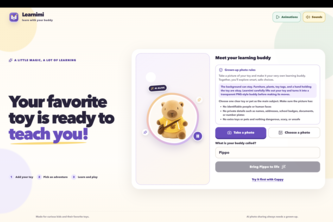
The description states that Learnimi allows a grown-up to approve a photo of a toy and create a learning buddy for a child, choosing from four safety themes: road, online, home, and big feelings. The companion stays with the learner throughout the journey, demonstrating actions, reacting to quizzes, and celebrating completed lessons.
Key commercial due-diligence questions include:
- Is there any evidence of user testing or feedback?
- What is the actual scope of the "learning buddy" experience?
- How does the platform ensure safety without persistent data storage?
The most important open question: What is the actual educational value and learning outcome of this experience, as opposed to just a visual companion?
This analysis is based entirely on self-reported information from the author’s Devpost submission. No independent verification or external evidence exists.
What The Product Actually Is
The description states that Learnimi:
- Allows a grown-up to approve a photo of a toy
- Creates a learning buddy for a child
- Offers four safety-themed adventures: road, online, home, and big feelings
- Uses the same companion throughout the learning journey
- Demonstrates actions, reacts to quiz answers, and celebrates completed lessons
The product is built using:
- React and TypeScript frontend
- Express.js backend
- OpenAI tools including GPT-5.6, GPT Image, Codex, moderation API
- IndexedDB for local storage
- Sora for animation (noted as a tool used but not described in detail)
- Text-to-speech
Not evidenced:
- Whether the product is currently live or available to users
- The actual functionality of the learning buddy beyond visual representation
- How lessons are structured or delivered
- Any form of curriculum or assessment mechanism
Positioning & Claim Evolution
The author states that Learnimi aims to make safety lessons less abstract and boring for kids by using a familiar, cozy companion. It claims to:
- Help children learn in a fun, responsible, and safe way
- Provide one vivid and cute animated companion that visibly demonstrates a bounded learning curriculum
- Offer a complete, responsive journey best suited for kids
The positioning appears to be centered on:
- Child safety
- Familiarity and comfort (using toys)
- Visual engagement through animation
- Parental approval and control
Inferences:
- The product is positioned as an educational tool for young children.
- It emphasizes emotional connection and visual learning.
Not evidenced:
- How the companion’s actions relate to actual learning outcomes
- Whether the platform supports adaptive learning or personalized paths
- Any claims about measurable impact on child behavior or knowledge retention
Target Customer & ICP
The description states that Learnimi is intended for:
- Kids (as learners)
- Grown-ups (as approvers and facilitators)
It implies a focus on:
- Parents or educators who want to teach safety lessons
- Children aged 3–10, based on the context of "big feelings" and "safety"
Not evidenced:
- Specific age ranges or developmental stages targeted
- Any segmentation beyond general parental involvement
- Whether there are plans for different user roles or access levels
Business Model & Pricing Evidence
The description does not state any pricing model or business model.
Inferences:
- Since the product is a hackathon submission, it likely has no commercial model at this stage.
- The author mentions that "the original upload is NOT persisted by Learnimi," suggesting no data monetization or long-term user retention strategy.
Not evidenced:
- Revenue streams
- Subscription or usage fees
- Any monetization plans
- Customer acquisition costs
Technical & Delivery Signals
The product is built with:
- React and TypeScript frontend
- Express.js backend
- OpenAI tools including GPT-5.6, GPT Image, Codex, moderation API
- IndexedDB for local storage
- Sora for animation (not elaborated)
- Playwright for browser feedback integration
Key technical notes from the author:
- Images are normalized and stripped of metadata before evaluation
- OpenAI moderation and GPT-5.6 provide safety boundaries around generated content
- Media is stored locally in IndexedDB, not persisted
- The system supports recovery behavior and automated verification
Inferences:
- The product prioritizes child privacy and data security.
- It uses AI for both content generation and safety control.
Not evidenced:
- Scalability or infrastructure details
- Deployment environment or hosting platform
- Any form of API or integration with other systems
Traction & Maturity Signals
The description states that this is a hackathon submission (OpenAI 2026) and does not include any evidence of:
- Revenue
- Customers
- User adoption
- Product usage metrics
- Market validation
Inferences:
- The product is in early development or prototype stage.
- It has no known traction or market presence.
Not evidenced:
- Any form of user testing or feedback
- Product roadmap or future releases
- Metrics on engagement or completion rates
Competitive Context
The description does not mention any competitors or existing solutions in the space of child safety education or AI-powered learning tools.
Inferences:
- The author may not have researched the competitive landscape.
- There is no indication of how Learnimi compares to other educational platforms or apps.
Not evidenced:
- Competitor analysis
- Market size or trends
- Similar products or platforms
Open Questions & Risks
Key risks and open questions based on the self-reported description:
- No Evidence of Real Users or Feedback
- The product is a hackathon submission with no mention of user testing or feedback.
- Unproven Educational Value
- While it claims to teach safety, there’s no evidence that the learning buddy actually improves educational outcomes.
- Privacy and Data Handling Concerns
- Although the original upload is not persisted, the use of AI tools like GPT-5.6 raises questions about data handling and compliance with child privacy laws (e.g., COPPA).
- Lack of Scalability or Long-Term Vision
- The product appears to be a one-off prototype without any indication of how it might scale or evolve.
- Unclear Learning Path Design
- It is unclear how lessons are structured, delivered, or assessed beyond the visual companion.
Questions the description leaves open
- What specific safety outcomes are you trying to achieve with this tool?
- Have you conducted any user testing with children or parents?
- How do you plan to validate that learning actually occurs through the use of the animated companion?
- Is there a mechanism for collecting feedback from educators or caregivers?
- What is your long-term vision for Learnimi beyond the hackathon?
- Are there any plans to integrate with existing educational frameworks or standards?
- How do you ensure compliance with privacy regulations like COPPA or GDPR in handling child data?
Overall Assessment
Not evidenced
The description does not provide sufficient information to assess whether Learnimi is a viable investment or partnership opportunity.
Inferences:
- The product is currently in prototype form and lacks commercial traction.
- It may have potential for educational impact but requires further development, testing, and validation.
No evidence exists of:
- Revenue or profitability
- Customer base or market demand
- Product-market fit
- Scalable business model
This is a preliminary concept with no demonstrated commercial viability. Further due diligence would require access to actual users, usage data, or product demos beyond the self-reported account.
User Stories BotA demo video on every pull request
Get a demo video on every new feature
GitHub App that watches your pull requests and records a narrated, captioned demo.
Save time on demo prep and make informed decisions faster with a video walkthrough of every new feature.
Source
Submitted to the OpenAI 2026 hackathon on Devpost. Project home on Devpost. Back to the full gallery on Devpost.
This competitive analysis was produced by top-founders.com (opens in a new tab)
Generated by a language model from this project's public Devpost page — its tagline, the author's own write-up and any built-with tags listed there — as captured in August 2026. Short quotations are the author's words. It is an opinion on the idea as a business, not on the people behind it, and it reflects the description as published then. If the project has moved on, request a correction below. The analysis is not independent research and contains no verified traction, revenue or customer data.
An independent guide by KFG International LLC — not affiliated with, endorsed by, or connected to Devpost or OpenAI.