

Archive position — measured, not model output
0 likes on Devpost
2,263 of the 7,850 archived projects have more likes, and 5,587 share exactly 0 — so this project's #3,301 place in the like-ranked listing is a tie-break inside that group, not a ranking.
Projects (log scale)
Likes on Devpost. ▲ marks this project's group.
Show the figures
| Likes | Projects | Share of archive |
|---|---|---|
| 0 | 5,587 | 71.2% |
| 1 | 1,758 | 22.4% |
| 2 | 284 | 3.6% |
| 3–4 | 132 | 1.7% |
| 5–9 | 75 | 1.0% |
| 10+ | 14 | 0.2% |
 User Stories BotA demo video on every pull request
Get a demo video on every new feature
GitHub App that watches your pull requests and records a narrated, captioned demo.
Save time on demo prep and make informed decisions faster with a video walkthrough of every new feature.
Executive Summary
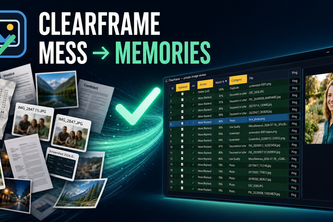
Clearframe is a self-reported local-first Windows desktop application designed to help users organize their photo libraries by categorizing images into types such as duplicates, documents, screenshots, blurry shots, and true memories. The app scans user-selected folders locally without uploading data to the cloud, and offers explanations for its recommendations before any action is taken.
The author states that Clearframe was built using Python 3.12 with PySide6/Qt, OpenCV, Tesseract OCR, and PyInstaller. It is described as a single-person project submitted to the OpenAI 2026 hackathon.
Key commercial due-diligence read
The description provides no evidence of revenue, customers, or product adoption. The stated functionality appears to be a proof-of-concept or prototype with no indication of market traction or business model execution.
Most important open question
Is there any evidence that the author has begun building a sustainable business around this idea, or whether they have validated demand from users beyond their own use case?
What The Product Actually Is
The description states that Clearframe is:
- A local-first Windows desktop app
- For reviewing an image folder safely
- That scans only folders the user selects
- Which explains its recommendations for categories like duplicates, screenshots, documents, thumbnails, low-quality images, photos, and items needing review
- Where nothing is moved, deleted, or edited during scanning
- And where users decide what should happen next
The author also notes that:
- The app uses Python 3.12, PySide6/Qt, OpenCV, Tesseract OCR, and PyInstaller
- It supports offline OCR with a bundled Tesseract runtime
- Scanning is done in worker threads to keep UI responsive
- Packaging is via PyInstaller and NSIS for a per-user Windows installer
This is a self-reported description of a desktop image organization tool. No evidence exists regarding actual product usage, performance metrics, or user feedback.
Positioning & Claim Evolution
The author claims:
- Clearframe addresses the problem of messy local photo folders
- It aims to provide a privacy-focused alternative to cloud-based solutions like Google Photos and OneDrive
- The app allows users to reclaim space by separating useful from useless images
- It offers automatic categorization without requiring cloud uploads or opaque third-party services
The positioning appears to be:
- A privacy-conscious, local-first solution
- For personal photo library cleanup
- With a user-controlled decision-making process
There is no evidence of prior versions, product evolution, or market positioning beyond this single project submission. The claims are self-reported and unverified.
Target Customer & ICP
The description states:
- The app targets users who take photos for various purposes: memories, receipts, documents, etc.
- It addresses the issue of messy local photo folders
- Users may be concerned about privacy and not wanting to upload private images to cloud services
- The tool is intended for people who want to organize their own image collections
No specific customer segments or personas are identified. No evidence exists regarding:
- Who specifically uses the app (e.g., individuals, professionals, small businesses)
- Whether there's a defined ideal customer profile beyond general "users"
- Any segmentation strategy or targeting approach
Business Model & Pricing Evidence
The description does not contain any information about:
- Revenue streams
- Pricing models
- Monetization strategies
- Subscription plans or one-time purchases
- Paid features or freemium offerings
There is no evidence of a business model beyond the self-reported project idea.
Technical & Delivery Signals
According to the author:
- The app is built with Python 3.12, PySide6/Qt, OpenCV, Tesseract OCR
- It uses Pillow, NumPy for image analysis
- Scanning is performed using worker threads to avoid UI lag
- OCR is done offline via a bundled Tesseract runtime
- The app is packaged as a per-user Windows installer with no API keys or admin permissions required
The author also mentions:
- Use of Codex for development acceleration
- Automated testing and linting
- Performance optimizations like bounded previews and cached detectors
- An opt-in Deep Scan feature
These are self-reported technical details, not verified by independent sources.
Traction & Maturity Signals
There is no evidence of:
- Revenue generation
- Customer base or user adoption
- Product usage statistics
- Market validation or feedback
- Iteration history or product maturity beyond the initial prototype
The project is described as a single-person hackathon submission, with no indication of ongoing development, user testing, or commercial traction.
Competitive Context
The description does not mention:
- Direct competitors
- Indirect substitutes
- Market size or growth trends
- Competitive advantages or differentiation strategies
It only implies that Clearframe is positioned as an alternative to cloud-based photo management tools like Google Photos and OneDrive. No competitive analysis or positioning relative to existing tools is provided.
Open Questions & Risks
Key risks and open questions include:
- No evidence of product-market fit or traction
- Single-person project with no team, business model, or go-to-market strategy
- Unverified claims about functionality and privacy features
- Lack of user feedback or real-world testing
- No indication of scalability or monetization plans
- Potential technical limitations in image recognition accuracy or performance
The app is presented as a prototype with no evidence of commercial viability.
Questions the description leaves open
- What specific problems are users experiencing with their current photo organization methods?
- Have you conducted any user interviews or usability tests?
- How do you plan to monetize this tool, if at all?
- Are there any existing competitors in the local-first image organization space?
- What is your roadmap for product development beyond the current prototype?
- Do you have any plans to expand beyond Windows or support other platforms?
- How do you intend to validate demand and attract early adopters?
Overall Assessment
There is no evidence of:
- Revenue
- Customers
- Product adoption
- Business model execution
- Market traction
The project is described as a single-person hackathon submission, with no indication of commercial viability or strategic value beyond its conceptual stage.
This is a self-reported prototype with no verified product-market fit, user feedback, or business momentum. It cannot be evaluated for investment or partnership potential based on the provided information alone.
Assessment Not evidenced.
User Stories BotA demo video on every pull request
Get a demo video on every new feature
GitHub App that watches your pull requests and records a narrated, captioned demo.
Save time on demo prep and make informed decisions faster with a video walkthrough of every new feature.
Source
Submitted to the OpenAI 2026 hackathon on Devpost. Project home on Devpost. Back to the full gallery on Devpost.
This competitive analysis was produced by top-founders.com (opens in a new tab)
Generated by a language model from this project's public Devpost page — its tagline, the author's own write-up and any built-with tags listed there — as captured in August 2026. Short quotations are the author's words. It is an opinion on the idea as a business, not on the people behind it, and it reflects the description as published then. If the project has moved on, request a correction below. The analysis is not independent research and contains no verified traction, revenue or customer data.
An independent guide by KFG International LLC — not affiliated with, endorsed by, or connected to Devpost or OpenAI.