

Archive position — measured, not model output
1 like on Devpost
505 of the 7,850 archived projects have more likes, and 1,758 share exactly 1 — so this project's #1,339 place in the like-ranked listing is a tie-break inside that group, not a ranking.
Projects (log scale)
Likes on Devpost. ▲ marks this project's group.
Show the figures
| Likes | Projects | Share of archive |
|---|---|---|
| 0 | 5,587 | 71.2% |
| 1 | 1,758 | 22.4% |
| 2 | 284 | 3.6% |
| 3–4 | 132 | 1.7% |
| 5–9 | 75 | 1.0% |
| 10+ | 14 | 0.2% |
 User Stories BotA demo video on every pull request
Get a demo video on every new feature
GitHub App that watches your pull requests and records a narrated, captioned demo.
Save time on demo prep and make informed decisions faster with a video walkthrough of every new feature.
Executive Summary
What the company appears to be
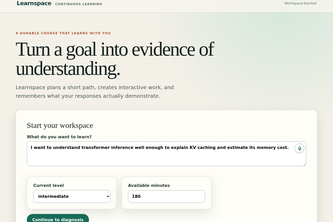
Learnspace is a self-reported agent-directed learning environment built as a Node.js/Express application using OpenAI’s Codex for its intelligence layer. It claims to diagnose knowledge gaps, author lessons, and adapt learning paths in a local filesystem.
What changed
The project was submitted to the OpenAI 2026 hackathon, indicating it is an early-stage prototype or proof-of-concept with no evidence of commercial traction or product-market fit.
Single most important open question
Is there any evidence that Learnspace has been used by learners beyond its author, and if so, how does it perform in real-world learning scenarios?
Analysis basis
The entire report is based on the self-reported description provided by the author. No external verification or historical data are available.
What The Product Actually Is
- The description states that Learnspace is a Node.js/Express application with a browser-based interface.
- It uses OpenAI’s Codex app-server as its intelligence layer.
- The system allows users to input learning goals (e.g., “understand how a GPU differs from a CPU”), and then diagnoses what the user needs to learn, drafts a plan, and generates an interactive activity tailored to that topic.
- Learnspace stores plans, activities, submissions, and assessments locally in a
.learnspace/folder. - It includes a chat-based companion that offers hints or questions but refuses to simply give answers.
- The core architectural principle is: "the model proposes, the host decides."
- Codex runs read-only without network access, and generated activities run inside a browser sandbox.
Inference Based on the description, Learnspace appears to be an experimental tool for personalized learning using AI agents. It is not yet a commercial product or platform with measurable adoption.
Positioning & Claim Evolution
- The tagline states: “Learnspace is an agent-directed learning environment for any topic.”
- The write-up claims that it diagnoses knowledge, authors lessons, and adapts the next step — all within the user's local filesystem.
- It positions itself as a tool that supports self-directed learning with AI assistance, emphasizing control over content generation through validation by the host.
- The author notes challenges in handling malformed outputs, making long assessments feel intentional, and teaching the companion to help without doing the thinking for the learner.
Claim vs. Fact
These are claims made by the author about the product’s functionality and design philosophy. No evidence of actual usage or performance is provided.
Target Customer & ICP
- The description does not identify a specific customer segment or target persona.
- It implies use by individuals seeking to learn new topics (e.g., GPU vs CPU).
- There is no indication of whether this is aimed at students, professionals, educators, or general learners.
Not evidenced No explicit identification of the ideal customer profile (ICP), including demographics, job roles, or learning contexts.
Business Model & Pricing Evidence
- The description does not mention any pricing model, monetization strategy, or business model.
- There is no indication of whether Learnspace intends to be free, subscription-based, or sold as part of a larger platform.
Not evidenced No evidence of a defined business model or pricing structure.
Technical & Delivery Signals
- Built with: codex, express.js, gpt-5.6, node.js
- The application is a Node and Express app with a browser-based interface.
- Uses Codex as the intelligence layer; runs read-only without network access.
- Activities are sandboxed in the browser.
- Model output is validated before being saved to the learner's files.
- Core architectural rule: “the model proposes, the host decides.”
- The system stores data locally in a
.learnspace/folder.
Inference The technical stack suggests a lightweight, local-first approach with strong emphasis on user control and sandboxing. However, there is no evidence of scalability or deployment beyond prototype status.
Traction & Maturity Signals
- The project was submitted to the OpenAI 2026 hackathon.
- It has one team member: Akash Tandon.
- No evidence of revenue, customers, or adoption metrics.
- The author mentions future plans such as more activity formats, sharper diagnostics, and voice-based learning — indicating this is still in development.
Not evidenced No signs of traction, usage, or product maturity beyond a hackathon submission.
Competitive Context
- The description does not reference competitors or similar tools.
- It does not describe how Learnspace compares to existing platforms for personalized learning or AI-assisted education.
- No mention of market positioning relative to other edtech or AI learning tools.
Not evidenced No competitive analysis or awareness of the broader landscape.
Open Questions & Risks
- The project is described as a hackathon submission, suggesting it may be an early prototype with limited functionality or scalability.
- There is no evidence of real-world testing or user feedback.
- The system relies heavily on validation by the host, which could limit automation and scalability.
- No clear path to monetization or customer acquisition is evident.
- The lack of team size information beyond one person raises questions about execution capability.
Inference The risk of failure lies in unproven assumptions around user behavior, adoption, and long-term viability without further development or traction.
Questions the description leaves open
- What specific learning outcomes have you observed from users who tested this tool?
- How do you plan to scale beyond a single developer's prototype?
- Have you conducted any usability studies or gathered feedback from learners?
- Is there a roadmap for integrating external content sources or APIs?
- What are your plans for monetization and customer acquisition?
- How does the system handle edge cases in model outputs, especially when they are malformed?
Overall Assessment
- Not evidenced No evidence of commercial traction, revenue, or market validation.
- The project appears to be a hackathon prototype with no clear path to product-market fit or scalability.
- It is unclear whether the tool has been used beyond its creator or if it addresses a real market need.
- Given its current state and lack of external validation, there is insufficient basis for investment or partnership consideration at this time.
Confidence level Low. This analysis is based entirely on self-reported information with no corroboration or historical data.
User Stories BotA demo video on every pull request
Get a demo video on every new feature
GitHub App that watches your pull requests and records a narrated, captioned demo.
Save time on demo prep and make informed decisions faster with a video walkthrough of every new feature.
Source
Submitted to the OpenAI 2026 hackathon on Devpost. Project home on Devpost. Back to the full gallery on Devpost.
This competitive analysis was produced by top-founders.com (opens in a new tab)
Generated by a language model from this project's public Devpost page — its tagline, the author's own write-up and any built-with tags listed there — as captured in August 2026. Short quotations are the author's words. It is an opinion on the idea as a business, not on the people behind it, and it reflects the description as published then. If the project has moved on, request a correction below. The analysis is not independent research and contains no verified traction, revenue or customer data.
An independent guide by KFG International LLC — not affiliated with, endorsed by, or connected to Devpost or OpenAI.