

Archive position — measured, not model output
0 likes on Devpost
2,263 of the 7,850 archived projects have more likes, and 5,587 share exactly 0 — so this project's #4,888 place in the like-ranked listing is a tie-break inside that group, not a ranking.
Projects (log scale)
Likes on Devpost. ▲ marks this project's group.
Show the figures
| Likes | Projects | Share of archive |
|---|---|---|
| 0 | 5,587 | 71.2% |
| 1 | 1,758 | 22.4% |
| 2 | 284 | 3.6% |
| 3–4 | 132 | 1.7% |
| 5–9 | 75 | 1.0% |
| 10+ | 14 | 0.2% |
 User Stories BotA demo video on every pull request
Get a demo video on every new feature
GitHub App that watches your pull requests and records a narrated, captioned demo.
Save time on demo prep and make informed decisions faster with a video walkthrough of every new feature.
Executive Summary
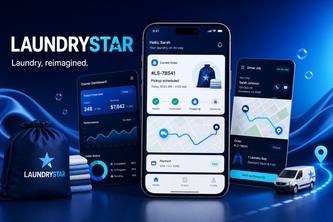
Laundrystar is a self-reported software platform built by one developer (Ken Y) to streamline pickup-and-delivery operations for laundromats. The project was submitted to the OpenAI 2026 hackathon and is described as a solution to gaps in existing products, based on the author’s experience managing a laundromat. It integrates ordering, scheduling, delivery, payments, and rewards into one system, with an emphasis on giving laundry owners control to scale.
The description states that the platform was built using GPT-5.6 and Codex, along with Firebase, Node.js, React, Stripe, and TypeScript. The author claims it addresses real-world operational challenges but does not provide evidence of revenue, customers, or adoption.
Key open question: Is there any evidence of real-world usage or traction beyond the single developer’s account?
What The Product Actually Is
The description states that Laundrystar is a platform designed to unify:
- Ordering
- Pickup
- Delivery
- Payments
- Rewards
- Operations
It aims to support laundromat workflows by integrating these functions into one system. The author notes that it was built using GPT-5.6 and Codex, and technologies include Firebase, Node.js, React, Stripe, and TypeScript.
Inference: Based on the description, Laundrystar appears to be a SaaS or web-based platform tailored for laundromat operators, with a focus on delivery logistics and customer engagement.
Positioning & Claim Evolution
The author positions Laundrystar as:
- A better solution than existing products
- Built based on real-world experience managing a laundromat
- Designed around actual laundromat workflows
- Capable of helping laundry owners scale operations
It is described as solving “genuine problems” for laundromat owners, employees, drivers, and customers.
Inference: The positioning reflects an attempt to address inefficiencies in traditional laundromat operations through digital integration. However, the claim of being a better solution is self-reported and not substantiated by external validation or data.
Target Customer & ICP
The description states that Laundrystar serves:
- Laundry owners
- Employees
- Drivers
- Customers
It is explicitly positioned for laundromat operators, with the goal of helping them scale their business through improved operational tools.
Inference: The target customer segment appears to be small-to-medium-sized laundromat businesses that are looking to digitize or improve their delivery and scheduling processes. However, no evidence of specific customer profiles or segmentation is provided.
Business Model & Pricing Evidence
The description does not include any information about:
- Revenue model
- Pricing structure
- Monetization strategy
It only states that the platform integrates payments and rewards, but does not elaborate on how it generates income.
Inference: No evidence of a business model or pricing is available from the self-reported description. The author's focus is on solving operational problems rather than commercial viability.
Technical & Delivery Signals
The project was built using:
- GPT-5.6 and Codex
- Firebase
- Node.js
- React
- Stripe
- TypeScript
It is described as a functional application designed around laundromat workflows, with features requiring careful planning, testing, and refinement.
Inference: The use of AI tools like Codex suggests an accelerated development process. However, no information is provided on scalability, architecture, or deployment practices beyond the tech stack mentioned.
Traction & Maturity Signals
The description states:
- The platform was built in a hackathon
- It has been refined through real-world testing and feedback
- The author plans to expand its capabilities and help more laundromats modernize
There is no mention of:
- Customers or users
- Revenue or monetization
- Product adoption or usage metrics
- Any measurable traction beyond the developer’s own account
Inference: No evidence of traction or maturity is provided. The project appears to be in early development or prototype stage, with no indication of real-world deployment or user engagement.
Competitive Context
The description states that existing products do not fully support real-world operations, implying a gap in the market for such solutions.
However, there is no mention of:
- Competitors
- Market size
- Competitive advantages
- Differentiation from other platforms
Inference: The competitive landscape is unknown. The author claims a gap exists but does not provide evidence to support this or identify who else might be serving this space.
Open Questions & Risks
Key risks and open questions based on the self-reported description:
- Single developer team (1 person) raises concerns about scalability, maintenance, and feature development
- No revenue or customer data suggests no proven commercial traction
- Self-reported claims without independent verification
- Hackathon project implies early-stage development with limited testing or real-world validation
- Use of AI tools like GPT-5.6 may indicate a lack of deep technical architecture or long-term maintainability
Inference: The platform lacks commercial proof-of-concept, and the single-person team raises questions about execution capability.
Questions the description leaves open
- What specific operational inefficiencies in laundromats does Laundrystar address?
- Have you conducted any user testing with actual laundromat owners or employees?
- How do you plan to monetize the platform, and what is your pricing model?
- What are the key features that differentiate Laundrystar from other delivery or operations platforms?
- Are there any existing partnerships or pilot programs with laundromats?
- What is the timeline for scaling beyond the current prototype?
Overall Assessment
Not evidenced
The description provides no evidence of:
- Revenue
- Customers
- Traction
- Market validation
- Commercial viability
It is a self-reported, unverified account of a hackathon project by one developer. The author claims to have solved real-world problems but does not substantiate this with data or outcomes.
Confidence level: Low — the entire analysis rests on a single developer’s description, which is not independently verified and lacks any commercial evidence.
User Stories BotA demo video on every pull request
Get a demo video on every new feature
GitHub App that watches your pull requests and records a narrated, captioned demo.
Save time on demo prep and make informed decisions faster with a video walkthrough of every new feature.
Source
Submitted to the OpenAI 2026 hackathon on Devpost. Project home on Devpost. Back to the full gallery on Devpost.
This competitive analysis was produced by top-founders.com (opens in a new tab)
Generated by a language model from this project's public Devpost page — its tagline, the author's own write-up and any built-with tags listed there — as captured in August 2026. Short quotations are the author's words. It is an opinion on the idea as a business, not on the people behind it, and it reflects the description as published then. If the project has moved on, request a correction below. The analysis is not independent research and contains no verified traction, revenue or customer data.
An independent guide by KFG International LLC — not affiliated with, endorsed by, or connected to Devpost or OpenAI.