

Archive position — measured, not model output
0 likes on Devpost
2,263 of the 7,850 archived projects have more likes, and 5,587 share exactly 0 — so this project's #6,851 place in the like-ranked listing is a tie-break inside that group, not a ranking.
Projects (log scale)
Likes on Devpost. ▲ marks this project's group.
Show the figures
| Likes | Projects | Share of archive |
|---|---|---|
| 0 | 5,587 | 71.2% |
| 1 | 1,758 | 22.4% |
| 2 | 284 | 3.6% |
| 3–4 | 132 | 1.7% |
| 5–9 | 75 | 1.0% |
| 10+ | 14 | 0.2% |
 User Stories BotA demo video on every pull request
Get a demo video on every new feature
GitHub App that watches your pull requests and records a narrated, captioned demo.
Save time on demo prep and make informed decisions faster with a video walkthrough of every new feature.
Executive Summary
What the company appears to be
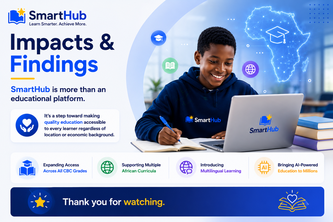
SomaHub is an AI-powered learning platform built for the Competency-Based Curriculum (CBC) in Kenya. The description states it provides structured lessons, quizzes, assessments, and AI-generated explanations organized by grade, subject, topic, and lesson. It aims to democratize education by making high-quality CBC content accessible anytime, anywhere.
What changed
This is a self-reported project submitted as part of the OpenAI 2026 hackathon. The author describes building an end-to-end educational platform with AI tutoring, intelligent search, progress tracking, and scalable architecture. It was built using Next.js, TypeScript, Firebase, PostgreSQL, and AI technologies like OpenAI.
The single most important open question
Is there any evidence of actual user adoption or traction beyond the hackathon submission? The description makes no claims about revenue, customers, usage metrics, or product-market fit beyond its own self-reporting.
What The Product Actually Is
The description states that SomaHub is an AI-powered learning platform built for the Competency-Based Curriculum (CBC). It offers:
- Structured lessons
- Revision notes
- Quizzes
- Assignments
- Assessments
- AI-generated explanations
All organized by Grade, Subject, Topic, and Lesson.
It also includes:
- Intelligent search
- Student progress tracking
- A scalable content management system for administrators
- Responsive dashboards for desktop and mobile users
The platform is described as supporting future expansion across all CBC grades.
Evidence
- The author's own write-up describes the product’s features.
- Technology stack includes Next.js, TypeScript, Firebase, PostgreSQL, AI tools like OpenAI.
Inference It appears to be a web-based educational tool targeting students in Kenya using the CBC framework.
Positioning & Claim Evolution
The description states that SomaHub aims to:
- Democratize learning
- Give every student instant access to high-quality CBC materials
- Help learners prepare for exams faster
- Enable intelligent search and personalized support via AI
- Make learning accessible anytime, anywhere
It positions itself as a platform that combines curriculum management, AI tutoring, and progress tracking into one seamless experience.
Evidence
- The tagline: “SomaSmart transforms CBC learning with AI-powered lessons, quizzes and personalized learning paths. Affordable, engaging and accessible—helping every student learn smarter, anytime, anywhere.”
- The project write-up emphasizes accessibility, personalization, and exam preparation.
Inference The positioning is focused on improving access to quality education in a resource-constrained environment (Kenya), using AI as a key enabler. It has evolved from a hackathon idea into a vision for a scalable educational platform.
Target Customer & ICP
The description states that SomaHub targets students preparing for exams, particularly those in the Competency-Based Curriculum (CBC) system in Kenya. It aims to help every student learn smarter, anytime, anywhere.
It also mentions:
- Teachers and parents may be part of the ecosystem (though not explicitly targeted)
- The platform supports multilingual support, offline learning, and gamification — suggesting broader audience intent
Evidence
- “We wanted learners to prepare for exams faster...”
- “Our vision is to make SomaHub the leading AI-powered learning platform for Africa.”
Inference The core ICP appears to be students in Kenya using CBC. Teachers and parents may be secondary users, but not clearly defined.
Business Model & Pricing Evidence
There is no evidence of pricing or business model in the description. The author does not state:
- How the platform will monetize
- Whether it’s freemium, subscription-based, or pay-per-use
- If there are plans for B2B or B2C models
- Any revenue streams or partnerships
Evidence
- No mention of pricing, subscriptions, or monetization strategy.
Inference The business model remains undefined in the self-reported description. It is unclear if this will be a free service, paid subscription, or another model entirely.
Technical & Delivery Signals
The platform was built using:
- Frontend: Next.js, TypeScript, Tailwind CSS
- Backend: Node.js, Firebase Authentication, Firestore, PostgreSQL
- AI Integration: OpenAI
- Other technologies: GraphQL, REST API, JWT, OAuth, HTML5, CSS3, JavaScript, SQL
It supports:
- Secure authentication
- Role-based access
- Scalable content management
- Intelligent search
- Responsive dashboards for desktop and mobile
Evidence
- The author’s own write-up details the tech stack.
- Mention of scalable architecture designed to support thousands of learners.
Inference The technical foundation suggests a modern, full-stack application with cloud infrastructure and AI integration. However, no evidence of production deployment or performance data is provided.
Traction & Maturity Signals
There is no evidence of traction or maturity beyond the hackathon submission:
- No mention of users, customers, or active learners
- No data on engagement, retention, or usage metrics
- No indication of product-market fit or real-world testing
- No revenue or funding information
Evidence
- The project was submitted to a hackathon.
- No references to live users, pilot programs, or adoption.
Inference This is an early-stage prototype or proof-of-concept. There is no evidence of traction or product-market fit.
Competitive Context
The description does not provide any information about:
- Competitors in the Kenyan or African educational technology space
- Existing platforms offering similar services
- Market differentiation strategies
Evidence
- No mention of competitors or competitive positioning.
Inference Without external context, it is impossible to assess how SomaHub compares to other tools in the market. The lack of competitive analysis makes this a blind spot for due diligence.
Open Questions & Risks
Key risks and open questions based on the self-reported description:
- No traction or user feedback: This is a hackathon project with no evidence of real-world usage.
- Unproven business model: No indication of how the platform will generate revenue.
- Limited team size: Only one member listed (John Makola).
- Unclear scalability: While described as scalable, there’s no evidence of performance or infrastructure testing.
- AI integration risk: The description mentions integrating AI but does not clarify its effectiveness or limitations.
- Market validation gap: No evidence that the CBC curriculum needs this type of solution.
Evidence
- Only one team member listed.
- No mention of users, revenue, or product-market fit.
- No data on performance or user experience.
Inference This is a speculative early-stage idea with no demonstrated viability or traction. The risk of failure is high without further development and validation.
Questions the description leaves open
- What specific problems in the CBC curriculum are you solving, and how do you know?
- Have you tested this with actual students or teachers? If so, what were the results?
- How will you monetize SomaHub? Are there any existing partnerships or pilot programs?
- What is your plan for expanding beyond the hackathon prototype to a full product?
- How do you intend to scale content creation and AI integration across all CBC grades?
- What are the key challenges in implementing offline learning, multilingual support, and gamification?
- Do you have any data on student engagement or learning outcomes from early testing?
Overall Assessment
Not evidenced.
The description provides no evidence of:
- Revenue
- Customers
- Traction
- Product-market fit
- Business model
- Team experience beyond one person
This is a self-reported hackathon project with no external validation or proof of concept.
Confidence Level Low
Next Steps
If this were to move forward, it would require significant validation through user testing, market research, and product development before any investment or partnership consideration.
User Stories BotA demo video on every pull request
Get a demo video on every new feature
GitHub App that watches your pull requests and records a narrated, captioned demo.
Save time on demo prep and make informed decisions faster with a video walkthrough of every new feature.
Source
Submitted to the OpenAI 2026 hackathon on Devpost. Project home on Devpost. Back to the full gallery on Devpost.
This competitive analysis was produced by top-founders.com (opens in a new tab)
Generated by a language model from this project's public Devpost page — its tagline, the author's own write-up and any built-with tags listed there — as captured in August 2026. Short quotations are the author's words. It is an opinion on the idea as a business, not on the people behind it, and it reflects the description as published then. If the project has moved on, request a correction below. The analysis is not independent research and contains no verified traction, revenue or customer data.
An independent guide by KFG International LLC — not affiliated with, endorsed by, or connected to Devpost or OpenAI.