

Archive position — measured, not model output
0 likes on Devpost
2,263 of the 7,850 archived projects have more likes, and 5,587 share exactly 0 — so this project's #4,890 place in the like-ranked listing is a tie-break inside that group, not a ranking.
Projects (log scale)
Likes on Devpost. ▲ marks this project's group.
Show the figures
| Likes | Projects | Share of archive |
|---|---|---|
| 0 | 5,587 | 71.2% |
| 1 | 1,758 | 22.4% |
| 2 | 284 | 3.6% |
| 3–4 | 132 | 1.7% |
| 5–9 | 75 | 1.0% |
| 10+ | 14 | 0.2% |
 User Stories BotA demo video on every pull request
Get a demo video on every new feature
GitHub App that watches your pull requests and records a narrated, captioned demo.
Save time on demo prep and make informed decisions faster with a video walkthrough of every new feature.
Executive Summary
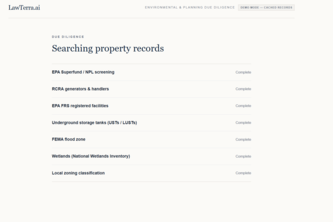
LawTerra is a self-reported AI-powered legal due diligence tool for property and land use matters, built by a single founder with a background in law. The product automates manual tasks typically performed by junior associates, including searching public and private databases (e.g., FEMA flood zones, EPA Superfund listings, zoning) and drafting partner-ready memos. It is described as an application built using GPT 5.6, Codex, and Next.js, deployed on Vercel.
The description states that LawTerra was developed in a single day, with the founder leveraging domain expertise to write a detailed spec for Codex to execute. The tool claims to generate cited memos in minutes, with findings footnoted to sources and a partner review step included. It is positioned as an AI junior lawyer for M&A land due diligence.
The most important open question
Is there evidence of traction, revenue or customer validation beyond the founder’s personal experience and self-reported development process?
What The Product Actually Is
The description states that LawTerra is a legal automation tool for property and land use due diligence. It works by allowing a lawyer to describe a matter in plain language (e.g., acquiring a warehouse site in Oakland for residential redevelopment). A GPT 5.6 agent then:
- Determines which searches are relevant.
- Runs those searches (e.g., FEMA flood, EPA Superfund, zoning).
- Drafts a risk-rated due diligence memo.
- Footnotes findings to source records.
- Allows partner review and export as a Word document in firm template.
The tool is built using Codex, Next.js, and deployed on Vercel. Search modules use either live APIs (e.g., FEMA) or cached data for demo purposes.
Inference: The product appears to be a proof-of-concept prototype, not yet a commercial offering with a scalable architecture or production-grade infrastructure.
Positioning & Claim Evolution
The description states that LawTerra is positioned as:
- An AI junior lawyer.
- A tool that automates due diligence that takes associates hundreds of hours.
- A solution to a problem the founder experienced firsthand in a global law firm (Ashurst).
It claims to draft partner-ready memos in minutes, with findings cited and tied back to client objectives.
Inference: The positioning is rooted in personal experience, not market research or customer feedback. It is framed as solving an internal pain point rather than a broader commercial need.
Target Customer & ICP
The description states that LawTerra targets:
- Law firms, particularly those handling M&A transactions involving land.
- Junior associates who perform due diligence manually.
- Partners who review and sign off on the final memo.
It is described as useful for property and land use law, especially in M&A contexts, where due diligence involves checking contamination, heritage listings, zoning, etc.
Inference: The target customer is a legal services firm or in-house legal team. However, there is no evidence of actual customers or market validation beyond the founder’s experience.
Business Model & Pricing Evidence
The description does not state:
- A business model.
- Any pricing structure.
- Whether LawTerra is sold as a SaaS product, a service, or a one-time tool.
- If there are plans for monetization or revenue streams.
Inference: The business model is not evident. It appears to be a prototype with no commercial traction or pricing data.
Technical & Delivery Signals
The description states:
- LawTerra was built in a single Codex session.
- It uses GPT 5.6, Codex, and Next.js.
- It is deployed on Vercel.
- Search modules use:
- Live public API for FEMA.
- Cached records for Superfund and zoning (for demo purposes).
- The tool includes a scoping agent, search modules, memo generation, and document view.
Inference: The technical stack suggests a prototype built quickly with AI tools. There is no evidence of scalability or production-grade architecture.
Traction & Maturity Signals
The description states:
- The founder worked at Ashurst for 6 years and 7 months.
- The tool was built in one day.
- It was submitted to the OpenAI 2026 hackathon.
- No revenue, customers or adoption data are mentioned.
Inference: There is no evidence of traction, customer validation, or commercial use beyond the founder’s personal experience and a hackathon submission. The tool is not described as being in production or used by any firm.
Competitive Context
The description does not mention:
- Competitors.
- Existing tools in legal due diligence or AI legal automation.
- Market size or competitive positioning.
Inference: No competitive context is provided. It is unclear whether LawTerra addresses a gap, overlaps with existing tools, or has a unique value proposition in the market.
Open Questions & Risks
- No commercial traction or revenue: The tool is described as a prototype built for a hackathon.
- Founder-only team: Only one person is involved, which raises concerns about scalability and execution.
- Unverified claims: The description makes strong claims (e.g., “drafts partner-ready memos”) without evidence of validation.
- Prototype nature: Built in one day, with no mention of testing or iteration beyond the hackathon.
- AI hallucinations risk: The founder notes challenges with avoiding hallucinations and ensuring referable results.
Inference: The project is a personal solution rather than a scalable business. Risks include lack of validation, limited team capacity, and unproven commercial viability.
Questions the description leaves open
- What is the actual legal experience of the founder beyond Ashurst?
- Has the tool been tested with any law firms or legal teams?
- How does LawTerra handle edge cases or complex legal scenarios?
- Are there plans to scale beyond the demo environment (e.g., live data, more jurisdictions)?
- What is the long-term vision for monetization and product development?
- How does the tool ensure accuracy and avoid legal liability in its outputs?
Overall Assessment
The description states that LawTerra was built as a hackathon submission by a single founder with a legal background. It is described as a prototype, not a commercial product.
Assessment: Not evidenced as a viable investment or partnership opportunity at this stage. The project lacks traction, revenue, customer validation, and a clear business model. It is a personal solution built for a hackathon, not a scalable product.
Confidence: Low — based on self-reported evidence only, with no third-party verification or commercial data.
User Stories BotA demo video on every pull request
Get a demo video on every new feature
GitHub App that watches your pull requests and records a narrated, captioned demo.
Save time on demo prep and make informed decisions faster with a video walkthrough of every new feature.
Source
Submitted to the OpenAI 2026 hackathon on Devpost. Project home on Devpost. Back to the full gallery on Devpost.
This competitive analysis was produced by top-founders.com (opens in a new tab)
Generated by a language model from this project's public Devpost page — its tagline, the author's own write-up and any built-with tags listed there — as captured in August 2026. Short quotations are the author's words. It is an opinion on the idea as a business, not on the people behind it, and it reflects the description as published then. If the project has moved on, request a correction below. The analysis is not independent research and contains no verified traction, revenue or customer data.
An independent guide by KFG International LLC — not affiliated with, endorsed by, or connected to Devpost or OpenAI.