

Archive position — measured, not model output
0 likes on Devpost
2,263 of the 7,850 archived projects have more likes, and 5,587 share exactly 0 — so this project's #4,879 place in the like-ranked listing is a tie-break inside that group, not a ranking.
Projects (log scale)
Likes on Devpost. ▲ marks this project's group.
Show the figures
| Likes | Projects | Share of archive |
|---|---|---|
| 0 | 5,587 | 71.2% |
| 1 | 1,758 | 22.4% |
| 2 | 284 | 3.6% |
| 3–4 | 132 | 1.7% |
| 5–9 | 75 | 1.0% |
| 10+ | 14 | 0.2% |
 User Stories BotA demo video on every pull request
Get a demo video on every new feature
GitHub App that watches your pull requests and records a narrated, captioned demo.
Save time on demo prep and make informed decisions faster with a video walkthrough of every new feature.
Executive Summary
What the company appears to be: Larry is a voice-based AI assistant designed to guide vulnerable women through home emergencies and routine maintenance, with an emphasis on safety, privacy, and emotional support. It is built as a proof-of-concept for a larger product called Bea, which targets women in transition (e.g., divorce or widowhood) and aims to provide financial and practical guidance during the first year after loss.
What changed: The project evolved from a planned feature within Bea into a standalone prototype during an OpenAI hackathon. It leverages AI tools like Codex, GPT-5.6, and gpt-realtime-2.1 for voice interaction and image generation, with a focus on nontechnical development using "vibe coding."
Single most important open question: Is there sufficient evidence of user demand or market traction to justify further investment or product development beyond this prototype?
What The Product Actually Is
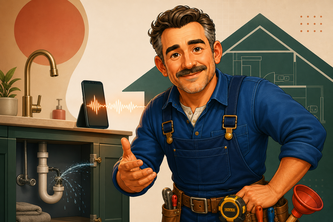
The description states that Larry is a voice guide for home emergencies, built with the aim of helping users navigate unexpected issues in their homes. It includes two main components:
- Safety Switches: A guided walkthrough where users locate and photograph key household systems (e.g., water shutoff, breaker panel), building a "House File" stored locally on the device.
- Emergency Response Module: When a user encounters a problem (e.g., a broken sink), they call Larry who asks one question at a time, uses saved photos and house map to guide them, and avoids dangerous areas like gas or electrical boundaries.
The product is described as being built using:
- Codex for voice interaction
- GPT-5.6 for image generation
- gpt-realtime-2.1 for speech-to-speech functionality
It also includes automated tests to encode character, privacy, and safety invariants.
Inference: The author describes the product as a prototype built during a hackathon; no commercial deployment or production data is provided.
Positioning & Claim Evolution
The author positions Larry as:
- A calm, house-aware voice guide for moments when something breaks.
- An extension of a broader product called Bea, which serves women in transition (e.g., divorce or widowhood).
- A tool that builds capacity building and mental health support through practical home knowledge.
The claim evolution shows:
- From a planned feature within Bea to a standalone prototype during the OpenAI hackathon.
- Emphasis on emotional safety, vulnerability, and user trust, particularly for women navigating difficult life transitions.
Inference: The positioning is rooted in empathy and user-centric design rather than market data or competitive differentiation.
Target Customer & ICP
The description states that the target customer is:
- Women in transition, such as those going through divorce or the death of a spouse.
- These users are described as being vulnerable, with limited experience managing household tasks and often unprepared for home maintenance.
The ICP (Ideal Customer Profile) appears to be:
- Nontechnical individuals
- Women aged 50+ who may have lived with a partner and now face solo home management
- Users who are emotionally and financially stressed during major life changes
Inference: The positioning is highly specific but lacks evidence of actual user testing, customer interviews, or market validation.
Business Model & Pricing Evidence
There is no explicit mention of pricing, business model, monetization strategy, or revenue streams in the description.
The author states that Larry will eventually become a module within Bea, which is described as an AI guide for financial support after loss. However, no details are given about how Bea would generate value or income.
Inference: No commercial viability or pricing model has been demonstrated or claimed beyond the prototype stage.
Technical & Delivery Signals
The project was built using:
- Codex
- GPT-5.6
- gpt-realtime-2.1
It includes:
- Voice interaction via speech-to-speech
- Function calling and turn-taking
- Local storage of house maps and photos
- Automated tests for character, privacy, and safety
The author notes that the build was done through "vibe coding" — a method they describe as iterative and experimental.
Inference: The technology stack is consistent with current AI development practices, but there is no evidence of scalability, performance metrics, or production-grade infrastructure.
Traction & Maturity Signals
There is no traction data provided in the description. No customers, users, revenue, ARR, or usage statistics are mentioned.
The project is described as a hackathon prototype, and the author explicitly says:
"I'm nontechnical so I vibe coded it."
This implies that the product has not yet reached a mature or scalable state.
Inference: No evidence of traction, adoption, or commercial readiness exists beyond the initial concept and prototype phase.
Competitive Context
The description does not mention any competitors. It does not reference existing tools for home maintenance, emergency response, or AI-powered voice assistants for vulnerable populations.
Inference: There is no competitive analysis or positioning against other players in the market.
Open Questions & Risks
- No user validation or market research: The description lacks any mention of customer discovery, interviews, or feedback loops.
- Prototype-only status: The product is described as a hackathon prototype with no indication of further development or commercialization plans.
- Nontechnical founder: The author states they are "nontechnical", which raises questions about long-term technical execution and scalability.
- Privacy concerns: While the author acknowledges the need for clear privacy guardrails, there is no evidence of how these will be implemented in practice.
- Lack of business model clarity: No indication of monetization or revenue generation strategies.
Inference: The project is at a very early stage with significant uncertainty around execution, market fit, and commercial viability.
Questions the description leaves open
- What specific user feedback have you gathered from potential customers?
- How do you plan to validate the need for this product in the real world?
- Are there any existing partnerships or pilot programs with organizations serving women in transition?
- What are your plans for scaling beyond the prototype, including technical architecture and team growth?
- How will you ensure privacy and security for sensitive user data (voice, images)?
- What is your roadmap for integrating Larry into Bea, and what features are planned next?
Overall Assessment
Not evidenced.
The description provides no evidence of:
- Revenue
- Customers
- Traction
- Market validation
- Business model
- Team traction or prior experience
- Product-market fit
This is a preliminary prototype built during a hackathon by a single founder with limited technical background. The author claims to be building for vulnerable women, but there is no data to support that claim or demonstrate demand.
Confidence Level: Low — based entirely on self-reported information without corroboration or external validation.
Assessment: Not ready for investment or partnership at this stage. Further due diligence would require evidence of user testing, market research, and a clear path to product-market fit.
User Stories BotA demo video on every pull request
Get a demo video on every new feature
GitHub App that watches your pull requests and records a narrated, captioned demo.
Save time on demo prep and make informed decisions faster with a video walkthrough of every new feature.
Source
Submitted to the OpenAI 2026 hackathon on Devpost. Project home on Devpost. Back to the full gallery on Devpost.
This competitive analysis was produced by top-founders.com (opens in a new tab)
Generated by a language model from this project's public Devpost page — its tagline, the author's own write-up and any built-with tags listed there — as captured in August 2026. Short quotations are the author's words. It is an opinion on the idea as a business, not on the people behind it, and it reflects the description as published then. If the project has moved on, request a correction below. The analysis is not independent research and contains no verified traction, revenue or customer data.
An independent guide by KFG International LLC — not affiliated with, endorsed by, or connected to Devpost or OpenAI.