

Archive position — measured, not model output
0 likes on Devpost
2,263 of the 7,850 archived projects have more likes, and 5,587 share exactly 0 — so this project's #4,880 place in the like-ranked listing is a tie-break inside that group, not a ranking.
Projects (log scale)
Likes on Devpost. ▲ marks this project's group.
Show the figures
| Likes | Projects | Share of archive |
|---|---|---|
| 0 | 5,587 | 71.2% |
| 1 | 1,758 | 22.4% |
| 2 | 284 | 3.6% |
| 3–4 | 132 | 1.7% |
| 5–9 | 75 | 1.0% |
| 10+ | 14 | 0.2% |
 User Stories BotA demo video on every pull request
Get a demo video on every new feature
GitHub App that watches your pull requests and records a narrated, captioned demo.
Save time on demo prep and make informed decisions faster with a video walkthrough of every new feature.
Executive Summary
What the company appears to be
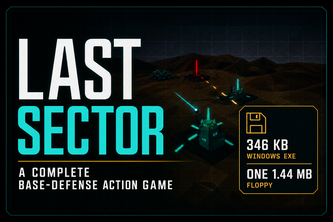
LAST SECTOR is a self-contained Windows base-defense action game built as a single 346 KB executable file, constrained by a 1.44 MB floppy disk limit. The author states it uses procedural generation for terrain, combat, building, UI, and sound, implemented in C++ with tools like Codex + GPT-5.6 and GitHub-based workflows.
What changed
The project is described as an experimental exploration of how much gameplay can be packed into a tiny binary, using AI-assisted development practices to meet strict size and determinism constraints.
Single most important open question
Is there any evidence of commercial traction, revenue, or customer adoption beyond the author's own development?
Note: This analysis is based entirely on the self-reported description provided by the project author. No external verification, funding history, headcount, or performance data are available. All claims are treated as stated by the author and not proven.
What The Product Actually Is
The description states that LAST SECTOR is:
- A base-defense action game for Windows
- Built as a single native executable
- Runs on Windows only, with no installer required
- Uses C++17, Sokol, and Direct3D 11
- Contains procedural terrain, models, effects, interface, and audio
- Operates within a 346 KB binary size limit (less than one quarter of a floppy disk)
- Has deterministic world generation using seeds
- Includes features such as:
- Drone piloting
- Base defense against enemy swarms
- Construction and resource management
- Salvage economy and upgrades
- Supply network defense
The author describes the game as a complete, replayable action game, not just a demo.
Positioning & Claim Evolution
The author positions LAST SECTOR as:
- An experimental exploration of minimalism in game development
- A technical demonstration of what can be achieved within extreme constraints (binary size and hardware)
- A replayable action game with strategic depth, not a novelty or proof-of-concept
- A modern take on retro constraints, inspired by older computing limitations
The claim evolution shows:
- From a "how much gameplay fits in 1.44 MB?" question to a complete game experience
- From a technical demo to a functional, playable product
- From AI-assisted development to human-in-the-loop decision making
The positioning is rooted in constraint-driven design and AI integration rather than market appeal or monetization.
Target Customer & ICP
Not evidenced.
The description does not state:
- Who the intended users are
- Whether there is a defined customer segment
- If the game targets gamers, developers, or hobbyists
- Any indication of who might buy or use this product beyond the creator
No evidence of target customer or ideal customer profile (ICP) exists.
Business Model & Pricing Evidence
Not evidenced.
The description does not mention:
- How the product would be monetized
- Whether it is sold, offered free, or used internally
- Any pricing model or revenue streams
- Licensing terms or distribution methods
No evidence of a business model or pricing strategy exists.
Technical & Delivery Signals
The author states that:
- The game is built in C++17, using Sokol and Direct3D 11
- Shaders are compiled offline and embedded into the executable
- There is no runtime shader compiler, external assets, or third-party DLLs required
- The build process uses GitHub Issues, Codex + GPT-5.6, Claude, and Windows CI
- The game supports reproducible builds and automated dependency auditing
- It is a single-file executable with no installer
These technical signals suggest a high degree of control over build process, binary size, and runtime behavior.
Traction & Maturity Signals
Not evidenced.
The description does not include:
- Any metrics on user engagement or playtime
- Customer feedback or reviews
- Adoption data or usage statistics
- Evidence of sales or downloads
- Post-launch activity or updates
No evidence of traction, adoption, or maturity beyond the initial development exists.
Competitive Context
Not evidenced.
The description does not:
- Identify competitors in the game space
- Compare to other games or platforms
- Mention similar projects or genres
- Describe market positioning relative to existing tools or products
No competitive context is provided.
Open Questions & Risks
Inferences based on self-reported information:
- Limited commercial viability — The product is a technical experiment, not a scalable business.
- No monetization strategy — There is no indication of how the product would generate revenue.
- Highly niche appeal — The constraint-driven nature may limit mainstream adoption.
- Dependency on AI tools — Reliance on Codex and Claude implies potential fragility if those tools change or become unavailable.
- No evidence of user feedback loops — Playtesting is described as human-led, but no data on iteration or improvement from users is shared.
These are inferences drawn from the lack of commercial signals and reliance on experimental development methods.
Questions the description leaves open
- What is your plan for monetizing this product?
- Who are you targeting with this game, and how do you expect to reach them?
- Have you tested the game with others outside of yourself?
- How do you intend to scale beyond a single-person development model?
- Are there any dependencies on specific AI tools or APIs that could affect long-term viability?
- What are your plans for ongoing support, updates, or expansion?
These questions aim to uncover commercial intent and future direction.
Overall Assessment
Not evidenced.
The description does not provide:
- Any indication of funding rounds
- Valuation data
- Investor interest or partnership discussions
- Evidence of a business case for investment or acquisition
No evidence supports an investment or partnership opportunity beyond the project's experimental nature.
User Stories BotA demo video on every pull request
Get a demo video on every new feature
GitHub App that watches your pull requests and records a narrated, captioned demo.
Save time on demo prep and make informed decisions faster with a video walkthrough of every new feature.
Source
Submitted to the OpenAI 2026 hackathon on Devpost. Project home on Devpost. Back to the full gallery on Devpost.
This competitive analysis was produced by top-founders.com (opens in a new tab)
Generated by a language model from this project's public Devpost page — its tagline, the author's own write-up and any built-with tags listed there — as captured in August 2026. Short quotations are the author's words. It is an opinion on the idea as a business, not on the people behind it, and it reflects the description as published then. If the project has moved on, request a correction below. The analysis is not independent research and contains no verified traction, revenue or customer data.
An independent guide by KFG International LLC — not affiliated with, endorsed by, or connected to Devpost or OpenAI.