

Archive position — measured, not model output
0 likes on Devpost
2,263 of the 7,850 archived projects have more likes, and 5,587 share exactly 0 — so this project's #4,850 place in the like-ranked listing is a tie-break inside that group, not a ranking.
Projects (log scale)
Likes on Devpost. ▲ marks this project's group.
Show the figures
| Likes | Projects | Share of archive |
|---|---|---|
| 0 | 5,587 | 71.2% |
| 1 | 1,758 | 22.4% |
| 2 | 284 | 3.6% |
| 3–4 | 132 | 1.7% |
| 5–9 | 75 | 1.0% |
| 10+ | 14 | 0.2% |
 User Stories BotA demo video on every pull request
Get a demo video on every new feature
GitHub App that watches your pull requests and records a narrated, captioned demo.
Save time on demo prep and make informed decisions faster with a video walkthrough of every new feature.
Executive Summary
What the company appears to be
Kukii is an AI-powered language-learning app designed to create personalized, game-like learning experiences tailored to a user’s real-life goals and interests. It positions itself as a bridge between fixed, one-size-fits-all language courses and open-ended AI conversation tools.
What changed
The project description reflects a self-built MVP by one founder (Stella Xu) that attempts to solve the problem of disengagement in traditional language learning apps like Duolingo, especially for users with ADHD. It introduces an AI-driven course creation pipeline, structured around personal goals and contextual needs, with a focus on gamification and short, rewarding lessons.
Single most important open question
Is there evidence that Kukii’s approach to AI-generated content can reliably produce consistent, high-quality learning paths at scale? The author states the app is functional but does not provide data or validation of its effectiveness in real-world use.
What The Product Actually Is
The description states that Kukii is an AI-powered, game-like language learning app for iOS. It builds personalized courses based on a user’s stated goals and real-life needs (e.g., traveling to Mexico for the World Cup). The app uses AI to interpret these goals and generate content such as vocabulary, phrases, sentence patterns, and exercises.
It is built with SwiftUI, stores data locally using SwiftData, and integrates with Cloudflare Workers for managing its AI pipeline. The current MVP supports English, Chinese, and Spanish interfaces and can generate courses in those languages.
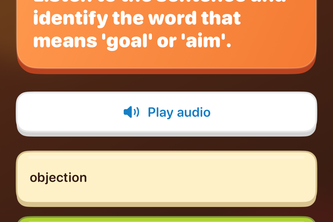
Lessons are designed to be short (a few minutes), include immediate feedback, XP, streaks, and visible progress. Exercises include matching, ordering, listening, fill-in-the-blank, and situational responses.
The app is described as non-linear, with content introduced and reinforced through structured lessons before introducing open-ended AI conversation practice.
Inference The product appears to be a self-contained iOS MVP that uses AI for course generation and deterministic rules for lesson structure. It is not yet a full platform or SaaS offering but a prototype of a personalized learning experience.
Positioning & Claim Evolution
The author states Kukii aims to solve the problem of disengagement in traditional language learning apps like Duolingo, particularly for users with ADHD who struggle with consistency and motivation. It positions itself as an alternative to rigid, standardized curricula and to AI conversation tools that assume prior knowledge.
Key claims:
- “Turn language learning into a game!”
- “100% tailored to your interests, goals, and real-life needs — so every lesson matters.”
- “Kukii is designed to bridge the gap between fixed language courses and AI conversation.”
The positioning evolves from a personal frustration (Duolingo not meeting specific needs) to a solution-oriented product that merges AI personalization with gamified learning.
Inference The app is positioned as a niche, user-centric tool for motivated learners who want more relevance than standard apps offer, but it has not yet proven adoption or traction.
Target Customer & ICP
The description states Kukii targets users who:
- Want to learn a language for specific real-life purposes (e.g., travel, interviews, conversations).
- Struggle with consistency due to ADHD or similar attention challenges.
- Prefer short, engaging lessons that provide immediate feedback and progress tracking.
It also implies a user base interested in gamification, such as XP, streaks, and visible progress.
Inference The ICP appears to be language learners with specific goals who are frustrated by generic apps, particularly those with attention-related challenges. However, no explicit segmentation or persona data is provided.
Business Model & Pricing Evidence
The description does not state a business model or pricing strategy. It also does not mention monetization plans, subscriptions, freemium tiers, or any revenue streams.
Inference No evidence of a defined business model or pricing structure exists in the self-reported description.
Technical & Delivery Signals
Kukii is built as a native iOS app using SwiftUI, with local data storage via SwiftData and AI content generation handled by Cloudflare Workers. The system uses a hybrid approach:
- AI interprets user goals and generates content.
- Deterministic rules control lesson structure, difficulty, answer validity, and pacing.
The author notes that the MVP supports English, Chinese, and Spanish. It includes structured schemas and semantic validation for generated content, with fallbacks for failed exercises.
Inference The technical architecture suggests a hybrid AI + deterministic system, with a focus on user experience and lesson flow. However, no evidence of scalability or infrastructure beyond the MVP is provided.
Traction & Maturity Signals
The description states that Kukii is an MVP built by one person (Stella Xu) for the OpenAI 2026 hackathon. It includes:
- A complete core journey from goal to lesson to progress screen.
- A functional AI pipeline and course generation system.
However, there is no mention of:
- Users or customer base
- Revenue or monetization
- Adoption metrics
- Product-market fit validation
Inference The product is at early MVP stage, with no evidence of traction or user engagement beyond the founder’s own use case.
Competitive Context
The author references Duolingo as a comparison, noting that it helped with consistency but failed to prepare users for real-life conversations. It also contrasts Kukii with AI conversation apps that assume prior knowledge and lack structure.
Inference Kukii positions itself in the gap between structured language courses and open-ended AI tools, aiming to offer both personalization and scaffolding for speaking practice.
Open Questions & Risks
- Single-founder MVP: No team, no external validation or early users.
- AI-generated content quality: The author acknowledges challenges with consistency and accuracy in AI output. No evidence of how this is being validated or improved.
- No monetization strategy: No indication of how the product will be monetized or scaled.
- Limited scope: MVP supports only iOS, English, Chinese, and Spanish.
- Gamification without data: While gamification is emphasized, no evidence of behavioral tracking or engagement metrics.
Inference The main risk is that the AI-generated content may not scale reliably, and the product lacks any commercial or user traction signals.
Questions the description leaves open
- What specific validation have you done with real users to test the effectiveness of your AI-generated lessons?
- How do you plan to ensure consistency and quality in AI-generated content as you scale beyond the MVP?
- What is your roadmap for monetization, and how do you expect to attract and retain users at scale?
- How are you addressing the challenge of balancing personalization with structured learning?
- Are there any plans to expand beyond iOS or support additional languages?
- What metrics do you track to measure user engagement and retention?
Overall Assessment
Not evidenced: There is no evidence of revenue, customers, traction, or financials. The project is described as a self-built MVP, with no indication of commercial viability or scalability.
The author states the app is functional but does not provide any data on user behavior, content quality, or product-market fit. The hybrid AI + deterministic approach shows promise, but the lack of external validation and team structure raises significant concerns about execution risk.
Confidence level: Low. This is a self-reported, unverified prototype, not a product with demonstrated traction or commercial potential.
User Stories BotA demo video on every pull request
Get a demo video on every new feature
GitHub App that watches your pull requests and records a narrated, captioned demo.
Save time on demo prep and make informed decisions faster with a video walkthrough of every new feature.
Source
Submitted to the OpenAI 2026 hackathon on Devpost. Project home on Devpost. Back to the full gallery on Devpost.
This competitive analysis was produced by top-founders.com (opens in a new tab)
Generated by a language model from this project's public Devpost page — its tagline, the author's own write-up and any built-with tags listed there — as captured in August 2026. Short quotations are the author's words. It is an opinion on the idea as a business, not on the people behind it, and it reflects the description as published then. If the project has moved on, request a correction below. The analysis is not independent research and contains no verified traction, revenue or customer data.
An independent guide by KFG International LLC — not affiliated with, endorsed by, or connected to Devpost or OpenAI.