

Archive position — measured, not model output
0 likes on Devpost
2,263 of the 7,850 archived projects have more likes, and 5,587 share exactly 0 — so this project's #4,851 place in the like-ranked listing is a tie-break inside that group, not a ranking.
Projects (log scale)
Likes on Devpost. ▲ marks this project's group.
Show the figures
| Likes | Projects | Share of archive |
|---|---|---|
| 0 | 5,587 | 71.2% |
| 1 | 1,758 | 22.4% |
| 2 | 284 | 3.6% |
| 3–4 | 132 | 1.7% |
| 5–9 | 75 | 1.0% |
| 10+ | 14 | 0.2% |
 User Stories BotA demo video on every pull request
Get a demo video on every new feature
GitHub App that watches your pull requests and records a narrated, captioned demo.
Save time on demo prep and make informed decisions faster with a video walkthrough of every new feature.
Executive Summary
What the company appears to be
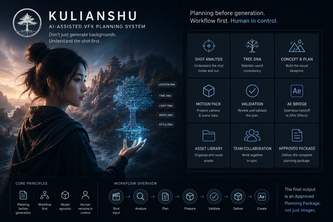
KULIANSHU is an AI-assisted planning system for visual effects (VFX) production, designed to help artists make creative decisions before generating backgrounds. It operates as a pre-generation workflow that analyzes shots, evaluates scenes, and builds structured planning packages.
What changed
The project evolved from an initial attempt at building another AI image generation tool into a focused solution centered on the “planning layer” of VFX production. This shift was driven by the realization that the core problem is not image generation but creative and technical planning prior to it.
Single most important open question
Is there a real need for such a planning system in current VFX workflows, or does this represent an unvalidated assumption about how artists currently work?
What The Product Actually Is
The description states that KULIANSHU is:
- An AI-assisted planning system for visual effects production.
- A modular workflow with defined inputs and outputs at each stage.
- Designed to analyze shots, evaluate scenes, determine object placement, build world planning, generate a structured Prompt Contract, and produce an Approved Planning Package.
- Not focused on direct image generation but on pre-generating creative decisions.
Inference The system appears to be a tool that uses AI to structure and support early-stage VFX production planning, rather than a generative tool per se. It is positioned as a workflow enabler for artists.
Positioning & Claim Evolution
The author states:
- The inspiration came from observing that visual effects artists spend time on creative planning before background creation.
- They questioned whether AI could understand the shot before generating the background.
- The product evolved from an image generation tool to a planning layer.
- The claim is that better VFX begins with better planning, and AI should first understand intent and context.
Inference The positioning has shifted from being a generative AI tool to a planning assistant. This evolution suggests a focus on workflow optimization rather than output generation.
Target Customer & ICP
The description states:
- The primary users are visual effects artists.
- The system is intended for use in VFX production environments.
- It supports creative decision-making before image generation begins.
Not evidenced No explicit customer segment, size of market, or specific job-to-be-done beyond general VFX workflow support.
Business Model & Pricing Evidence
The description states:
- No mention of pricing, monetization, or business model.
- The project is described as an MVP built for a hackathon.
- No evidence of revenue streams, customer acquisition, or commercial use cases.
Not evidenced No indication of how the product would be sold or who would pay for it.
Technical & Delivery Signals
The description states:
- Built using OpenAI GPT and Codex for architecture, documentation, and rapid iteration.
- Uses Python, PySide6, NumPy, OpenCV, Pillow, JSX, JSON, and other tech stack components.
- The MVP demonstrates a complete planning workflow before image generation.
- Modular design with single responsibility per stage.
Inference The technical approach is modular and AI-driven, leveraging existing open-source tools and APIs. It is built for rapid iteration and prototyping.
Traction & Maturity Signals
The description states:
- The project was submitted to the OpenAI 2026 hackathon.
- The MVP demonstrates a complete workflow.
- No evidence of revenue, customers, or adoption beyond the hackathon submission.
Not evidenced No data on usage, traction, or product-market fit beyond the initial prototype.
Competitive Context
The description states:
- No mention of competitors or existing solutions in the VFX planning space.
- The author focuses on the unique value of understanding shots before generation.
- No evidence of market analysis or competitive positioning.
Not evidenced No information about existing tools, platforms, or substitutes for this type of workflow.
Open Questions & Risks
The description states:
- The project is an MVP built for a hackathon.
- There is no evidence of real-world adoption or customer feedback.
- The author’s own evolution from image generation to planning suggests a potential misalignment with market needs.
Inference
Key risks include:
- Unvalidated assumptions about VFX workflow needs.
- Lack of commercial traction or revenue model.
- Unclear scalability or integration into existing production pipelines.
- Risk that the problem being solved is not widespread or urgent enough for adoption.
Questions the description leaves open
- What specific problems in current VFX workflows are you trying to solve?
- Have you spoken with visual effects artists about their planning processes?
- How does your system integrate into existing production pipelines?
- Are there any early adopters or pilot users of this tool?
- What is the expected timeline for moving from MVP to a commercial product?
- How do you plan to monetize this solution?
Overall Assessment
The description states:
- This is an MVP built for a hackathon.
- No evidence of revenue, customers, or traction.
- The idea has potential but lacks validation.
Inference At this stage, the project represents an interesting concept with limited commercial readiness. It may be worth exploring further if there is evidence of early customer interest or if the founders can demonstrate traction in a real-world VFX environment. However, based on the self-reported description alone, it is not yet a viable investment or partnership opportunity.
User Stories BotA demo video on every pull request
Get a demo video on every new feature
GitHub App that watches your pull requests and records a narrated, captioned demo.
Save time on demo prep and make informed decisions faster with a video walkthrough of every new feature.
Source
Submitted to the OpenAI 2026 hackathon on Devpost. Project home on Devpost. Back to the full gallery on Devpost.
This competitive analysis was produced by top-founders.com (opens in a new tab)
Generated by a language model from this project's public Devpost page — its tagline, the author's own write-up and any built-with tags listed there — as captured in August 2026. Short quotations are the author's words. It is an opinion on the idea as a business, not on the people behind it, and it reflects the description as published then. If the project has moved on, request a correction below. The analysis is not independent research and contains no verified traction, revenue or customer data.
An independent guide by KFG International LLC — not affiliated with, endorsed by, or connected to Devpost or OpenAI.