

Archive position — measured, not model output
1 like on Devpost
505 of the 7,850 archived projects have more likes, and 1,758 share exactly 1 — so this project's #926 place in the like-ranked listing is a tie-break inside that group, not a ranking.
Projects (log scale)
Likes on Devpost. ▲ marks this project's group.
Show the figures
| Likes | Projects | Share of archive |
|---|---|---|
| 0 | 5,587 | 71.2% |
| 1 | 1,758 | 22.4% |
| 2 | 284 | 3.6% |
| 3–4 | 132 | 1.7% |
| 5–9 | 75 | 1.0% |
| 10+ | 14 | 0.2% |
 User Stories BotA demo video on every pull request
Get a demo video on every new feature
GitHub App that watches your pull requests and records a narrated, captioned demo.
Save time on demo prep and make informed decisions faster with a video walkthrough of every new feature.
Executive Summary
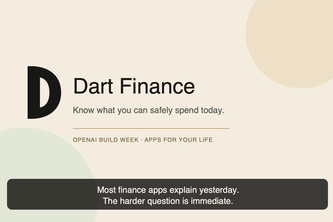
Company: Dart Finance
Self-reported basis: The description is entirely self-reported by the author, unverified, and lacks any independent corroboration.
What it appears to be: A financial decision-support tool that calculates how much a user can safely spend during a payday cycle while protecting various financial commitments. It uses a deterministic engine for authoritative calculations and an AI model (GPT-5.6 Sol) only for explanation.
What changed: The project was submitted as part of the OpenAI 2026 hackathon, indicating it is in early development or prototype form.
Single most important open question: Does Dart Finance have a viable commercial path beyond a hackathon demo, and can it scale its deterministic engine and AI explanation system to real-world financial users?
What The Product Actually Is
The description states that Dart Finance calculates how much someone can safely spend during the current payday cycle after protecting:
- upcoming bills and fixed costs;
- planned investing;
- a minimum cash buffer;
- sinking funds and irregular commitments;
- known uncertainty or stale data.
It allows users to ask concrete questions like “Can I spend €80 on dinner this weekend?” and returns a clear decision with:
- Safe to Spend before the purchase;
- the proposed purchase amount;
- Safe to Spend after the purchase;
- a Safe or Not safe assessment;
- relevant obligations and warnings;
- the assumptions that could change the result.
The public demo uses fictional data and requires no account. It begins with an €80 purchase that is Safe, but when a previously inferred annual insurance bill is confirmed, the same scenario recalculates to Not safe, with an exact €69.10 shortfall.
Evidence: The author's own write-up.
Inference: This is a prototype or proof-of-concept financial tool built for a hackathon.
Positioning & Claim Evolution
The description states that most budgeting apps are good at explaining where money went, but leave users to answer the question: “Can I safely spend this money before my next payday?”
It positions Dart Finance as filling a gap by providing a direct spending decision whose calculation, assumptions, and evidence can be inspected.
The product claims to close the gap between generic AI assistants (which explain financial concepts) and trusted financial decisions (which should not be invented or altered by AI).
Evidence: The author's own write-up.
Inference: The positioning is rooted in a perceived lack of trust in AI-generated financial advice, but this is unproven in the description.
Target Customer & ICP
The description does not state who the target customer is. It only describes the product’s functionality and how it works.
Evidence: Not evidenced.
Inference: Based on the problem described (spending decisions), the target may be individuals or households managing personal finances, but this is speculative without further evidence.
Business Model & Pricing Evidence
The description does not mention any business model or pricing structure. It only describes how the product works and its technical architecture.
Evidence: Not evidenced.
Inference: The project is a hackathon submission with no commercialization strategy described.
Technical & Delivery Signals
The system uses:
- A deterministic TypeScript engine for authoritative calculations (using integer cents);
- GPT-5.6 Sol only at the explanation boundary;
- Strict separation between financial truth and AI explanation;
- Structured-output schema, assessment checks, currency consistency guards, prompt-injection protection;
- Deterministic fallback if the model fails or is unavailable;
- Public demo endpoint with no user account or database access;
- Browser-level integration testing and API security.
Codex was used as an engineering collaborator across the monorepo to implement contracts, build providers, test failure paths, and validate edge cases.
Evidence: The author's own write-up.
Inference: The architecture is designed with strong separation of concerns and safety mechanisms, but this is a prototype, not a production-ready system.
Traction & Maturity Signals
The description does not include any traction data, revenue, customer base, or adoption metrics. It only describes the product’s functionality and technical implementation.
Evidence: Not evidenced.
Inference: The project is in early development (hackathon submission), with no evidence of real-world usage or user engagement.
Competitive Context
The description does not mention any competitors or market context beyond stating that most budgeting apps are good at explaining where money went, but leave users to answer the key spending question themselves.
Evidence: Not evidenced.
Inference: The product may compete with existing budgeting tools and AI financial assistants, but no competitive positioning is stated.
Open Questions & Risks
- Unproven commercial viability: No revenue, customers, or monetization strategy.
- AI dependency without clear control: While the model is constrained, it still plays a role in explanation. If not properly managed, this could lead to trust issues.
- Prototype scope: The system is described as a hackathon submission with no production-ready features.
- No user data integration: The demo uses fictional data and does not connect to real financial accounts or data sources.
- Limited team size: Only one team member is listed, which may limit development capacity.
Evidence: The author's own write-up.
Inference: These are risks inherent in a hackathon prototype with no traction or commercialization plan.
Questions the description leaves open
- What is the intended user journey from initial use to long-term adoption?
- How does Dart Finance plan to scale its deterministic engine and AI explanation system for real-world financial users?
- Are there any plans to integrate with real bank accounts or financial data providers?
- What are the key assumptions in the financial model, and how will they be validated or updated over time?
- How is the product intended to generate revenue or achieve commercial viability beyond a demo?
- What are the technical challenges in moving from a synthetic demo to a secure, scalable financial decision engine?
Overall Assessment
Confidence: Low
Assessment: Dart Finance appears to be an early-stage prototype submitted for a hackathon. It has a clear architectural approach to balancing deterministic financial logic with AI explanation, but lacks any evidence of traction, revenue, customers, or commercialization strategy.
It is not evident whether this project will evolve into a viable product or service. The description does not support claims about market fit, scalability, or monetization.
Evidence: Self-reported only, no independent verification.
Inference: This is a concept with potential but requires further development and validation to be considered for investment or partnership.
User Stories BotA demo video on every pull request
Get a demo video on every new feature
GitHub App that watches your pull requests and records a narrated, captioned demo.
Save time on demo prep and make informed decisions faster with a video walkthrough of every new feature.
Source
Submitted to the OpenAI 2026 hackathon on Devpost. Project home on Devpost. Back to the full gallery on Devpost.
This competitive analysis was produced by top-founders.com (opens in a new tab)
Generated by a language model from this project's public Devpost page — its tagline, the author's own write-up and any built-with tags listed there — as captured in August 2026. Short quotations are the author's words. It is an opinion on the idea as a business, not on the people behind it, and it reflects the description as published then. If the project has moved on, request a correction below. The analysis is not independent research and contains no verified traction, revenue or customer data.
An independent guide by KFG International LLC — not affiliated with, endorsed by, or connected to Devpost or OpenAI.