

Archive position — measured, not model output
0 likes on Devpost
2,263 of the 7,850 archived projects have more likes, and 5,587 share exactly 0 — so this project's #4,826 place in the like-ranked listing is a tie-break inside that group, not a ranking.
Projects (log scale)
Likes on Devpost. ▲ marks this project's group.
Show the figures
| Likes | Projects | Share of archive |
|---|---|---|
| 0 | 5,587 | 71.2% |
| 1 | 1,758 | 22.4% |
| 2 | 284 | 3.6% |
| 3–4 | 132 | 1.7% |
| 5–9 | 75 | 1.0% |
| 10+ | 14 | 0.2% |
 User Stories BotA demo video on every pull request
Get a demo video on every new feature
GitHub App that watches your pull requests and records a narrated, captioned demo.
Save time on demo prep and make informed decisions faster with a video walkthrough of every new feature.
Executive Summary
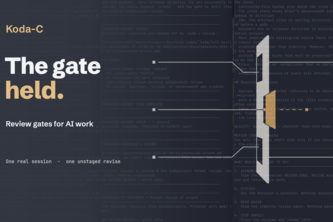
What the company appears to be: Koda-C is a self-reported workflow tool for AI-assisted development that enforces review gates using plain-file dependencies. The author describes it as a "gated harness" designed to ensure that reviews are not silently ignored in AI-driven work processes.
What changed: The project was built over ~51 hours using Codex and GPT-5.6, starting from an idea about how reviews can be bypassed in AI-assisted workflows. It is presented as a first implementation of a system where AI work phases must pass specific checks before advancing — including artifact existence, independent review binding, assessment approval, and receipt verification.
Single most important open question: Is there evidence that this tool has been adopted or used beyond the author's own development sessions? The description makes no claims about customers, revenue, or usage outside of the author’s personal workflow.
Note: This analysis is based entirely on the self-reported project description provided by the caller. No external verification, traction data, or third-party sources are available. All statements reflect the author's own account and should be treated as unverified claims.
What The Product Actually Is
The description states that Koda-C is a dependency-free, plain-file workflow for AI-produced work. It enforces four conditions for each phase to advance:
- The artifact exists and is non-empty.
- An independent review is bound to the artifact’s current content hash.
- The assessment permits movement.
- That review's unique receipt appears in the owner's approval ledger.
It uses a Guide/Producer/Reviewer relay architecture, with roles separated across contexts. Artifacts are stored on disk, not in chat memory, and changes invalidate prior reviews.
Inference: Based on the author’s description, Koda-C is a CLI-based tool that enforces review gates through file-based checks. It is built using Codex and GPT-5.6, with a focus on ensuring that AI-generated work cannot proceed without explicit, documented review.
Positioning & Claim Evolution
The author positions Koda-C as a solution to the problem of silent review bypasses in AI-assisted workflows. The core claim is that:
- Reviews should not be ignored by default.
- A review must enter the decision loop to count.
- The tool enforces this through immutable evidence on disk, not just chat history.
The project evolved from a personal frustration with how reviews were handled in his own development process, where "nothing refused. Nothing complained." He wanted to build something that would prevent such silent failures.
Inference: Koda-C is positioned as a process enforcement tool for AI-assisted work rather than an AI agent itself. It emphasizes control and accountability over automation speed.
Target Customer & ICP
The description does not name specific customers or target segments. However, the author describes himself as:
- A designer and imaginator, not a coder.
- Someone who directs products in C++, Swift, and Rust using AI.
- Someone who builds things that matter to him personally.
He also says he wants to take "the most capable models available" and have them work together while staying in control. This suggests the ICP is likely:
- Creative professionals or engineers who use AI tools but want to maintain process discipline.
- Developers or designers who are not comfortable handing off work without oversight.
- Users of agentic tooling who find generic outputs lacking purpose.
Claim: The author states he wants to build a system where "each skill has to be written by you, for how you want your work done." This implies a niche audience that values customization and control over generic workflows.
Business Model & Pricing Evidence
There is no evidence of pricing or business model in the description. The project is presented as a personal development effort, built during a hackathon.
Not evidenced: No mention of monetization, subscriptions, licensing, or any commercial structure.
Technical & Delivery Signals
The author reports:
- Built with Codex and GPT-5.6.
- Uses JavaScript/TypeScript on macOS.
- CLI-based interface.
- Repository-local skills.
- Persistent reviewer role (e.g., Terra).
- Immutable Git close.
- Deterministic test suite of 267 checks.
- Recovery paths hardened post-initial build.
Inference: The tool is built with a strong emphasis on reliability and traceability. It uses AI for engineering decisions but maintains human control over process design. The architecture supports separation of roles (Guide, Producer, Reviewer) and file-based state management.
Traction & Maturity Signals
There is no evidence of traction or adoption beyond the author’s own use. The project was built in ~51 hours during a hackathon and submitted to OpenAI's Dev Week 2026.
Not evidenced: No customers, revenue, usage metrics, or product-market fit data are provided.
Competitive Context
The description does not reference competitors directly. However, it implies a space where:
- AI agents are used for creative or technical tasks.
- There is a need to enforce process discipline in agentic workflows.
- Tools exist that allow generic task automation but lack accountability mechanisms.
Inference: Koda-C may compete with tools that automate workflows without enforcing review gates. It could be seen as a more disciplined alternative to generic AI-powered task runners or LLM orchestrators.
Open Questions & Risks
- No external validation or adoption — The tool is only described from the author’s perspective.
- Highly personal use case — The author’s workflow may not generalize well.
- Limited scalability — Built for one person, likely not designed for team environments.
- Unclear long-term viability — No roadmap beyond a headless Rust core; no evidence of community or ecosystem development.
- Dependency on Codex and GPT-5.6 — If these tools change or become unavailable, the project may lose value.
Inference: The tool is experimental and personal in nature. It lacks any indication of broader market traction or scalability.
Questions the description leaves open
- What specific problems did you encounter during real-world use that led to building this?
- Have others tried using Koda-C beyond your own sessions? If so, what feedback did they give?
- How do you plan to scale the tool beyond a single-user terminal-based workflow?
- Are there any known limitations or edge cases where the system fails?
- What is the intended long-term architecture and how does it differ from this initial version?
Overall Assessment
Not evidenced: There is no evidence of commercial traction, revenue, or customer base to support an investment or partnership decision.
Assessment: Based on the self-reported description alone, Koda-C appears to be a personal experiment aimed at solving a specific problem in AI-assisted development. It shows technical sophistication and clarity of intent but lacks any indication of product-market fit, adoption, or scalability. It is not ready for investment or partnership consideration without further evidence of traction or commercial viability.
User Stories BotA demo video on every pull request
Get a demo video on every new feature
GitHub App that watches your pull requests and records a narrated, captioned demo.
Save time on demo prep and make informed decisions faster with a video walkthrough of every new feature.
Source
Submitted to the OpenAI 2026 hackathon on Devpost. Project home on Devpost. Back to the full gallery on Devpost.
This competitive analysis was produced by top-founders.com (opens in a new tab)
Generated by a language model from this project's public Devpost page — its tagline, the author's own write-up and any built-with tags listed there — as captured in August 2026. Short quotations are the author's words. It is an opinion on the idea as a business, not on the people behind it, and it reflects the description as published then. If the project has moved on, request a correction below. The analysis is not independent research and contains no verified traction, revenue or customer data.
An independent guide by KFG International LLC — not affiliated with, endorsed by, or connected to Devpost or OpenAI.