

Archive position — measured, not model output
0 likes on Devpost
2,263 of the 7,850 archived projects have more likes, and 5,587 share exactly 0 — so this project's #4,823 place in the like-ranked listing is a tie-break inside that group, not a ranking.
Projects (log scale)
Likes on Devpost. ▲ marks this project's group.
Show the figures
| Likes | Projects | Share of archive |
|---|---|---|
| 0 | 5,587 | 71.2% |
| 1 | 1,758 | 22.4% |
| 2 | 284 | 3.6% |
| 3–4 | 132 | 1.7% |
| 5–9 | 75 | 1.0% |
| 10+ | 14 | 0.2% |
 User Stories BotA demo video on every pull request
Get a demo video on every new feature
GitHub App that watches your pull requests and records a narrated, captioned demo.
Save time on demo prep and make informed decisions faster with a video walkthrough of every new feature.
Executive Summary
What the company appears to be
KnowledgeOS is a self-reported local enterprise knowledge platform built for private, multilingual use cases. The author describes it as an AI-powered system that ingests documents and images, extracts text with OCR, and enables search, question-answering, citation inspection, translation, and reusable instruction generation — all within infrastructure the user controls.
What changed
The project evolved from a simple idea into a more structured platform with governed RAG memory, document quality rules, human review workflows, and enterprise-grade features like roles, audit history, and network controls. It was developed using an ongoing creator-Codex loop involving GPT-5.6 for backend and frontend work.
The single most important open question
Is there any evidence of real-world usage or customer feedback beyond the author’s own development experience?
What The Product Actually Is
The description states that KnowledgeOS is a local enterprise knowledge platform designed to run on infrastructure users control. It ingests documents and images, extracts text with OCR (Tesseract-OCR), and combines SQLite FTS5 with optional local semantic retrieval.
It supports search, question answering, citation inspection, translation, and turning evidence into reusable instructions.
Version 3 introduces governed RAG memory, document-quality and audience review, conversation-learning hypotheses requiring human approval, shared retrieval safeguards, and a formal AI release gate. It also includes monitoring, persistent alerts, configurable rules, optional SMTP, roles, sessions, audit history, and network controls for local administration.
The author notes that the system is not yet fully qualified as an autonomous operational assistant due to unmet thresholds in citation completeness, correctness, terminology, and required human review.
Evidence
- The description states KnowledgeOS ingests documents and images.
- It uses OCR (Tesseract-OCR) and SQLite FTS5 for indexing.
- It supports search, question answering, citation inspection, translation, and reusable instruction generation.
- Version 3 adds governed RAG memory, document quality rules, human review workflows, and enterprise controls.
Inference The system is built to support local execution without cloud access, based on the emphasis on “private” and “infrastructure you control.”
Positioning & Claim Evolution
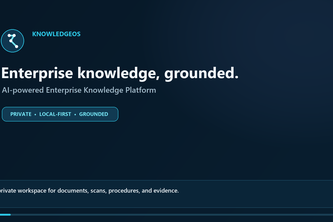
The author positions KnowledgeOS as an AI-powered platform for enterprise knowledge management that prioritizes privacy, multilingualism, and source-grounded responses. It is described not as a chatbot but as a local workspace where every answer can be checked against its source.
It began with a practical problem: dispersal of important knowledge across documents, scans, procedures, and conversations, while sensitive material could not be sent to cloud assistants.
Over time, the platform evolved from basic ingestion and search into more complex workflows involving human review, governed memory, and enterprise controls. The author emphasizes that it is not yet fully autonomous but rather a “governed local platform with experimental answer generation.”
Evidence
- The tagline: “AI-powered Enterprise Knowledge Platform — private, multilingual, source-grounded, and built to run on infrastructure you control.”
- The write-up states: “The goal was not another chatbot, but a local workspace where every answer could be checked against its source.”
- The evolution includes features like governed RAG memory, document quality rules, human review workflows.
Inference The positioning has shifted from a basic tool to a more structured platform with governance and enterprise controls, indicating an intent to move beyond proof-of-concept toward real-world deployment.
Target Customer & ICP
The description states that KnowledgeOS is intended for enterprise users who need to manage private, multilingual knowledge within their own infrastructure. It supports complex administrative workflows involving Russian, English, Hebrew, and Arabic.
It targets organizations with sensitive data that cannot be shared with cloud services and requires control over how information is processed and retrieved.
Evidence
- The tagline mentions “enterprise” and “private.”
- The write-up states: “sensitive material could not simply be sent to a cloud assistant.”
- It supports Russian, English, Hebrew, and Arabic.
- Features like roles, audit history, network controls, and enterprise identity are mentioned.
Inference The ICP likely includes large enterprises or government agencies with strict data sovereignty requirements and need for multilingual support.
Business Model & Pricing Evidence
There is no evidence of a business model or pricing structure in the provided description. The author does not mention any monetization strategy, subscription tiers, or sales channels.
Evidence
- No mention of revenue streams, pricing plans, or customer acquisition methods.
- No indication of whether the platform will be sold as SaaS, on-prem, or open-source.
Inference The project is currently in a development phase and lacks commercial traction or monetization details.
Technical & Delivery Signals
KnowledgeOS is built using technologies such as Codex, Docker, FastAPI, FTS5, GPT-5.6, PowerShell, Python, React, SQLite, Tesseract-OCR, and Vite. It supports local execution without automatic downloads or accidental network access.
The system includes backend architecture, security, retrieval, tests, and release engineering handled by GPT-5.6 Sol, while GPT-5.6 Terra handles frontend workflows, multilingual behavior, visual iteration, documentation, and presentation.
It has 151 passing backend tests and independent platform and AI release gates. A sanitized public release with synthetic demo data is available.
Evidence
- Built with: Codex, Docker, FastAPI, FTS5, GPT-5.6, PowerShell, Python, React, SQLite, Tesseract-OCR, Vite.
- Supports local execution without network access.
- Has 151 passing backend tests and independent platform and AI release gates.
- Includes a sanitized public release with synthetic demo data.
Inference The technical stack suggests a focus on modularity, security, and local deployment. The use of Codex indicates an automated development process.
Traction & Maturity Signals
There is no evidence of revenue, customers, or adoption beyond the author’s own development experience. The system is described as not yet fully qualified as an autonomous operational assistant due to unmet thresholds in citation completeness, correctness, terminology, and required human review.
The author notes that while regression suite and frontend checks pass, the stricter AI answer-quality gate remains NO-GO.
Evidence
- No mention of revenue or customers.
- The system is described as experimental with an “answer generation” feature that has not met quality thresholds.
- The current status is: “presented as a governed local platform with experimental answer generation.”
Inference The project is in early development and lacks real-world usage or commercial traction.
Competitive Context
There is no evidence of competitors mentioned in the description. The author does not reference existing platforms or tools in this space, nor do they compare KnowledgeOS to others.
Evidence
- No mention of competitors.
- No comparison with other knowledge management or RAG systems.
Inference The competitive landscape is unknown from this description alone.
Open Questions & Risks
- Unproven commercial viability: The platform lacks any evidence of revenue, customers, or monetization strategy.
- Experimental answer generation: The system’s AI answer quality has not met thresholds, suggesting it may not be ready for production use.
- Limited scope and maturity: The project is described as experimental and not yet fully qualified as an autonomous assistant.
- No external validation or feedback: All evidence comes from the author’s own account; no third-party verification exists.
Evidence
- No revenue, customers, or traction data.
- AI answer quality gate remains NO-GO.
- Described as experimental with incomplete features.
Inference The lack of real-world usage and commercial validation raises significant risk for investment or partnership.
Questions the description leaves open
- What specific enterprise use cases have you tested KnowledgeOS in, if any?
- How do you plan to monetize the platform beyond its current experimental state?
- Are there any early adopters or pilot customers who are using it in production?
- What is your roadmap for closing the citation and terminology gaps that currently prevent full AI answer quality?
- Can you provide more details on how the governed memory system works, especially around human review workflows?
Overall Assessment
Not evidenced.
The description provides no information about revenue, customers, or traction. The platform is described as experimental and not yet fully qualified for autonomous operation. There is no evidence of a business model, pricing strategy, or external validation.
Confidence level Low — based entirely on self-reported claims with no supporting data.
Conclusion
KnowledgeOS appears to be an early-stage, experimental project focused on local enterprise knowledge management. It has not demonstrated commercial viability or real-world adoption. Any investment or partnership decision would require further due diligence into its actual usage, traction, and monetization strategy.
User Stories BotA demo video on every pull request
Get a demo video on every new feature
GitHub App that watches your pull requests and records a narrated, captioned demo.
Save time on demo prep and make informed decisions faster with a video walkthrough of every new feature.
Source
Submitted to the OpenAI 2026 hackathon on Devpost. Project home on Devpost. Back to the full gallery on Devpost.
This competitive analysis was produced by top-founders.com (opens in a new tab)
Generated by a language model from this project's public Devpost page — its tagline, the author's own write-up and any built-with tags listed there — as captured in August 2026. Short quotations are the author's words. It is an opinion on the idea as a business, not on the people behind it, and it reflects the description as published then. If the project has moved on, request a correction below. The analysis is not independent research and contains no verified traction, revenue or customer data.
An independent guide by KFG International LLC — not affiliated with, endorsed by, or connected to Devpost or OpenAI.