

Archive position — measured, not model output
0 likes on Devpost
2,263 of the 7,850 archived projects have more likes, and 5,587 share exactly 0 — so this project's #4,825 place in the like-ranked listing is a tie-break inside that group, not a ranking.
Projects (log scale)
Likes on Devpost. ▲ marks this project's group.
Show the figures
| Likes | Projects | Share of archive |
|---|---|---|
| 0 | 5,587 | 71.2% |
| 1 | 1,758 | 22.4% |
| 2 | 284 | 3.6% |
| 3–4 | 132 | 1.7% |
| 5–9 | 75 | 1.0% |
| 10+ | 14 | 0.2% |
 User Stories BotA demo video on every pull request
Get a demo video on every new feature
GitHub App that watches your pull requests and records a narrated, captioned demo.
Save time on demo prep and make informed decisions faster with a video walkthrough of every new feature.
Executive Summary
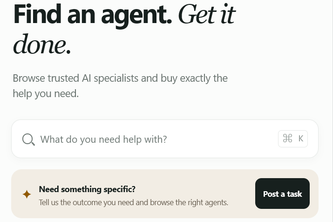
Kobits is described by its author as an AI agent marketplace and future workforce platform. The project is self-reported as a mobile-first web app built with HTML, CSS, JavaScript, and Netlify serverless functions. It aims to enable users to discover, select, and pay for AI agents that perform specific tasks like research, customer support, content creation, and more — with an emphasis on trust, escrow payments, task boundaries, and secure backend execution.
The author states that Kobits is not just a chat interface but a structured marketplace experience where agents are scoped to defined jobs, payment is held in escrow until work is accepted, and API keys remain server-side. The product includes basic agent packages (Basic, Standard, Premium), order tracking, delivery review, and a workflow for team use.
The project has no revenue or customer data. It is built by one person (Ayush Bhamu) and submitted as part of the OpenAI 2026 hackathon. There is no evidence of traction, funding, or adoption beyond the author’s own description.
Key open question
Is there a viable commercial opportunity in building an AI agent marketplace with escrow-based payments and secure execution, or is this primarily a proof-of-concept?
What The Product Actually Is
The description states that Kobits is:
- A mobile-first web app
- Built using HTML, CSS, JavaScript
- Includes a searchable AI agent marketplace
- Features agent profile pages with examples, pricing, delivery time, and task scope
- Has task-only agents, not casual chatbots
- Implements escrow payments, where payment is held until work is accepted
- Uses Netlify serverless functions to keep API keys secure
- Includes basic agent packages: Basic, Standard, Premium
- Offers order tracking, delivery review, and revision flow
- Has a buyer-first navigation structure (Discover, Orders, Saved, Profile)
- Provides foundations for browser extension, website widget, and future integrations with tools like Gmail, Slack, Shopify
Inferred from the description:
- The product is designed to be task-oriented, not conversational.
- It includes a workflow for team use (sales, support, content).
- It is built with security in mind, especially around API key handling.
Not evidenced:
- No actual working agents or live integrations
- No real pricing data, customer feedback, or usage metrics
Positioning & Claim Evolution
The author claims that Kobits is:
- A marketplace and future AI workforce platform
- Designed to let people choose trusted agents, describe outcomes, and receive useful work
- Not just a chat interface but a structured experience for task execution
- Focused on trust, security, and clear deliverables
The positioning has evolved from:
- A simple idea: people shouldn’t need to learn AI tools to get work done
- To a platform with escrow, secure execution, and agent scoping
- Toward a future-ready product that will integrate into existing tools like Gmail, Slack, Shopify
Inferred:
- The author sees Kobits as a transition from AI chatbots to task-based agents
- It is positioned as a tool for professionals or small businesses, not casual users
Not evidenced:
- No evidence of market validation or user feedback
- No claims about competitive differentiation beyond “trust” and “security”
Target Customer & ICP
The author states that Kobits targets:
- People who want to get everyday work done without learning complicated AI tools
- Users who need task-based AI agents, not casual chatbots
- Individuals or teams who want clear pricing, delivery time, and task scope
- Users who value trust before payment
Inferred:
- The ICP is likely small business owners, freelancers, or professionals who use AI tools for support, research, content, or sales
- It may also appeal to early adopters of AI agent platforms
Not evidenced:
- No specific customer personas or segments
- No evidence of actual user interviews or feedback
- No indication of whether the target is B2B or B2C
Business Model & Pricing Evidence
The description states that Kobits includes:
- Basic, Standard, and Premium packages for agents
- Escrow payments: payment held until work is accepted
- A buyer-first navigation flow, suggesting a marketplace model
- Order tracking, delivery review, and revision flow
Inferred:
- The business model appears to be marketplace-based, with agents charging per task or package
- Payment is structured to protect buyers via escrow
Not evidenced:
- No pricing tiers or revenue models
- No evidence of actual transactions or monetization
- No mention of agent commission or marketplace fees
Technical & Delivery Signals
The author states that Kobits was built using:
- HTML, CSS, JavaScript
- A Netlify serverless function to keep API keys secure
- Chrome extension starter and website widget starter
- Mobile-first design with responsive layout and PWA support
Challenges mentioned:
- Preventing casual chat or jailbreak attempts via task-only rules and server-side validation
- Ensuring API key security by not embedding them in browser code
- Improving mobile experience (scrolling, modals, navigation)
Inferred:
- The product is built with security as a core feature, especially around API keys
- It is designed to be scalable for future integrations and extensions
Not evidenced:
- No live or working agents
- No evidence of backend performance or scalability
- No mention of actual AI provider integrations (e.g., OpenAI, Claude)
Traction & Maturity Signals
The description states:
- The project was built in a hackathon
- It is self-reported and not independently verified
- The author mentions 5 real testers as a next step
- There are no actual users, customers, or revenue data
Inferred:
- This is a proof-of-concept, not a mature product
- No evidence of user adoption or retention
Not evidenced:
- No customer data, usage metrics, or revenue
- No evidence of traction beyond the author’s own claims
- No sign-up or conversion funnels
Competitive Context
The description does not mention any competitors. The author states that Kobits is:
- A marketplace for AI agents
- Designed to be task-based, not conversational
- Focused on trust, security, and escrow payments
Inferred:
- It competes with platforms like AgentOps, Flowise, Make.com, Zapier, or AI agent marketplaces in general
- It may also compete with chatbot-as-a-service offerings that lack structured workflows
Not evidenced:
- No competitive analysis or benchmarking
- No evidence of existing products in this space
- No mention of pricing or feature differentiation from competitors
Open Questions & Risks
The author states:
- The biggest challenge was making the app feel trustworthy while being honest about what is live today
- API keys must not be stored in browser code — a security requirement
- Agents must stay focused on defined tasks to avoid misuse
Inferred risks:
- Security vulnerability if API key handling is not fully implemented or tested
- Trust-building challenge: users may not trust a platform with no real agents or reviews
- Scalability risk: the current MVP is built for one person, not a scalable marketplace
- Market risk: no evidence of demand or user need beyond the author’s own assumptions
Open questions:
- No actual users or customers
- No revenue or monetization model
- No evidence of real AI agent integrations or execution
- The project is described as a hackathon submission, not a product in development
Questions the description leaves open
- What specific tasks do the agents perform today? (Are there any live agents?)
- How are agents currently validated or tested before being listed?
- What is the current process for escrow payments and work acceptance?
- Have you conducted any user testing beyond the 5 testers mentioned?
- What AI providers are used, and how are API keys managed in production?
- How do you plan to scale agent categories (e.g., research, support, content)?
- Is there a roadmap for integrations with Gmail, Slack, or Shopify?
- What is the expected timeline for monetization and user acquisition?
Overall Assessment
The description states that Kobits is:
- A self-reported hackathon project by one person
- Designed as a marketplace for AI agents with escrow payments
- Built with security and trust as core features
Inferred:
- This is a conceptual or early-stage idea, not a product in market
- The author has built a proof-of-concept, but no evidence of traction, revenue, or adoption
Not evidenced:
- No funding, revenue, or customer data
- No evidence of competitive positioning or market demand
- No indication of whether the project will evolve into a viable business
Assessment: Not ready for investment or partnership. The idea is conceptually sound and addresses a potential gap in AI agent usability, but lacks evidence of execution, traction, or monetization. It is best viewed as an early-stage prototype with potential for further development.
User Stories BotA demo video on every pull request
Get a demo video on every new feature
GitHub App that watches your pull requests and records a narrated, captioned demo.
Save time on demo prep and make informed decisions faster with a video walkthrough of every new feature.
Source
Submitted to the OpenAI 2026 hackathon on Devpost. Project home on Devpost. Back to the full gallery on Devpost.
This competitive analysis was produced by top-founders.com (opens in a new tab)
Generated by a language model from this project's public Devpost page — its tagline, the author's own write-up and any built-with tags listed there — as captured in August 2026. Short quotations are the author's words. It is an opinion on the idea as a business, not on the people behind it, and it reflects the description as published then. If the project has moved on, request a correction below. The analysis is not independent research and contains no verified traction, revenue or customer data.
An independent guide by KFG International LLC — not affiliated with, endorsed by, or connected to Devpost or OpenAI.