

Archive position — measured, not model output
1 like on Devpost
505 of the 7,850 archived projects have more likes, and 1,758 share exactly 1 — so this project's #1,293 place in the like-ranked listing is a tie-break inside that group, not a ranking.
Projects (log scale)
Likes on Devpost. ▲ marks this project's group.
Show the figures
| Likes | Projects | Share of archive |
|---|---|---|
| 0 | 5,587 | 71.2% |
| 1 | 1,758 | 22.4% |
| 2 | 284 | 3.6% |
| 3–4 | 132 | 1.7% |
| 5–9 | 75 | 1.0% |
| 10+ | 14 | 0.2% |
 User Stories BotA demo video on every pull request
Get a demo video on every new feature
GitHub App that watches your pull requests and records a narrated, captioned demo.
Save time on demo prep and make informed decisions faster with a video walkthrough of every new feature.
Executive Summary
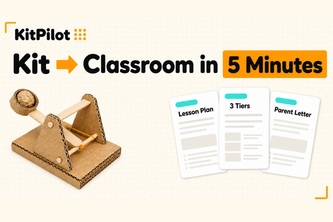
KitPilot is a self-reported AI-powered tool designed to automate lesson planning for teachers using the BeaverBot STEAM education robotics kits. The product generates ready-to-use classroom materials — including lesson plans, differentiated instruction tiers, and parent letters — based on input parameters like grade level, class size, and kit type.
The authors describe a tight, 3-day build process using GPT-5.6 as the generation engine and Codex for engineering. They emphasize grounding outputs in real curriculum content rather than creativity, with strict constraints to prevent invention of untested activities or materials.
Key commercial due-diligence question: Does this tool actually solve a real problem that teachers are willing to pay for, or is it a prototype that works in the demo but lacks traction or monetization?
What The Product Actually Is
The description states that KitPilot takes one input — a BeaverBot kit — and generates three outputs:
- A lesson plan, localized to a teacher's class constraints (grade, size, time).
- Differentiation in three tiers (foundational support / core / extension challenge), with adaptation notes for ELLs and students with special needs.
- A parent letter, covering what was built, learned, and conversation starters.
Each document can be exported as a PDF or copied to clipboard.
The system uses:
- GPT-5.6 via the OpenAI API
- A structured YAML knowledge base of official curriculum content
- Post-processing code to enforce structural contracts (e.g., table position, word limits)
- Next.js + TypeScript + Tailwind for UI and backend streaming
Not evidenced: actual product usage, revenue, or customer feedback beyond the authors' own account.
Positioning & Claim Evolution
The authors claim KitPilot is built around teacher pain points — specifically, time spent on paperwork instead of engaging with students. They state that teachers want materials ready to use as-is.
They position KitPilot as a workflow wrapper around the existing BeaverBot kits, not a replacement for them.
The product’s evolution appears to be:
- From a full teacher workflow (five stages) → reduced scope (three stages: prep, differentiation, parent communication)
- From generic templates → grounded in real curriculum content
- From demo-only → usable in classrooms
Not evidenced: market positioning beyond the authors’ own claims. No evidence of competitor positioning or pricing strategy.
Target Customer & ICP
The description states that KitPilot is for teachers using BeaverBot kits, particularly those in under-resourced schools with large class sizes.
It targets:
- Teachers who use BeaverBot STEAM kits
- Educators working with mixed-ability groups
- Users seeking ready-to-teach materials to reduce prep time
Not evidenced: specific customer segments, adoption rate, or feedback from actual teachers beyond the authors’ own interviews.
Business Model & Pricing Evidence
The description does not state anything about a business model or pricing. The authors describe the tool as part of a teacher resource program within BeaverBot, but do not clarify if KitPilot is sold separately or bundled.
Not evidenced: revenue streams, pricing tiers, or monetization strategy.
Technical & Delivery Signals
The system uses:
- GPT-5.6 via API
- A structured YAML knowledge base for curriculum content
- Deterministic post-processing to enforce output structure
- Next.js + TypeScript + Tailwind for UI and backend
- Playwright + OpenAI TTS + FFmpeg for demo video generation
Key technical decisions include:
- Using a three-call pipeline to generate lesson plan, then differentiation, then parent letter, ensuring consistency.
- Enforcing structural contracts in code rather than relying on prompts alone.
- Handling proxy environments and error states explicitly.
- Building the demo as a scripted pipeline, not manual re-shoot.
Not evidenced: scalability, performance metrics, or production deployment details beyond the 3-day build.
Traction & Maturity Signals
The description states that KitPilot was built in three days for a hackathon and is based on feedback from teachers who use BeaverBot kits. It includes:
- A working demo
- Use of real curriculum content
- Iteration through acceptance tests
However, there is no evidence of:
- Real-world usage or adoption
- Customer acquisition or retention
- Revenue or monetization
- Product iteration beyond the hackathon version
Not evidenced: any traction or maturity indicators beyond the authors’ own account.
Competitive Context
The description does not mention any competitors. It implies that KitPilot is built for BeaverBot’s existing ecosystem, but no comparison to other lesson-planning tools, AI-powered education platforms, or curriculum management systems is made.
Not evidenced: competitive landscape, market positioning, or differentiation from similar tools.
Open Questions & Risks
- No revenue or monetization strategy — the tool appears to be a prototype with no clear path to paid adoption.
- Self-reported only — all claims are unverified and based on internal experience.
- Limited scope — the product was built for a single brand (BeaverBot) and only three stages of workflow.
- Dependency on AI model — GPT-5.6 is used without mention of cost, availability, or risk of API changes.
- No evidence of real teacher feedback or usage beyond the authors’ own interviews.
Inference: If KitPilot is not monetized and remains tied to a single brand, it may have limited scalability or commercial viability.
Questions the description leaves open
- What is your current plan for monetization? Is this tool sold separately or bundled with BeaverBot?
- How many teachers have you spoken to about this product, and what was their feedback on usability and willingness to pay?
- Are there any plans to expand beyond the BeaverBot ecosystem?
- What are the long-term costs of maintaining the GPT-5.6 pipeline and the structured curriculum database?
- How do you plan to handle edge cases or constraints that aren’t in the YAML knowledge base?
- Have you tested this with actual teachers in real classrooms, or is it still a prototype?
Overall Assessment
The description states that KitPilot was built as a 3-day hackathon project for the OpenAI 2026 hackathon. It is not evidenced to have any traction, revenue, or customer base.
It appears to be a proof-of-concept with strong engineering execution and alignment to a real teacher pain point — but without evidence of commercial viability or scalability.
Assessment: Not ready for investment or partnership unless further validated in the market. The product shows promise in solving a specific problem, but lacks any demonstrated traction or monetization strategy.
User Stories BotA demo video on every pull request
Get a demo video on every new feature
GitHub App that watches your pull requests and records a narrated, captioned demo.
Save time on demo prep and make informed decisions faster with a video walkthrough of every new feature.
Source
Submitted to the OpenAI 2026 hackathon on Devpost. Project home on Devpost. Back to the full gallery on Devpost.
This competitive analysis was produced by top-founders.com (opens in a new tab)
Generated by a language model from this project's public Devpost page — its tagline, the author's own write-up and any built-with tags listed there — as captured in August 2026. Short quotations are the author's words. It is an opinion on the idea as a business, not on the people behind it, and it reflects the description as published then. If the project has moved on, request a correction below. The analysis is not independent research and contains no verified traction, revenue or customer data.
An independent guide by KFG International LLC — not affiliated with, endorsed by, or connected to Devpost or OpenAI.