

Archive position — measured, not model output
1 like on Devpost
505 of the 7,850 archived projects have more likes, and 1,758 share exactly 1 — so this project's #1,294 place in the like-ranked listing is a tie-break inside that group, not a ranking.
Projects (log scale)
Likes on Devpost. ▲ marks this project's group.
Show the figures
| Likes | Projects | Share of archive |
|---|---|---|
| 0 | 5,587 | 71.2% |
| 1 | 1,758 | 22.4% |
| 2 | 284 | 3.6% |
| 3–4 | 132 | 1.7% |
| 5–9 | 75 | 1.0% |
| 10+ | 14 | 0.2% |
 User Stories BotA demo video on every pull request
Get a demo video on every new feature
GitHub App that watches your pull requests and records a narrated, captioned demo.
Save time on demo prep and make informed decisions faster with a video walkthrough of every new feature.
Executive Summary
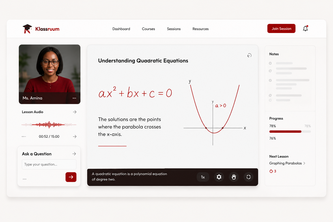
Klassruum is an AI-powered virtual classroom platform described by its author as a system where an "intelligent teacher" delivers structured lessons, adapts to learners, answers questions naturally, and makes education more engaging and accessible. The platform is built using modern web technologies including React, TanStack Start, Supabase, and OpenAI APIs, with a focus on voice AI, real-time interaction, and accessibility.
The author states that Klassruum transforms educational content into interactive lessons, orchestrating AI behavior to mimic a trained educator through structured explanations, whiteboard animations, adaptive questioning, and learner progress tracking. It is positioned as an alternative to traditional video calls or static presentations in online learning environments.
Key commercial due-diligence read: The description does not evidence any revenue, customers, or traction. It presents a self-reported vision of an AI teaching platform but lacks proof of adoption, usage metrics, or monetization. The author claims the product will make high-quality education accessible to every learner, but this is a claim, not a fact.
Most important open question: Is there any evidence that Klassruum has been tested with real learners or institutions? If not, what are the implications for its readiness for scale or commercial viability?
What The Product Actually Is
The description states that Klassruum is an AI-powered virtual classroom platform. It is described as a system where:
- Institutions upload curriculum or learning materials
- Klassruum organizes them into structured courses, lessons, assessments, and classroom experiences
- An AI teacher delivers lessons by:
- Introducing learning objectives
- Explaining concepts naturally using voice
- Writing on an animated whiteboard
- Drawing diagrams and solving problems step-by-step
- Checking learner understanding
- Answering questions based on lesson context
- Adapting explanations when learners struggle
- Generating quizzes and practice activities
- Summarizing learning outcomes
The AI teacher is described as behaving like a trained educator, not as a chatbot. It uses OpenAI models for reasoning and integrates with Supabase, PostgreSQL, TanStack Start, React, and other technologies.
Inference: The product appears to be a web-based platform that combines AI orchestration with interactive teaching tools such as voice synthesis, whiteboard animation, and adaptive learning features.
Positioning & Claim Evolution
The author states that Klassruum was built to answer the question: “What if every learner could have access to an exceptional teacher at any time?” This is a positioning claim about democratizing access to high-quality teaching.
The description also claims that Klassruum does not act like a chatbot but instead behaves like a trained educator following proven teaching practices. It emphasizes:
- Structured lessons
- Natural voice explanations
- Adaptive learning
- Formative assessment
- Learner progress tracking
Inference: The positioning is evolving from a general AI tool to a specialized educational platform that mimics the role of a human teacher in a virtual setting.
Target Customer & ICP
The description states that institutions upload curriculum or course materials, suggesting that Klassruum targets educational institutions such as schools, universities, or training organizations. These are the entities that would use the platform to deliver lessons to learners.
It also implies that the end users are learners who engage with the AI teacher in virtual classrooms.
There is no explicit mention of specific customer segments beyond institutions and learners.
Inference: The ICP appears to be educational institutions looking for scalable, interactive teaching solutions, with learners as downstream users. However, the description does not define a clear细分 market or persona.
Business Model & Pricing Evidence
The description does not provide any information about pricing, monetization, or business model.
It states that institutions upload materials and Klassruum organizes them into lessons, but there is no mention of how institutions pay for access, what features are included in different tiers, or whether the platform is sold to end-users directly or through institutions.
Inference: No evidence of a business model or pricing structure exists in the description.
Technical & Delivery Signals
The author states that Klassruum is built using:
- Frontend: React, TanStack Start, TanStack Router, TypeScript
- Backend: Supabase, PostgreSQL, REST API
- AI integration: OpenAI models (GPT), ElevenLabs for voice generation, Web Speech API
- Additional features: Real-time updates, PWA support, accessibility tools
The platform is described as supporting:
- Synchronized voice and whiteboard teaching
- Lesson orchestration
- Adaptive questioning
- Learner progress tracking
- Analytics for teachers and institutions
Inference: The technical stack suggests a modern, web-based platform with AI integration and real-time capabilities. However, the description does not provide evidence of delivery performance or scalability.
Traction & Maturity Signals
The description states that this project was submitted to the OpenAI 2026 hackathon, indicating it is in an early development stage.
It also mentions:
- A team size of one (Maxwell Otieno)
- A roadmap including future features like multilingual support, collaborative classrooms, and offline-first classroom support
There is no evidence of:
- Revenue
- Customers
- User engagement or usage data
- Product-market fit
- Beta testing or pilot programs
Inference: The product is at a very early stage. It has not demonstrated traction or maturity.
Competitive Context
The description does not mention any competitors. However, it implies that Klassruum is positioned in the edtech and AI teaching space, which includes:
- AI chatbots for education
- Virtual classroom platforms (e.g., Zoom, Google Meet, Microsoft Teams)
- LMS (Learning Management Systems) with AI features
- Platforms like Duolingo, Coursera, Khan Academy, etc.
Inference: The competitive landscape is not described, but Klassruum appears to be attempting to differentiate itself from generic chatbots and static online learning tools by offering a more structured, adaptive, and interactive teaching experience.
Open Questions & Risks
- No traction or revenue: The platform has no evidence of adoption or monetization.
- Single-founder team: A team size of one raises questions about execution capacity.
- Early-stage hackathon project: Not yet proven in real-world use cases.
- Unverified claims: The description is self-reported and unverified; it does not include data on user feedback, performance, or impact.
- Lack of clarity on pedagogy implementation: While the author mentions “pedagogy,” there is no evidence that teaching methods have been rigorously tested or validated.
Inference: Klassruum is a conceptual and early-stage idea with strong ambition but no demonstrated commercial viability or market validation.
Questions the description leaves open
- Has Klassruum been tested with real learners or institutions?
- What specific teaching methodologies are embedded in the AI teacher’s behavior?
- How does the platform ensure that AI responses stay grounded in curriculum while allowing natural follow-up questions?
- Are there any partnerships or pilot programs with educational institutions?
- What is the current development timeline and roadmap for key features like multilingual support or collaborative classrooms?
- How does Klassruum plan to monetize its platform, and what pricing model is being considered?
Overall Assessment
Not evidenced: The description provides no information on revenue, customers, traction, or financials. It is a self-reported vision of an AI teaching platform that has not yet demonstrated commercial viability.
Confidence level: Low — the evidence is limited to the author’s own claims and project submission.
Assessment: Klassruum is in an early conceptual stage and lacks any evidence of traction, revenue, or customer adoption. It may be a promising idea with ambition, but it does not yet meet the criteria for investment or partnership consideration at this time. It would require significant validation before being considered for further due diligence.
User Stories BotA demo video on every pull request
Get a demo video on every new feature
GitHub App that watches your pull requests and records a narrated, captioned demo.
Save time on demo prep and make informed decisions faster with a video walkthrough of every new feature.
Source
Submitted to the OpenAI 2026 hackathon on Devpost. Project home on Devpost. Back to the full gallery on Devpost.
This competitive analysis was produced by top-founders.com (opens in a new tab)
Generated by a language model from this project's public Devpost page — its tagline, the author's own write-up and any built-with tags listed there — as captured in August 2026. Short quotations are the author's words. It is an opinion on the idea as a business, not on the people behind it, and it reflects the description as published then. If the project has moved on, request a correction below. The analysis is not independent research and contains no verified traction, revenue or customer data.
An independent guide by KFG International LLC — not affiliated with, endorsed by, or connected to Devpost or OpenAI.