

Archive position — measured, not model output
0 likes on Devpost
2,263 of the 7,850 archived projects have more likes, and 5,587 share exactly 0 — so this project's #3,256 place in the like-ranked listing is a tie-break inside that group, not a ranking.
Projects (log scale)
Likes on Devpost. ▲ marks this project's group.
Show the figures
| Likes | Projects | Share of archive |
|---|---|---|
| 0 | 5,587 | 71.2% |
| 1 | 1,758 | 22.4% |
| 2 | 284 | 3.6% |
| 3–4 | 132 | 1.7% |
| 5–9 | 75 | 1.0% |
| 10+ | 14 | 0.2% |
 User Stories BotA demo video on every pull request
Get a demo video on every new feature
GitHub App that watches your pull requests and records a narrated, captioned demo.
Save time on demo prep and make informed decisions faster with a video walkthrough of every new feature.
Executive Summary
Project: CIP Music
Self-reported basis: The entire analysis is based on the author-supplied project description, tagline, and write-up — all of which are self-reported and unverified. No external corroboration or historical data is available.
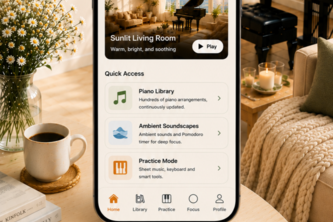
CIP Music is a piano-centered music app that the author describes as bringing together a curated music library, interactive practice tools, white noise, and ambient soundscapes into one place. The project was submitted to the OpenAI 2026 hackathon and uses Codex, GPT-5.6, Expo.io, React Native, and Supabase for development.
The description states that CIP Music aims to make piano music a more personal part of everyday life by allowing users to listen, learn, focus, rest, or create calm spaces. It is described as a flexible piano-centered music space with features around exploration, active engagement, and environment building.
Key open question: Is there any evidence of user adoption, revenue, or traction beyond the author’s own description?
What The Product Actually Is
The description states that CIP Music is a piano-centered music app. It includes:
- A curated piano music library
- Interactive practice tools
- White noise and ambient soundscapes
- A flexible, piano-focused environment for listening, learning, focusing, or relaxing
The author describes it as an app that brings these elements together in one place to allow users to explore music, engage with it actively, or build a focus and relaxation environment.
It was built during the OpenAI Build Week using Codex and GPT-5.6, and developed with Expo.io, React Native, and Supabase.
Not evidenced: No details on how the app functions technically beyond its stack; no screenshots, UI elements, or feature descriptions are provided.
Positioning & Claim Evolution
The author states that CIP Music was created to make piano music a more personal part of everyday life, with users coming to piano music for different reasons: listening, learning, focusing, resting, or creating calm spaces.
It is positioned as a flexible piano-centered music space that allows users to explore, engage actively, or build environments around piano music.
The app is described as an evolution from scattered experiences across separate apps into one unified space. It also integrates AI tools (Codex and GPT-5.6) during the OpenAI Build Week to enhance its functionality.
Inference: The positioning suggests a focus on personalization, mindfulness, and accessibility of piano music — but this is not backed by any data or user feedback.
Target Customer & ICP
The author states that people come to piano music for different reasons, including:
- Listening
- Learning
- Focusing
- Resting
- Creating a calmer space
It is implied that the app targets users who are interested in piano music and want to integrate it into their daily lives, whether for practice, relaxation, or ambient background.
Not evidenced: No specific customer personas, user segments, or market research are provided. The ICP is not defined beyond general interest in piano music.
Business Model & Pricing Evidence
The description does not mention any business model, pricing, or monetization strategy.
It does not state whether the app will be free, subscription-based, ad-supported, or paid.
Not evidenced: No pricing information, revenue streams, or monetization plans are provided.
Technical & Delivery Signals
The project was built using:
- Codex
- GPT-5.6
- Expo.io
- React Native
- Supabase
It was submitted as part of the OpenAI 2026 hackathon and is described as a prototype or proof-of-concept.
Not evidenced: No information on scalability, deployment architecture, or long-term technical roadmap. The app’s current state (e.g., whether it's live, in beta, or fully functional) is not stated.
Traction & Maturity Signals
The description states that the project was submitted to the OpenAI 2026 hackathon, and that it was built during the OpenAI Build Week.
It is described as a prototype or proof-of-concept.
There is no evidence of:
- User adoption
- Revenue
- Customers
- Product-market fit
- Any traction beyond the author’s own description
Not evidenced: No metrics, user feedback, or usage data are provided.
Competitive Context
The author does not mention any competitors, nor does it describe how CIP Music differentiates from existing piano or music apps.
It is implied that the app aims to unify features currently scattered across multiple apps — but no competitive analysis or differentiation strategy is described.
Not evidenced: No information on existing players in the piano music, ambient sound, or productivity music space.
Open Questions & Risks
- No traction or revenue evidence: The project is described as a hackathon submission with no indication of real-world usage.
- Unverified claims: All descriptions are self-reported and unverified.
- Unclear business model: No monetization strategy or pricing information provided.
- Prototype nature: Built during a hackathon, likely not production-ready.
- AI dependency: Relies on Codex and GPT-5.6 — which may not be scalable or stable for long-term use.
Inference: The lack of any real-world data or product maturity raises concerns about viability beyond the hackathon stage.
Questions the description leaves open
- What is the current development status of CIP Music? Is it a prototype, beta version, or live app?
- Have you conducted any user testing or gathered feedback from early users?
- What is your monetization strategy and business model?
- How do you plan to differentiate from existing piano or ambient music apps?
- Are there any plans for scaling beyond the hackathon project?
- What are the long-term technical and AI integration plans?
Overall Assessment
Not evidenced: No data on financials, traction, or commercial viability is available.
The description states that CIP Music is a hackathon submission, built with AI tools during OpenAI Build Week. It is described as a prototype or proof-of-concept, with no evidence of revenue, customers, or product-market fit.
Confidence level: Very low — this is a self-reported, unverified idea with no demonstrated traction or commercial viability.
Assessment: Not ready for investment or partnership at this stage. The project lacks the evidence to support any commercial due-diligence read beyond its initial concept.
User Stories BotA demo video on every pull request
Get a demo video on every new feature
GitHub App that watches your pull requests and records a narrated, captioned demo.
Save time on demo prep and make informed decisions faster with a video walkthrough of every new feature.
Source
Submitted to the OpenAI 2026 hackathon on Devpost. Project home on Devpost. Back to the full gallery on Devpost.
This competitive analysis was produced by top-founders.com (opens in a new tab)
Generated by a language model from this project's public Devpost page — its tagline, the author's own write-up and any built-with tags listed there — as captured in August 2026. Short quotations are the author's words. It is an opinion on the idea as a business, not on the people behind it, and it reflects the description as published then. If the project has moved on, request a correction below. The analysis is not independent research and contains no verified traction, revenue or customer data.
An independent guide by KFG International LLC — not affiliated with, endorsed by, or connected to Devpost or OpenAI.