

Archive position — measured, not model output
0 likes on Devpost
2,263 of the 7,850 archived projects have more likes, and 5,587 share exactly 0 — so this project's #7,182 place in the like-ranked listing is a tie-break inside that group, not a ranking.
Projects (log scale)
Likes on Devpost. ▲ marks this project's group.
Show the figures
| Likes | Projects | Share of archive |
|---|---|---|
| 0 | 5,587 | 71.2% |
| 1 | 1,758 | 22.4% |
| 2 | 284 | 3.6% |
| 3–4 | 132 | 1.7% |
| 5–9 | 75 | 1.0% |
| 10+ | 14 | 0.2% |
 User Stories BotA demo video on every pull request
Get a demo video on every new feature
GitHub App that watches your pull requests and records a narrated, captioned demo.
Save time on demo prep and make informed decisions faster with a video walkthrough of every new feature.
Executive Summary
What the company appears to be
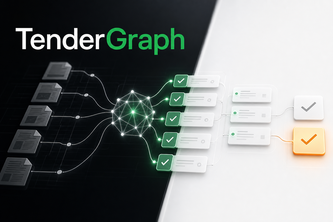
TenderGraph is described as an "agentic tender operating system" built for bid teams. The author states it helps with finding opportunities, preparing compliant bids, tracking changes, and maintaining human control over final submissions.
What changed
This project was submitted to the OpenAI 2026 hackathon, suggesting a recent development or prototype phase. No evidence of prior traction, revenue, or customer adoption is provided.
Single most important open question
Is there any evidence that TenderGraph has moved beyond a hackathon prototype into actual use by bidder teams? The description provides no indication of product-market fit, real users, or commercial viability.
What The Product Actually Is
The description states: "An agentic tender operating system that helps bidder teams find the right opportunities, prepare compliant bids, track every change, and keep final submission under human control."
- Product nature: A software platform described as an “operating system” for managing public procurement bidding processes.
- Functionality claimed:
- Finding relevant tender opportunities
- Preparing compliant bids
- Tracking changes in bid documents
- Maintaining human oversight of final submissions
Not evidenced The actual technical architecture, user interface, or core features beyond this high-level description. No screenshots, demos, or functional specifications are provided.
Positioning & Claim Evolution
The author positions TenderGraph as an “agentic” system — implying automation or AI-assisted workflows within the tender process.
- Key positioning element: It is framed as a tool for "bidder teams" rather than individual bidders.
- Evolutionary claim: The term “operating system” suggests a comprehensive platform, not just one feature or tool.
- Agent-based functionality: Implies AI or automated assistance in parts of the bidding lifecycle.
Not evidenced No evidence of prior versions, roadmap, or how this differs from existing tools. The description does not indicate whether this is a new concept or an evolution of something already available.
Target Customer & ICP
The author states: “helps bidder teams find the right opportunities, prepare compliant bids, track every change, and keep final submission under human control.”
- Target customer: Bidder teams — likely those involved in public procurement or government contracting.
- ICP (Ideal Customer Profile): Teams that:
- Regularly engage with tender processes
- Require compliance tracking
- Need to manage multiple bid submissions
Not evidenced No evidence of specific industries, company sizes, or geographic focus. No mention of existing customers or use cases.
Business Model & Pricing Evidence
The description does not contain any information about pricing models, monetization strategies, or business model assumptions.
- Business model: Not stated.
- Pricing evidence: None provided.
Not evidenced No indication of whether TenderGraph is intended for subscription, one-time purchase, freemium, or other structures. No mention of revenue streams or customer acquisition costs.
Technical & Delivery Signals
The author lists technologies used:
- Built with: cheerio, codex, ffmpeg, github, lucide, mammoth.js, nextjs, node.js, openai, pdf.js, pipertts, playwright, react, typescript, vercel, zod
- Tech stack: Indicates a full-stack web application using React/Next.js frontend, Node.js backend, and integration with OpenAI APIs.
- Delivery signals: The project was submitted to a hackathon, suggesting early-stage development or prototype status.
Not evidenced No evidence of deployment, scalability, performance metrics, or production readiness. No mention of infrastructure, data handling, or security practices.
Traction & Maturity Signals
The description provides no traction indicators:
- No revenue figures
- No customer base
- No usage statistics
- No product adoption data
Not evidenced The project is described as a hackathon submission, implying it may be in early development. There is no evidence of market validation or user feedback.
Competitive Context
The description does not mention competitors or the broader marketplace for tender management tools.
- Competitive landscape: Not described.
- Differentiation claims: Not made.
Not evidenced No indication of existing solutions in this space, nor how TenderGraph would compare to them. No evidence of competitive advantage or market positioning.
Open Questions & Risks
- Prototype risk: Submitted to a hackathon; likely not yet mature for commercial use.
- Unproven market demand: No evidence of traction, customers, or validated need.
- Unclear monetization path: No business model or pricing structure described.
- Limited team size: Only one member listed (Daslav Ríos), raising questions about execution capacity.
Not evidenced No evidence of product-market fit, scalability, or long-term viability. The lack of any commercial or user-facing detail is a major open question.
Questions the description leaves open
- What specific tender processes does TenderGraph aim to automate or assist with?
- How does it ensure compliance in bid preparation?
- Has there been any real-world testing or feedback from bidder teams?
- What is the intended business model and monetization strategy?
- Is there a plan for scaling beyond the current prototype?
- What are the key technical challenges in moving from prototype to production?
Overall Assessment
Not evidenced No basis for assessing investment or partnership potential.
- Investment viability: Not demonstrated.
- Partnership opportunity: Not evident.
- Commercial readiness: Not shown.
The description is limited to a hackathon submission with no evidence of traction, customers, or commercial viability. Any future value would depend on significant development beyond this initial stage.
User Stories BotA demo video on every pull request
Get a demo video on every new feature
GitHub App that watches your pull requests and records a narrated, captioned demo.
Save time on demo prep and make informed decisions faster with a video walkthrough of every new feature.
Source
Submitted to the OpenAI 2026 hackathon on Devpost. Project home on Devpost. Back to the full gallery on Devpost.
This competitive analysis was produced by top-founders.com (opens in a new tab)
Generated by a language model from this project's public Devpost page — its tagline and any built-with tags listed there, since the author published no write-up — as captured in August 2026. Short quotations are the author's words. It is an opinion on the idea as a business, not on the people behind it, and it reflects the description as published then. If the project has moved on, request a correction below. The analysis is not independent research and contains no verified traction, revenue or customer data.
An independent guide by KFG International LLC — not affiliated with, endorsed by, or connected to Devpost or OpenAI.