

Archive position — measured, not model output
0 likes on Devpost
2,263 of the 7,850 archived projects have more likes, and 5,587 share exactly 0 — so this project's #3,258 place in the like-ranked listing is a tie-break inside that group, not a ranking.
Projects (log scale)
Likes on Devpost. ▲ marks this project's group.
Show the figures
| Likes | Projects | Share of archive |
|---|---|---|
| 0 | 5,587 | 71.2% |
| 1 | 1,758 | 22.4% |
| 2 | 284 | 3.6% |
| 3–4 | 132 | 1.7% |
| 5–9 | 75 | 1.0% |
| 10+ | 14 | 0.2% |
 User Stories BotA demo video on every pull request
Get a demo video on every new feature
GitHub App that watches your pull requests and records a narrated, captioned demo.
Save time on demo prep and make informed decisions faster with a video walkthrough of every new feature.
Executive Summary
What the company appears to be
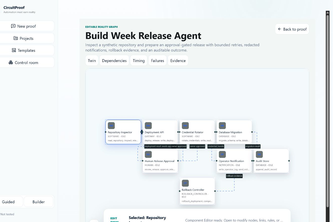
CircuitProof is a self-reported automation assurance tool designed for builders, platform teams, security reviewers, and governance teams. It integrates with development workflows through a "Build Week" extension called Adversarial Review. The system uses GPT-5.6 to propose adversarial failure hypotheses, which are then adjudicated via deterministic checks. Only human-approved repairs are applied.
What changed
The project was submitted as part of an OpenAI 2026 hackathon. It builds on a pre-existing baseline and introduces an extension that adds adversarial review capabilities using GPT-5.6 and deterministic evidence evaluation.
Single most important open question
Is there any evidence of real-world usage, customer feedback, or traction beyond the author's own development and demonstration?
What The Product Actually Is
The description states that CircuitProof is an automation assurance studio for builders, platform teams, security reviewers, and governance teams. It includes a Build Week extension called Adversarial Review.
- The system sends a bounded, redacted snapshot of an automation twin to GPT-5.6.
- GPT-5.6 proposes structured failure hypotheses with components, preconditions, consequences, and test ideas.
- These proposals are mapped to deterministic checks that result in one of three outcomes:
- Proved
- Unsupported
- Human review
- For proved findings, a repair is only applied if derived from supported evidence and approved by a human operator.
Evidence
- The description states the product uses GPT-5.6 via OpenAI Responses API.
- It includes a Python backend (FastAPI, Pydantic, SQLite) and React frontend.
- The system has a "zero-build offline replay sandbox" and a live Windows demo path.
- It is described as a "challenge-to-evidence-to-repair-to-re-run workflow".
Inference This appears to be a proof-of-concept or prototype built for a hackathon, not a commercial product.
Positioning & Claim Evolution
The description states that CircuitProof was built around the principle: “AI proposes. Evidence decides. Humans approve repair.”
- The system is positioned as an assurance tool for automation workflows.
- It emphasizes adversarial testing using frontier models to explore failure space beyond conventional tests.
- The author claims it avoids giving AI authority by enforcing a strict boundary between AI hypotheses and deterministic evidence.
Evidence
- The tagline: “GPT-5.6 proposes adversarial failure hypotheses. Deterministic evidence decides. Humans approve supported repairs.”
- The system is described as having an "authority boundary" to prevent AI from acting autonomously.
- It distinguishes itself from certification by focusing on evidence, not model assertions.
Inference The positioning suggests a niche in automation assurance and risk mitigation for teams managing complex systems or workflows. However, the claim of being a commercial product is not evidenced.
Target Customer & ICP
The description states that CircuitProof targets:
- Builders
- Platform teams
- Security reviewers
- Governance teams
Evidence
- The description explicitly names these groups as users.
- It mentions "automation assurance studio" and "adversarial review."
Inference These are likely internal engineering or security teams within organizations that manage automation systems. No specific industry, size, or use case is detailed.
Business Model & Pricing Evidence
There is no evidence of a business model or pricing structure in the description.
Evidence
- No mention of revenue streams, licensing, subscriptions, or pricing tiers.
- The project is described as a hackathon submission.
Inference It is unclear whether this is intended to be a commercial product or a prototype with no monetization plan.
Technical & Delivery Signals
The system is built using:
- Backend: Python 3.12, FastAPI, Pydantic, SQLite, Uvicorn
- Frontend: React, Vite, React Flow, Lucide icons
- AI: GPT-5.6 via OpenAI Responses API
- Testing: Pytest and Node test suites
Evidence
- The description lists these technologies.
- It mentions a “zero-build offline replay sandbox” and a live Windows demo path.
Inference The system is built with modern development tools and includes both backend and frontend components. It supports local testing and has a clear demonstration path, but no evidence of production deployment or scalability.
Traction & Maturity Signals
There is no evidence of traction, customers, or adoption beyond the author’s own development and demo.
Evidence
- The project was submitted to a hackathon.
- No mention of users, revenue, or product usage.
- The system is described as existing before Build Week but with the extension added during the event.
Inference This appears to be an early-stage prototype or proof-of-concept. No evidence of market traction or product maturity.
Competitive Context
There is no mention of competitors in the description.
Evidence
- No reference to similar tools, platforms, or products.
- The author does not position CircuitProof against any existing solutions.
Inference It’s unclear whether this addresses a known gap in automation assurance or if it is a novel concept. No competitive landscape is described.
Open Questions & Risks
- No commercial traction or revenue evidence: The system is presented as a hackathon submission with no real-world usage.
- Unverified AI claims: The description states that GPT-5.6 is used, but there is no verification of its performance or behavior in the context described.
- Unclear monetization strategy: No indication of how this would be sold or deployed at scale.
- Limited scope: The demo uses a synthetic software release agent and does not reflect real-world complexity.
Evidence
- The project is described as a hackathon submission.
- No evidence of customers, revenue, or product adoption.
- The system is built for demonstration purposes with no production deployment mentioned.
Questions the description leaves open
- What is the actual use case that drove this development?
- Has this been tested in real-world environments beyond the demo?
- How does CircuitProof plan to scale beyond a single developer’s prototype?
- Is there any intention to commercialize this, and if so, how?
- What are the limitations of GPT-5.6 in this context, and how are they mitigated?
- Are there plans for integrations with existing CI/CD or automation platforms?
Overall Assessment
Not evidenced.
The description does not provide any information about funding, valuation, team traction, or commercial viability.
Inference This is a prototype or hackathon submission with no evidence of a viable business model or market readiness. It may be an early-stage idea with potential but lacks the signals needed for investment or partnership consideration at this stage.
User Stories BotA demo video on every pull request
Get a demo video on every new feature
GitHub App that watches your pull requests and records a narrated, captioned demo.
Save time on demo prep and make informed decisions faster with a video walkthrough of every new feature.
Source
Submitted to the OpenAI 2026 hackathon on Devpost. Project home on Devpost. Back to the full gallery on Devpost.
This competitive analysis was produced by top-founders.com (opens in a new tab)
Generated by a language model from this project's public Devpost page — its tagline, the author's own write-up and any built-with tags listed there — as captured in August 2026. Short quotations are the author's words. It is an opinion on the idea as a business, not on the people behind it, and it reflects the description as published then. If the project has moved on, request a correction below. The analysis is not independent research and contains no verified traction, revenue or customer data.
An independent guide by KFG International LLC — not affiliated with, endorsed by, or connected to Devpost or OpenAI.